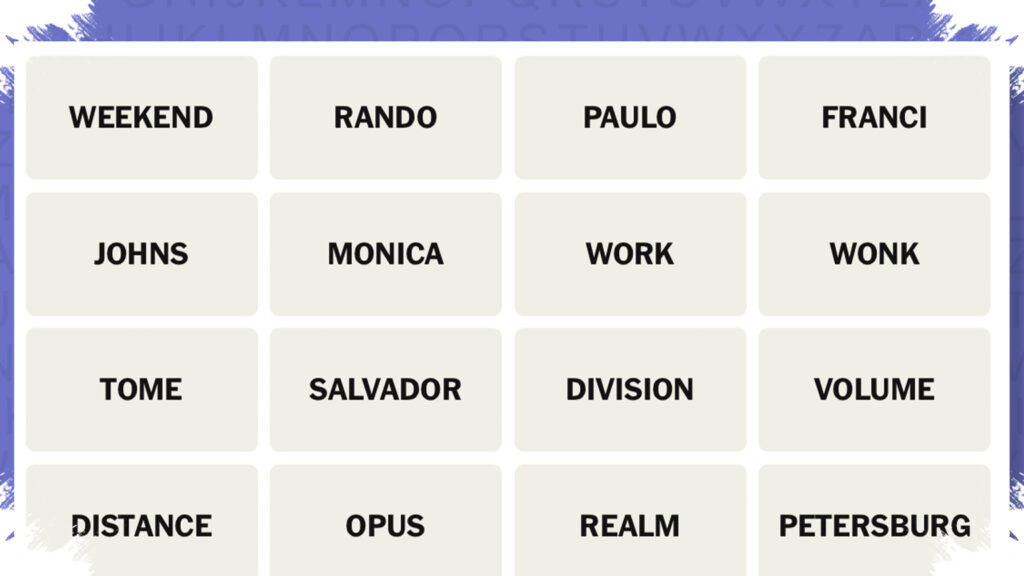
The toughest part of NYT Connections on 12 May was not finding obvious word links, but avoiding the traps hidden in plain sight. Puzzle #1066 pushed players to look beyond meaning and pay attention to spelling patterns, sound, and subtle associations.
That is what made this daily New York Times word game so effective again. Like Wordle and Spelling Bee, Connections keeps the rules simple while forcing players to sort 16 words into four hidden groups of four, with only four mistakes allowed.
The color system sets the tone for the challenge. Yellow is usually the easiest group, green sits in the middle, blue is harder, and purple often becomes the most difficult because it tends to rely on language tricks rather than direct definitions.
On this day, the 16 words were OPUS, TOME, VOLUME, WORK, MONICA, PAULO, PETERSBURG, SALVADOR, DISTANCE, DIVISION, JOHNS, WEEKEND, FRANCI, RANDO, REALM, and WONK. At first glance, the list looks balanced, but the puzzle rewards players who slow down and test the words against less obvious links.
The more straightforward groups
The yellow category pointed to substantial books. That group contained OPUS, TOME, VOLUME, and WORK, all of which fit the idea of something large or weighty in publication form.
The green set centered on Saint cities. MONICA, PAULO, PETERSBURG, and SALVADOR all connect once the shared “Saint” clue is understood. Without that hint, the words can look like unrelated names and place references.
Blue was built around things that can be described with “long.” DISTANCE, DIVISION, JOHNS, and WEEKEND fit that pattern, even though the words do not immediately appear to belong together when read one by one.
Why purple caused the most trouble
The purple group was the real trap. It used currencies with one extra letter added, which meant the answer depended on noticing small changes in spelling and sound rather than broad semantic links.
That style of clue is typical of the hardest Connections category. It often rewards players who separate proper nouns from common words early and who are willing to read the entries aloud to catch hidden patterns.
How the puzzle played out
This edition showed how Connections can mix direct definitions with indirect language games in the same board. A word such as MONICA or PAULO may seem ordinary until the “Saint” pattern makes the city connection clear, while DISTANCE and WEEKEND only make sense once the “long” clue is considered.
The game continues to draw a strong audience because it blends vocabulary, logic, and pattern recognition in a short daily format. The board refreshes at midnight local time, and players can share their results on social media using the colored grid without revealing the answers directly.
The previous puzzle, #1065, followed a different set of themes, including “Move Stealthily, With ‘In’,” “Kinds of Schemes,” “Detective Movies,” and “Body Parts Surrounded by Two Letters.” That daily rotation is part of what keeps the game challenging, since each board asks players to reset their assumptions and look for a new kind of connection.