Samsung’s Galaxy S26 series is shaping up as a camera-first lineup, with the strongest attention placed on low-light performance, long-range zoom, and video stabilization. The Galaxy S26 Ultra stands out as the most ambitious model, combining a brighter main camera, 100x Space Zoom, and a new stabilization approach designed to reduce the need for an external gimbal.
The most visible upgrade centers on Nightography. On the Galaxy S26 Ultra, the main camera uses a 200MP f/1.4 sensor, a wider aperture than the f/1.7 setup on the S25 Ultra and S24 Ultra, and Samsung says it can capture up to 47 percent more light.
That improvement is aimed at darker scenes, where more incoming light can help preserve detail and lower noise. Samsung also adds real-time AI ISP processing for Nightography video, which works during recording to brighten scenes, sharpen details, and reduce noise while keeping the image looking natural.
The same AI ISP support extends to the front camera as well. That means selfie video and video calls are expected to hold facial detail more effectively even when only ambient light is available.
Samsung’s low-light tuning is also designed for scenarios such as recording a night concert. In that setting, the system is meant to keep facial detail visible, suppress noise, and avoid making stage lighting look unnatural.
Zoom remains a major selling point
The Galaxy S26 Ultra also pushes hard on distance shooting. It includes a 50MP f/2.9 telephoto camera, 10x optical zoom, and a maximum Space Zoom range of 100x.
Samsung pairs that hardware with Next-Gen AI Zoom to produce cleaner results when shooting faraway subjects. The system analyzes each pixel in real time, with a stronger focus on noise reduction while still preserving texture and color depth.
That approach is meant to make very distant subjects easier to capture on a phone. For users, the 100x Space Zoom remains one of the headline features of the Ultra model.
The broader S26 family keeps zoom capabilities in play as well. The Galaxy S26 and Galaxy S26+ both carry a maximum zoom figure of 10x, alongside their own 50MP f/1.4 wide camera and 50MP f/2.8 telephoto camera.
Video stability moves closer to gimbal-like results
Samsung is also trying to improve handheld video without extra accessories. The Galaxy S26 Ultra introduces Horizontal Lock, a feature not available on the S25 Ultra or S24 Ultra.
Horizontal Lock is built to keep the horizon level while recording, even when the phone is moving through a more demanding shooting situation. Samsung says it combines a gyroscope, an accelerometer, and OIS to counter shake automatically.
That makes the phone more useful for fast-moving content, where stable footage often requires a separate gimbal. The goal is to produce smoother, more professional-looking video directly from the smartphone.
Manual control remains available
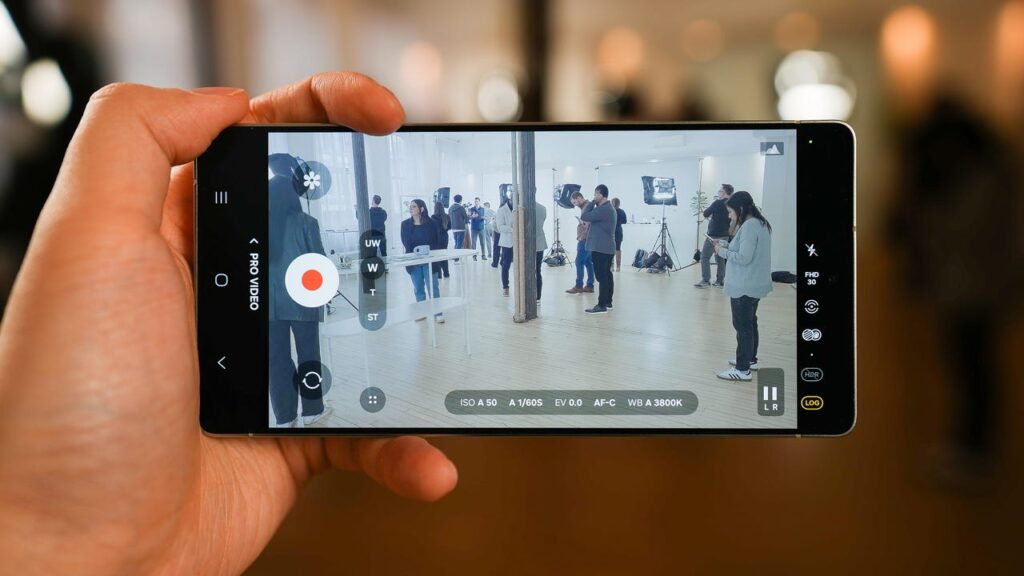
For users who want more control, the Galaxy S26 Ultra also includes Expert RAW. The feature allows manual adjustment of ISO, shutter speed, white balance, and exposure.
The RAW files it produces provide a wider dynamic range for editing. Samsung also adds support for a Virtual ND Filter, which opens the door to motion blur effects and long-exposure styles.
Taken together, the camera package places the Galaxy S26 Ultra at the top of the series in imaging capability. The standard Galaxy S26 and Galaxy S26+ still bring meaningful camera improvements, but the Ultra carries the most complete set of upgrades across low-light shooting, zoom, stabilization, and manual tools.