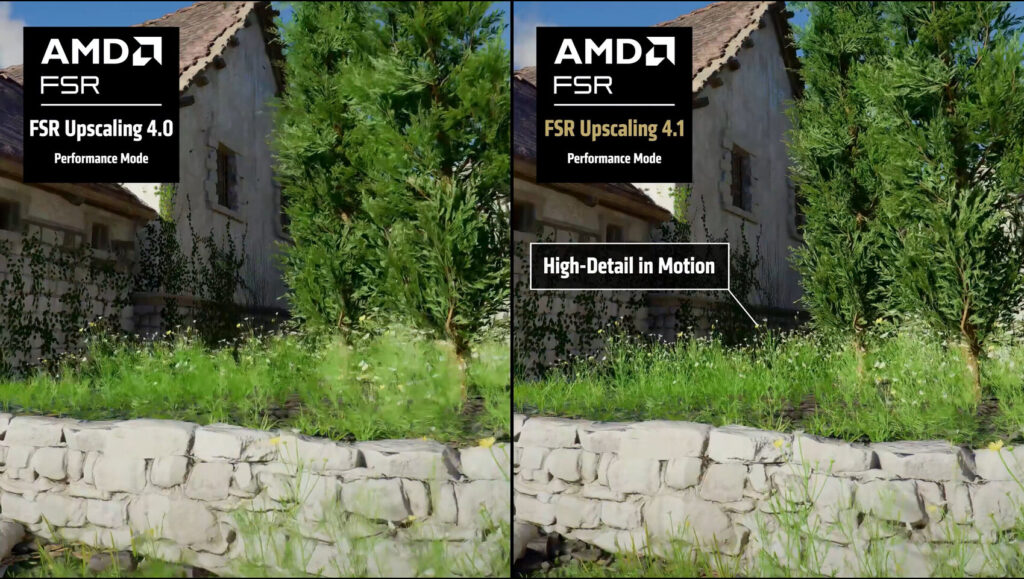
AMD is widening access to FSR 4.1 in a way that matters most to owners of older Radeon hardware. The AI-based upscaling feature will not stay limited to the newest cards, and that makes this rollout more important than a standard software update.
The first beneficiaries will be GPUs based on RDNA 3, including the Radeon RX 7000 family, which is set to get FSR 4.1 in July. Support for RDNA 2 is also planned, although that will not arrive until early 2027.
A broader FSR 4.1 rollout
FSR 4.1 first arrived on the Radeon RX 9000 series in March, so AMD is now moving the feature outward to older platforms. That shift gives RX 7000 owners access to a newer upscaling path without forcing an immediate hardware upgrade.
AMD says the support list will eventually extend to more than 300 games. Titles mentioned in that lineup include Assassin’s Creed Shadows, Battlefield 6, and Cyberpunk 2077.
What changes with FSR 4.1
FSR 4.1 is more than a routine refresh of AMD’s upscaling software. The key change is its use of machine learning for the upscaling process, which places it closer to the modern AI-driven approach often associated with Nvidia’s DLSS.
For players, the goal remains straightforward: higher frame rates while preserving resolution and image quality. AMD is positioning the feature as a way to make demanding games smoother without giving up visual fidelity.
Why RX 7000 gets attention first
Jack Huynh, AMD’s Senior Vice President and General Manager of Computing and Graphics, said FSR 4.1 will reach RDNA 3 GPUs in July. That means the Radeon RX 7000 range becomes the first older family to gain access to AMD’s latest AI upscaling technology.
That timing is notable because RX 7000 is still a relatively recent product line. Even so, it had not yet received FSR 4.1 before this announcement.
RDNA 2 users will wait longer
The schedule looks different for RDNA 2. AMD plans to bring FSR 4.1 to those GPUs in early 2027, and that includes handheld devices built on RDNA 2 as well.
Valve’s Steam Deck is part of that group, showing that AMD’s support plan extends beyond desktop graphics cards. The move also underlines how important software support has become for portable gaming hardware, where efficiency matters as much as raw performance.
A software update with long-term value
The wider rollout reflects a larger trend in the GPU market. As hardware upgrades become harder to justify for many players, features like FSR 4.1 can help extend the useful life of existing cards.
That is why the announcement has drawn strong interest from the Radeon community. For many users, a GPU is now judged not only by its launch specifications, but also by how far the software ecosystem continues to advance around it.
Competitive pressure remains high
AMD’s expansion comes as Nvidia continues pushing its own upscaling and frame generation technologies. Nvidia has recently rolled out DLSS 4.5 and 6X Dynamic Multi Frame Generation to games such as Alan Wake 2, Cyberpunk 2077, and Avowed.
Nvidia has also shown DLSS 5, which is said to improve visual elements such as character models and environments. Against that backdrop, AMD’s decision to bring FSR 4.1 to older Radeon hardware adds another layer to the competition between the two graphics vendors.
Source: www.xda-developers.com