Samsung emerged as the clearest winner in a Southeast Asian smartphone market that started 2026 under pressure. While overall shipments fell, the Korean brand was the only major player to post growth and also took the regional lead.
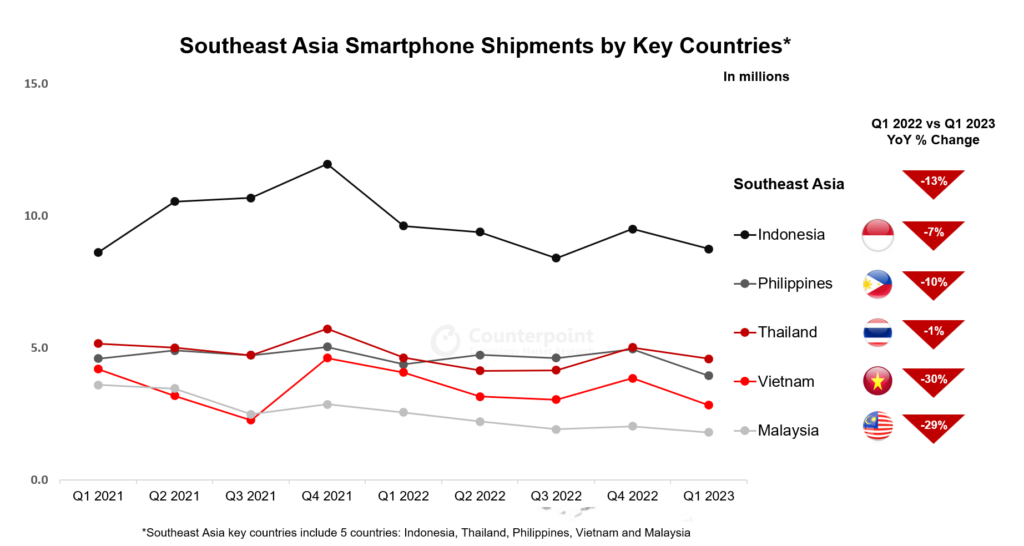
Omdia said smartphone shipments in Southeast Asia dropped 9 percent year on year in the first quarter, falling from 23.7 million units to 21.6 million units. The decline shows that the market has entered the year with softer demand and tighter competition.
Samsung shipped 4.6 million units in the quarter, up from 4.4 million a year earlier. That 4 percent increase lifted its market share from 19 percent to 21 percent and pushed it to the top of the regional ranking.
A market where fewer devices moved, but not every brand lost ground
The first quarter numbers show that the slowdown did not hit all vendors equally. Samsung expanded its share even as the total market contracted, suggesting that product mix and portfolio strength mattered more in the current environment.
Omdia attributed Samsung’s performance to the Galaxy S26 Series in the flagship segment and continued strong sales of the Galaxy A Series in the midrange. Those two lines appear to have helped the company hold demand across different price tiers.
The sell-in shipment data also matters here. It measures devices shipped by vendors to distributors, retailers, and sales channels, not phones already bought by end consumers.
Competitors moved in the opposite direction
Other leading brands saw their volumes weaken during January to March. Oppo ranked second with 4.2 million units, down from 5.1 million units in the first quarter of 2025, and its share slipped from 21 percent to 20 percent.
Xiaomi followed with 3.7 million units. That was below the 4.2 million units it shipped a year earlier, marking a 12 percent decline and reducing its share from 18 percent to 17 percent.
Transsion, which owns Infinix, Tecno, and Itel, placed fourth with 3.4 million units. Although its shipment volume fell from 3.7 million units, its market share stayed at 16 percent.
Vivo completed the top five with 2.1 million units. The brand had shipped 2.8 million units in the first quarter of 2025, and its market share fell from 12 percent to 9 percent.
Outside the top five, the “other brands” category grew from 3.5 million units to 3.7 million units. Its share also widened from 15 percent to 17 percent.
Higher prices are reshaping the market
Volume weakness did not come alone. Omdia said the region’s average selling price rose sharply to $349 per unit, up 19 percent from a year earlier and above the sub-$300 level seen before.
That increase points to more than just softer demand. Rising component costs, especially for DRAM and NAND memory, have pushed up manufacturing costs across the smartphone industry.
The pressure is felt most strongly in entry-level and midrange phones, where memory components make up a larger share of total cost. As those expenses climb, vendors have been forced to reconsider pricing, specifications, and supply planning.
Le Xuan Chiew, Research Manager at Omdia, said smartphone vendors are now focusing more on profitability and higher ASPs than on volume growth. That shift reflects a market where cost pressure and cautious demand are both shaping business decisions.
What comes next for Southeast Asia
Omdia expects volatility in smartphone prices and supply to continue in the near term. Vendors still face component constraints while also weighing how far they can raise prices without further hurting demand.
The lower-priced segment is expected to be the most exposed because it is highly sensitive to price changes. In that environment, the first quarter of 2026 points to a market that is shrinking, but not evenly, and Samsung is currently making the most of the space left behind.
Source: tekno.kompas.com