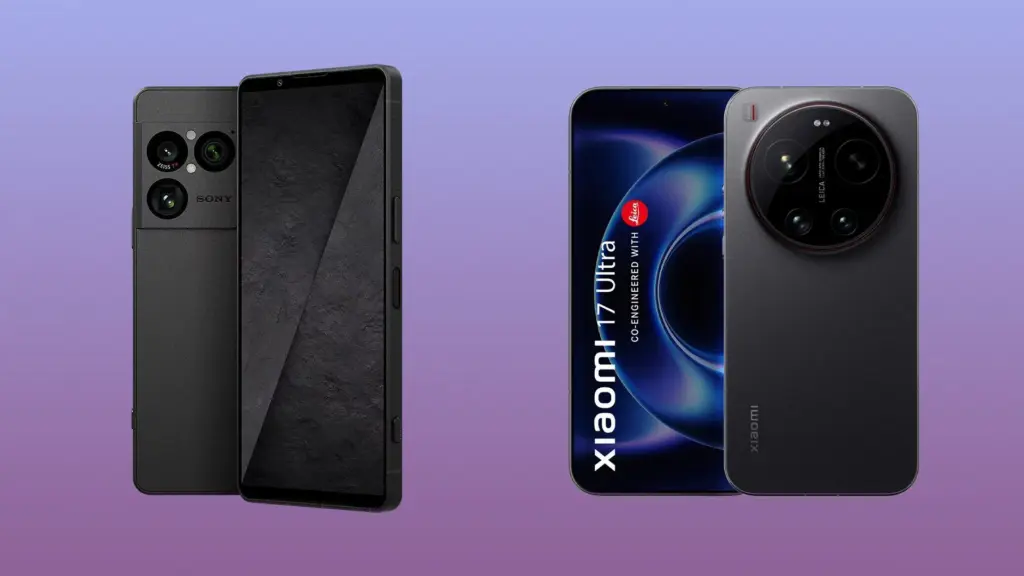
Sony’s Xperia 1 VIII and Xiaomi’s 17 Ultra are aimed at the same premium tier, but they appeal to very different buyers. One leans on compactness and creator-friendly tools, while the other pushes harder on battery life, display size, and value.
That split matters because both phones use the Snapdragon 8 Elite Gen 5, which removes raw performance from the center of the debate. Once that is equalized, the real differences come from design, imaging hardware, software approach, and pricing.
Two flagship philosophies
Xperia 1 VIII stays close to Sony’s familiar identity. It weighs around 200 grams, uses Gorilla Glass Victus 2 on the front, an aluminum frame, and carries IP65 or IP68 protection.
The Xiaomi 17 Ultra takes a more aggressive route. It weighs up to 223.4 grams, uses aerospace-grade glass fiber or eco-leather, and offers IP68 or IP69 resistance.
That contrast shapes the user experience right away. Sony’s phone is easier to handle with one hand, while Xiaomi’s model is built more around media use and endurance.
Different display priorities
The screen strategy also reflects two separate ideas of what a flagship should be. Xperia 1 VIII uses a 6.5-inch LTPO OLED panel with a 120Hz refresh rate and a 1080 x 2340 resolution.
Xiaomi 17 Ultra answers with a larger 6.9-inch LTPO AMOLED display at 120Hz. It also reaches a listed peak brightness of 3500 nits and supports Dolby Vision and HDR10+.
On paper, Xiaomi has the advantage in size, brightness, and pixel density at 416 ppi. Sony, meanwhile, keeps the more compact format that may suit users who prefer a smaller device for films and everyday use.
Performance is tied, software is not
Because both devices run on Snapdragon 8 Elite Gen 5 built on a 3nm process, neither phone has a clear lead in basic processing power. The more visible difference comes from the software layer and the surrounding features.
Sony ships Xperia 1 VIII with Android 16 close to stock Android and promises up to four major upgrades. Xiaomi uses HyperOS 3 on top of Android 16, bringing a more customizable approach that also feels denser than Sony’s interface.
Memory configurations reinforce the same split. Xperia 1 VIII comes in 12GB or 16GB RAM options with 512GB to 1TB of storage, while Xiaomi 17 Ultra offers 16GB RAM paired with 512GB or 1TB.
Cameras show the sharpest divide
Photography is where the two phones separate most clearly. Xperia 1 VIII uses a triple 48MP rear setup with wide, periscope telephoto, and ultrawide cameras, along with a 12MP front camera.
Sony also includes Zeiss optics, a color spectrum sensor, and native Sony Alpha camera support. That makes the phone especially relevant for users who want their handset to work as a monitor or companion device for Alpha gear.
Xiaomi 17 Ultra goes after a more hardware-heavy formula. It brings a 50MP wide camera, a 200MP continuous telephoto camera, and a 50MP ultrawide unit, plus a 50MP front camera.
Its main attraction is the 200MP periscope telephoto system with continuous 3.2x to 4.3x optical zoom and 8K video recording. For fast shooting and zoom flexibility, Xiaomi’s package looks more versatile on paper.
Battery and charging widen the gap
The largest practical difference appears in power management. Xperia 1 VIII has a 5000 mAh battery with 30W wired charging.
Xiaomi 17 Ultra uses a 6000 mAh battery, 90W wired charging, and 50W wireless charging. For heavy users, that combination gives Xiaomi a strong daily-use advantage that is difficult to ignore in this class.
Sony still keeps one feature that remains unusual in this segment: a dedicated microSDXC slot. For users who store large amounts of photos and video, that expandable storage remains valuable.
Xiaomi addresses storage needs through large internal options instead, including 512GB and 1TB variants. The phone is also said to be available with internal storage up to 2TB.
Pricing favors Xiaomi
The pricing gap strengthens Xiaomi’s position further. Xperia 1 VIII has launched in the UK and is not yet available in India.
Its 12GB/256GB version is priced at around 1,80,000 Indian Rupees, while the 16GB/1TB model costs about 2,30,000 Indian Rupees. Xiaomi 17 Ultra is positioned more aggressively, with the 16GB/512GB variant at 1,39,900 Indian Rupees and the 1TB version at 1,66,758 Indian Rupees.
With a larger display, a 6000 mAh battery, 90W charging, a 200MP telephoto camera, and a lower price, Xiaomi 17 Ultra comes across as the harder flagship to resist. Xperia 1 VIII still has clear appeal for buyers who value a slimmer body, microSD support, and close integration with Sony Alpha equipment.
Source: tech.sportskeeda.com