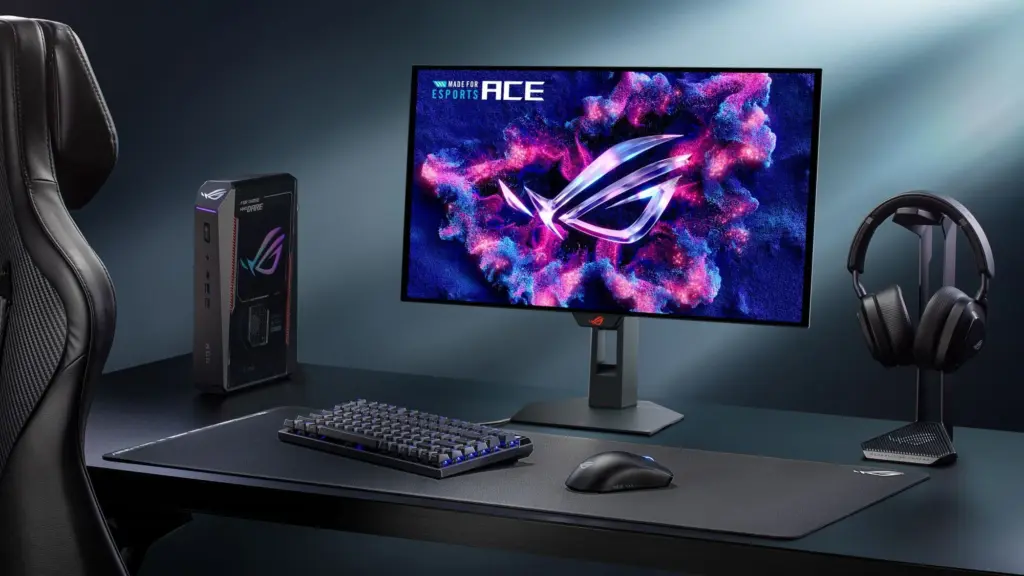
Asus is pushing esports monitors toward a new benchmark with the ROG Strix OLED XG259QWPG Ace, a 24.5-inch OLED display built around a 540Hz refresh rate and a claimed 0.02 ms response time. The combination is aimed squarely at competitive players who have long relied on TN panels in tournament-sized formats.
The key detail is not only speed, but size. Asus has kept the panel at 24.5 inches with native 1080p resolution, a layout that fits the familiar standard for games such as Counter-Strike 2 and Valorant, where players often prefer a screen that stays fully within peripheral vision.
Aimed at a gap the market left open
High-refresh OLED monitors are not new, and models above 480Hz have already appeared. The problem has been their size, because many of them arrive in 27-inch or 32-inch formats that do not match the traditional esports setup.
That mismatch has often forced competitive players to rely on software cropping or downscaling when they wanted OLED performance in a tournament-friendly size. Asus is positioning the XG259QWPG Ace as a direct answer to that long-standing compromise.
The monitor uses a Tandem WOLED panel. Asus says the dual-layer OLED architecture improves peak brightness by 15 percent, expands color volume by 25 percent, and extends lifespan by 60 percent compared with standard single-layer WOLED panels.
Built for speed without dropping OLED traits
The headline numbers remain the main attraction. A 540Hz refresh rate works alongside the 0.02 ms response time, and Asus adds full Nvidia G-Sync support to help reduce tearing and input lag when games run at very high frame rates.
Even with an esports-first focus, the monitor does not give up the visual strengths associated with OLED. It supports 99.5 percent DCI-P3 coverage, true 10-bit color, and VESA DisplayHDR 600 True Black certification.
Asus also says the display is factory calibrated to Delta E below 2. That level of tuning is meant to keep color accuracy stable from the start, which matters even on a screen designed primarily for competition.
A nod to players coming from TN
Asus appears aware that many esports players still come from older TN monitors. To ease that transition, the company includes three special Esports Color modes designed to mimic the visual profile of legacy tournament displays.
That approach suggests Asus is not only selling higher specifications, but also trying to preserve a familiar look for players who are used to the behavior of older competitive panels. It makes the move to OLED feel less abrupt for those who value consistency in fast-paced titles.
The screen also uses a TrueBlack glossy layer. Asus says this finish is intended to improve text clarity and overall image sharpness compared with traditional matte anti-glare coatings.
Practical touches for LAN environments
Several details were developed with esports organizers BLAST and PGL. Those collaborations are reflected in features that focus on repeated setup and teardown at live events rather than just desktop use.
The stand and base include precise size markers, allowing players to record and recreate their preferred height, tilt, and swivel positions when reinstalling the monitor at a venue. Asus also added a new Quick OSD menu for faster access to core settings such as brightness and shadow boost.
Those additions reinforce the idea that the XG259QWPG Ace is meant for real competitive use, not just spec-sheet appeal. Asus has not announced pricing or a release date yet, but the monitor is clearly being aimed at esports buyers who want the standard tournament size, an extremely high refresh rate, and OLED performance in one package.
Source: www.gizmochina.com