


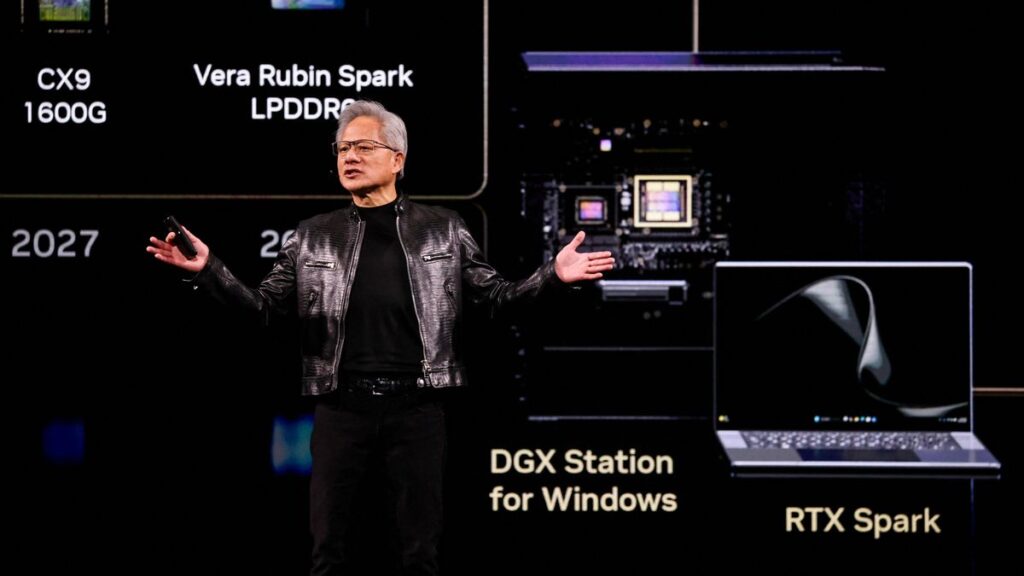
Nvidia’s RTX Spark has quickly turned a quiet Windows on ARM market into a more competitive fight, and Qualcomm is now facing a challenge that goes beyond raw chip specifications. The pressure became visible almost immediately after Nvidia’s Computex 2026 announcement, when Qualcomm shares fell more than 10% in premarket trading and erased more than $10 billion in market value.
That reaction matters because Qualcomm has spent the last two years building momentum in Windows on ARM. Snapdragon X Elite, which arrived in 2024, gave the company a clear lead, and that position was reinforced again with the Snapdragon X2 series at the end of 2025.
Qualcomm still has the timing advantage
For now, Qualcomm remains first to market. Laptops powered by Snapdragon X2 Elite Extreme are expected to start shipping in the first half of 2026, giving the company a head start before Nvidia’s chip reaches consumers.
The Snapdragon X2 lineup includes three chips built on TSMC’s 3nm process and third-generation Oryon CPU cores. The standout model is the Snapdragon X2 Elite Extreme, identified as X2E-96-100, which Qualcomm says is its most powerful laptop chip so far.
That chip carries 18 Oryon cores, up from 12 cores in the first Snapdragon X Elite generation. Its layout includes 12 Prime cores and 6 Performance cores, with two Prime cores able to boost up to 5 GHz.
Nvidia is aiming at a broader Windows ARM reset
Nvidia is not entering the segment as a minor rival. The company wants RTX Spark to become a Windows equivalent of the Apple Silicon shift, combining ARM CPU design, RTX graphics, and AI acceleration in a single package.
RTX Spark is based on the GB10 Grace Blackwell Superchip, the same foundation used for the DGX Spark developer workstation. Nvidia has repackaged that hardware for mainstream Windows laptops, which greatly expands its target market.
The chip combines a custom ARM CPU developed with MediaTek, a Blackwell RTX GPU, and an AI accelerator. It is also built on TSMC’s 3nm process and contains 70 billion transistors.
Nvidia’s claims are aggressive. RTX Spark is said to support up to 20 CPU cores, a Blackwell GPU with 6,144 cores, and unified memory of up to 128 GB. The company also says local AI performance exceeds 1 petaflop FP4, positioning the chip for large AI models and large language models running directly on the device.
Why Nvidia’s pitch looks stronger in AI and graphics
The CPU and GPU inside RTX Spark are linked through NVLink-C2C, which Nvidia says can deliver bandwidth of up to 600 GB/s. That kind of connection is central to its pitch for heavy AI workloads and graphics-driven applications.
On the AI side, RTX Spark offers more than 100 TOPS for on-device computing, compared with 80 TOPS on Snapdragon X2 Elite. Nvidia also brings CUDA to the platform, an important advantage because CUDA has supported many AI models, frameworks, and GPU acceleration tools for more than 15 years.
Graphics could become an even bigger difference. RTX Spark includes a Blackwell GPU with support for DLSS 4.5, an AI-based upscaling technology that Snapdragon does not yet match in its lineup.
That gives Nvidia a clear angle for gaming and creative workloads such as video editing and 3D rendering. Qualcomm has improved its GPU, but the available numbers do not yet show the same level of strength.
Snapdragon X2 is powerful, but not fully safe
Internal Qualcomm testing at Snapdragon Summit showed strong CPU results for the Snapdragon X2 Elite Extreme. In Cinebench 2024, the chip scored 1,964 points, while Geekbench 6.3 multi-core testing reached 23,693 points.
Qualcomm says those results are enough to match or exceed Apple M4 Pro in several scenarios. Compared with the first Snapdragon X Elite generation, the company claims gains of around 39% in single-core and 50% in multi-core performance.
The chip also includes 53 MB of total cache, an 80 TOPS NPU, LPDDR5x memory up to 48 GB on a 192-bit bus, PCIe 5.0 storage, and support for up to three USB 4.0 ports. On paper, that keeps it highly competitive for productivity users.
But graphics are still a weak point. In 3DMark Steel Nomad, Snapdragon X2 Elite Extreme scored only 1,306 points at 13 fps, while Apple M4 Pro reached around 1,620 points in the same test.
Software still holds Windows ARM back
Compatibility remains the biggest problem for the Windows ARM ecosystem. Tom’s Hardware found that AutoCAD is not supported, and some games can crash or show graphical issues when run through emulation on Windows ARM.
That weakness limits how far Qualcomm’s lead can stretch, even as Snapdragon laptops reach the market earlier. It also makes Snapdragon X2 Elite Extreme a better fit for everyday productivity and CPU-heavy tasks than for demanding creators or serious gamers.
Nvidia is targeting those stronger-use cases directly. RTX Spark-based laptops are expected to arrive in autumn 2026, with starting prices said to be around $1800, and brands including ASUS, Dell, HP, Lenovo, and Microsoft Surface are listed among the partners involved.
Source: www.gizmochina.com