


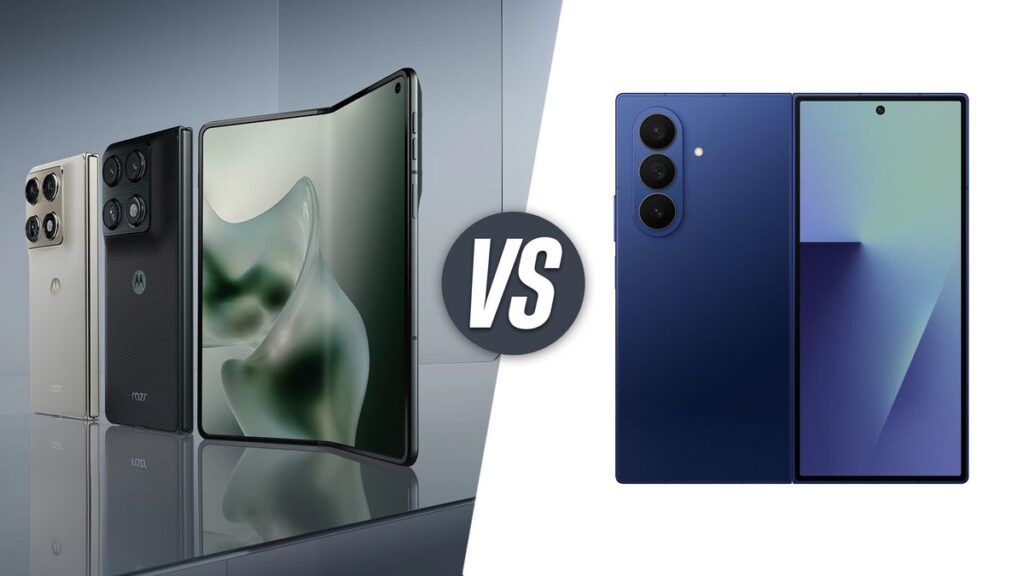
Motorola is pushing more aggressively into the premium foldable phone market with the Razr Fold, a book-style device that is now drawing attention from global reviewers. The phone is being viewed as a serious challenger to Samsung’s Galaxy Z Fold and Google Pixel Fold because it combines a thin body, a large battery, flagship-class cameras, and Android 16-based multitasking features.
The move marks an important shift for Motorola, which has spent recent years focusing mainly on clamshell foldables under the Razr family. By entering the book-style category, Motorola is taking on a wider group of rivals that already includes Samsung, Honor, Oppo, and Google in one of the most competitive smartphone segments.
A new direction for Motorola’s foldable lineup
The Razr Fold stands out because it is not just a refinement of earlier Razr models. It is Motorola’s first book-style foldable, and that alone changes how the brand is positioned in the premium market.
The device carries an 8.1-inch internal folding display and a 6.6-inch external screen, both using AMOLED panels with high refresh rates. That setup aims to support both everyday use and more immersive tasks without forcing users to open the device every time.
Motorola also equips the Razr Fold with Snapdragon 8 Gen 5, 16GB of RAM, and 512GB of internal storage. Those specifications place the handset firmly in flagship territory and give it the hardware needed for demanding apps, gaming, and multitasking.
Battery life becomes a key selling point
One of the strongest aspects of the Razr Fold is its 6,000mAh battery, which uses silicon-carbon technology. This approach allows a higher energy density than conventional lithium-ion batteries, helping Motorola keep the phone slim while still offering a large power reserve.
Android Central reportedly highlighted battery endurance as one of the phone’s biggest advantages over several other premium foldables. Motorola also supports the device with 80W wired charging and 50W wireless charging, giving users faster refueling options across different charging habits.
That battery strategy matters because foldable phones often face a trade-off between thin design and battery size. Motorola appears to be betting that a large battery will help the Razr Fold stand out in a segment where endurance remains a frequent concern.
Cameras and software aim at premium users
Motorola has also tried to make the camera system competitive. The Razr Fold includes three 50MP sensors with Sony Lytia support and Pantone color validation technology. The setup covers the main, ultrawide, and telephoto lenses, with optical zoom reaching up to 3x.
The imaging package has been described as one of Motorola’s most surprising efforts in 2026, especially because foldable buyers now expect more than just flexible screens. Strong cameras are becoming essential for premium users who want a single device for work, content creation, and everyday photography.
On the software side, Motorola uses Hello UX based on Android 16. The interface brings foldable-focused features such as adaptive split-screen, desktop mode, and laptop mode when the device connects to an external display or smart glasses.
Productivity tools expand the use case
Motorola is also trying to make the Razr Fold more than a luxury smartphone. Smart Connect lets the phone behave like a portable desktop when paired with XR glasses such as Viture Beast or Xreal, according to Android Central.
That approach opens the door for productivity, video calls, and gaming through a larger virtual display. Motorola also offers the Moto Pen Ultra, a stylus with pressure sensitivity and AI features such as Sketch to Image, which adds another layer to the device’s creative and productivity appeal.
These additions show that Motorola is targeting users who want a foldable that can serve as a phone, a mini workstation, and a creative tool in one device.
Price and support remain important questions
Despite the positive response, the Razr Fold is not without challenges. Its US$1,899 price places it in the same premium bracket as major rivals, even though Motorola’s brand image still leans more toward the midrange segment in many markets.
Some reviewers have also pointed out that Motorola’s accessory ecosystem and software optimization still trail Samsung’s Galaxy Z Fold. In online discussions, many users praised the hinge design, screen quality, and reduced crease visibility, while others questioned the company’s long-term update reliability based on older Motorola devices.
Motorola says the Razr Fold will receive operating system and security updates for seven years. That commitment is important as foldable buyers increasingly look for long software support, especially in a segment led for years by Samsung and Google.
The Razr Fold shows that competition in foldable phones is no longer about the hinge alone. Brands now have to compete on battery life, camera quality, software features, AI tools, and productivity functions, and Motorola is clearly trying to close the gap quickly.