


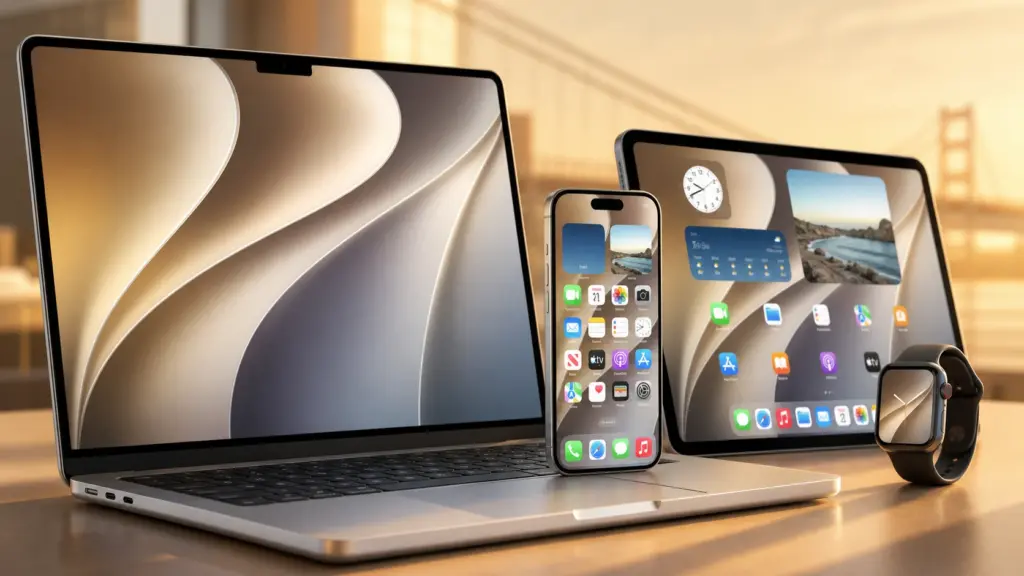
Apple is preparing a major reset for the Mac with macOS 27 Golden Gate. The update ends support for Intel-based Macs and gives Siri a new place on the desktop as a standalone app.
The shift matters because it changes both who can install the system and how users will interact with it. From this version onward, macOS will support only devices with M-series and A-series chips, leaving older Intel Mac models outside the supported list.
Siri Moves From Feature To Dedicated App
One of the clearest changes in macOS 27 Golden Gate is the new role of Siri. Rather than remaining a background assistant feature, it now appears as a separate app on Mac.
Apple is pairing that change with a broader push for Apple Intelligence on the desktop. The focus is moving beyond voice commands and toward personal context, cross-app integration, and recognition of content displayed on the screen.
That includes support for system-level apps that extend where AI can operate across the operating system. Apple is also adding Visual Intelligence, which can identify items shown on the user’s display.
A new Type to Siri option brings another layer of flexibility. Users can type prompts directly into Spotlight Search, which now comes with a refreshed interface.
That integration makes Spotlight a more central entry point for Siri interactions. Search and AI prompts can move through a faster and more direct workflow on the Mac.
Apple Intelligence Gets More Selective
Not every compatible Mac will receive the same AI experience. Apple says the new Siri app will be available on Macs with the M1 chip and newer, as well as on MacBook Neo with A18 Pro.
More advanced Apple Intelligence features and higher-level customization will be limited to Macs with M3 or newer chips. Those devices also need at least 12GB of unified memory.
This creates a clearer split between basic compatibility and full AI access. A Mac may still run macOS 27 Golden Gate without getting the most complete set of intelligence features.
Liquid Glass Becomes More Controlled
Apple is also changing the look of the system with its Liquid Glass design language. In macOS 27 Golden Gate, the visual style is softened so readability stays strong across the interface.
The effect is being tuned for consistency across elements such as toolbars and menus. Apple’s goal is to preserve a modern appearance without sacrificing comfort during everyday work.
Users will also get more control over how strong the effect appears. Apple is adding a slider that adjusts the opacity of Liquid Glass across the entire UI.
That approach shows Apple trying to balance new visual identity with productivity needs. On a desktop system, overly aggressive effects can become distracting during long sessions.
System Performance Also Gets Attention
Golden Gate is not only about AI and design. Apple says AirDrop transfers are faster, file browsing is quicker, and Safari load times have been improved.
These gains may be less dramatic than the AI changes, but they are the kinds of updates users feel in daily use. Faster basic tasks often make the biggest difference after a system upgrade.
Apple has also confirmed support for 5K/120Hz ultrawide monitors. That matters for professional users who rely on high-resolution external displays and high refresh rates.
Together, these changes show that macOS 27 Golden Gate is aimed at more than one area of the desktop experience. It combines AI expansion, visual refinement, and broader display support in a single release.
Release Timeline
Apple has already opened the developer beta for macOS 27 Golden Gate. The public beta is scheduled to arrive in July, with the final release set for September.
That timeline gives developers and early users time to test the platform’s biggest changes. Attention now turns to how the full move toward Apple Silicon and the arrival of Siri AI will reshape the Mac experience in the next update cycle.