


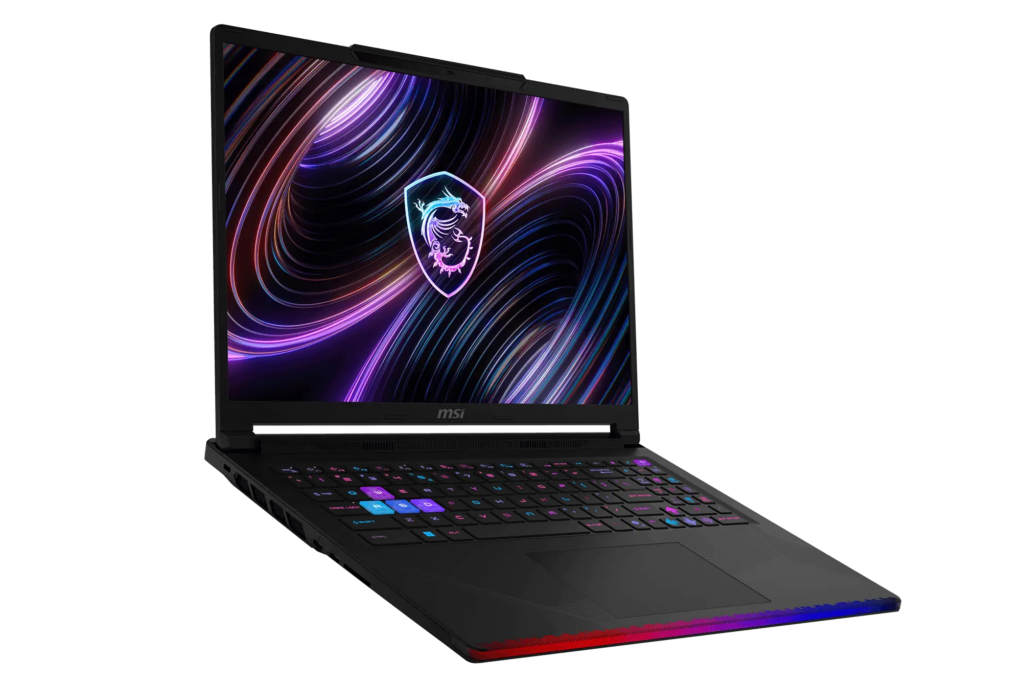
MSI Raider 16 Max HX arrives as one of the company’s most ambitious 16-inch gaming laptops, but its appeal is not as straightforward as its performance numbers suggest. The machine can push hard in gaming workloads, yet two familiar premium features are missing from the package.
Powered by Intel Core Ultra 9 290HX Plus, the laptop is described as delivering benchmark-leading performance in the 16-inch class. In testing, it also managed to outperform nearly every 16-inch gaming laptop previously evaluated.
Peak performance comes first
MSI positions the Raider and Titan families at the top of its gaming lineup, where raw speed and flagship treatment are expected to go hand in hand. On the Raider 16 Max HX, that philosophy becomes most obvious when Apex mode or Cooler Boost is enabled.
In that configuration, GPU power can rise to 175 W, turning the system into a serious AAA gaming machine with the headroom to handle demanding titles at high graphics settings. For buyers focused primarily on performance, that specification is clearly the main draw.
Two missing features stand out
The sharper criticism comes from the display side, where Advanced Optimus and G-Sync are absent despite a price of more than US$3,000, or around Rp48 million. Those omissions are unusual in a premium gaming laptop that sits near the top of the market.
Without Advanced Optimus, the Raider 16 Max HX relies on a standard MUX switch. That means users must reboot the system whenever they switch between integrated graphics and discrete graphics, which is less convenient than the seamless behavior many flagship buyers expect.
The lack of G-Sync also matters. By reducing screen tearing and stuttering, G-Sync is especially valuable in fast-paced games such as first-person shooters and racing titles, where smooth frame delivery can strongly shape the experience.
Panel choice may explain the gap
One clue points to the Samsung display panel used in the laptop. The panel carries the model code ATNA60HU01-0, which differs slightly from the ATNA60HU06-0 panel found in the Razer Blade 16.
That small change may be tied to the feature limitations seen on the Raider 16 Max HX. Another possibility mentioned is a supply or technical specification issue that prevented Advanced Optimus and G-Sync from being implemented.
This is not an isolated pattern
The same absence has already appeared on other MSI flagships, including the Titan 18 HX and Raider 18 HX. That makes the issue look less like a one-off omission and more like a broader limitation within the top end of MSI’s lineup.
For a brand that places these models at the summit of its gaming portfolio, the missing display features are likely to weigh on buyer perception. Strong performance alone does not fully offset the expectations attached to a laptop in this price tier.
A premium price invites tougher comparisons
Competition in the high-end segment is also part of the story, especially with the Razer Blade 16 offering both technologies. Against that backdrop, the Raider 16 Max HX has to rely on its extreme performance to justify a premium price that exceeds US$3,000.
No official information has confirmed availability in Indonesia so far. For shoppers seeking a no-compromise 16-inch gaming laptop, the Raider 16 Max HX is still notable, but the missing display features ensure it will not be an easy recommendation.