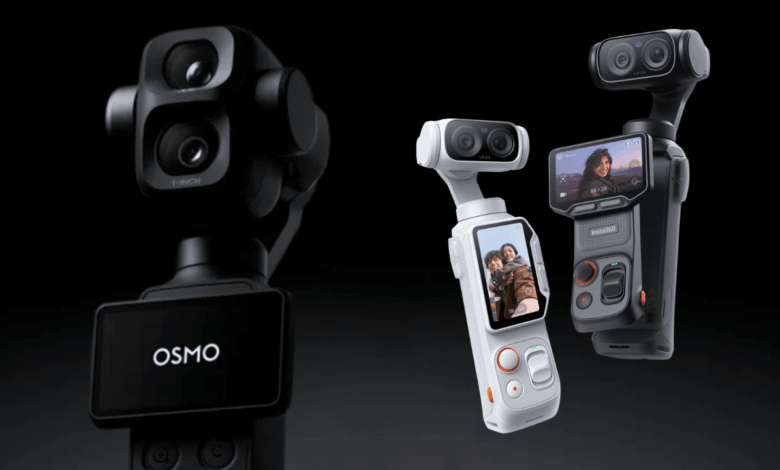
The dispute between DJI and Insta360 has quickly become one of the sharpest patent fights in the consumer camera market. What began as a clash over the new Luna Ultra has now expanded into a broader legal battle involving multiple product lines and several core imaging technologies.
DJI moved first with two lawsuits in the US District Court for the Eastern District of Texas. The company says Insta360’s Luna Ultra and Luna Pro infringe design and utility patents tied to the Osmo Pocket line, and it is seeking a permanent ban on sales of both cameras across the United States.
DJI’s claims focus on familiar Osmo Pocket features
In its filings, DJI argues that the Luna models copy the distinctive look of its own products. The company also says the disputed patents cover automatic subject tracking, dynamic gimbal mode switching, and the ability to keep camera direction stable during shooting.
Along with injunctive relief, DJI is asking for monetary damages. That combination suggests the company is not treating the case as a narrow disagreement over one device, but as a challenge to what it sees as protected design and engineering choices.
Insta360 answers with a wider counterattack
Insta360 responded with two counterclaims and accused DJI of infringing five of its utility patents. Those patents are said to cover stabilizing gimbal systems, gimbal direction control, mechanical smoothing mechanisms, telemetry overlay, and panoramic video stabilization.
The company says the disputed technologies appear across several DJI product families, including the Osmo Pocket series, Ronin/RS, Osmo Mobile, and the Osmo 360 camera. That broader target list pushes the dispute beyond a single launch and into DJI’s wider ecosystem.
Luna Ultra launch timing added more heat
The confrontation became public only two days after Insta360 introduced the Luna Ultra on 10 June 2026, as reported by Medcom. The close timing between the launch and DJI’s legal move has made the case stand out even more.
Insta360 founder JK Liu said the company is ready to defend all of its intellectual property rights through legal channels. He added that Insta360 prefers to let products speak through innovation, but will not hesitate to act when patents are allegedly violated.
Insta360 also rejected DJI’s accusations and said independent research and development for Luna Ultra has been underway since 2020, well before the product reached the market.
A larger contest for the camera market
Liu said Luna Ultra was built on years of accumulated experience and a technology portfolio developed through products such as ONE R, the Link Series webcam line, and the Flow Series gimbal line. That statement frames Luna Ultra as an internal evolution rather than a copied design.
He also suggested that DJI’s decision to file on the day of the Luna Ultra launch was not accidental. In his view, the move reflects serious concern about a new competitor gaining strength in the premium gimbal camera segment.
Industry watchers see the case as one of the most significant legal clashes in modern consumer camera history. Because both companies play major roles in action cameras, video stabilizers, and creator-focused imaging tools, the outcome could shape the global competitive landscape.
Some analysts expect the dispute could eventually end in a cross-licensing agreement. For now, Luna Ultra is still being sold in the United States while the courts work through the case.