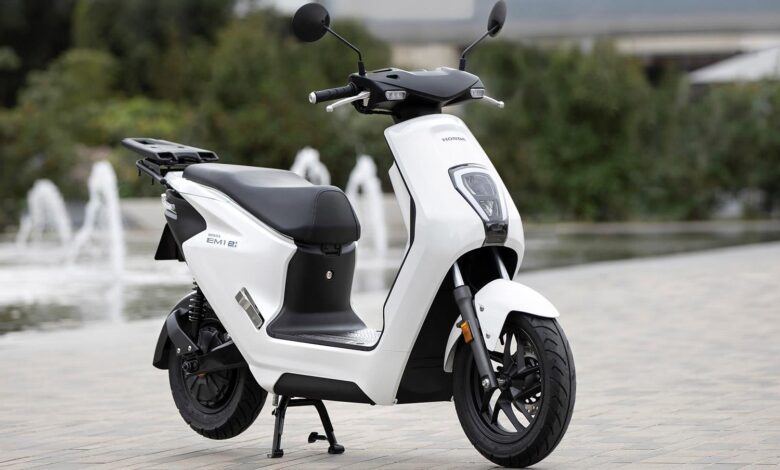
Honda EM1 e: is drawing attention in Indonesia’s electric scooter market because it focuses on practical urban use rather than high-speed performance. With pricing that starts at tens of millions of rupiah, it is positioned as an entry point into Honda’s electric motorcycle line.
The model is aimed at riders who need a compact vehicle for short, repeated trips in the city. For many prospective buyers, the most important question is not speed, but whether the scooter fits daily commuting patterns and charging habits.
What the price buys
The standard Honda EM1 e: is sold in the OTR range of Rp40.000.000 to Rp42.000.000. The Honda EM1 e: Plus is listed at around Rp45.000.000 to Rp46.500.000 OTR, depending on the sales region.
That gap gives buyers a clear choice based on budget and use case. The Plus variant adds a rear carrier, which increases practicality for everyday errands and light cargo.
Prices can vary across regions, including East Java and the Malang area, because of distribution costs, local tax rules, and dealer policy. For that reason, checking with an authorized Honda dealer remains the most reliable way to confirm the latest number.
Built for city distances
Honda gives the EM1 e: a top speed of about 45 kilometers per hour, a figure that matches dense urban traffic more than highway travel. That makes the scooter relevant for trips to the office, campus, market, or shopping areas.
The riding experience is also quieter than a conventional gasoline scooter. For city users who want a simpler and calmer commute, that can be an important part of the appeal.
Its compact body is another reason it suits urban environments. In crowded streets and limited parking spaces, a smaller footprint often matters as much as range or styling.
Battery flexibility is the key feature
The most notable feature of the Honda EM1 e: is the Honda Mobile Power Pack e: battery system. The battery can be removed and charged separately, giving users more flexibility than fixed-battery layouts.
In certain locations, the system also supports swapping, which can be useful for riders who do not have easy access to electricity near their parking area. Honda’s approach shows that charging convenience is part of its broader electric-vehicle strategy, not just an afterthought.
A full charge is claimed to provide a range of around 41.1 kilometers. That distance is enough for short urban routes, but it clearly places the scooter in the daily-use category rather than long-distance touring.
Charging from empty to full takes about six hours using a household power source. Power consumption is around 400 watts, keeping running costs relatively low for routine use.
Who it suits best
The EM1 e: is most relevant to riders with predictable short trips and regular stop-and-go travel. In that setting, its low operating cost, compact size, and flexible battery system become more valuable than outright performance.
The standard version is suited to buyers who only need the basics, while the Plus variant offers a little more convenience for carrying items. Both are clearly designed as simple urban transport rather than performance-focused electric scooters.
As interest in electric motorcycles continues to rise, the EM1 e: stands out as one of Honda’s straightforward options for city mobility. Its mix of pricing, removable battery design, and daily-use range makes it easy to understand, even if its range and top speed remain modest.
For buyers considering a switch from gasoline to electric, the details that matter most are already visible here: how far it can go, how long it takes to charge, and whether the battery setup matches daily routines. On those points, the Honda EM1 e: offers a clear answer tailored to urban life.