


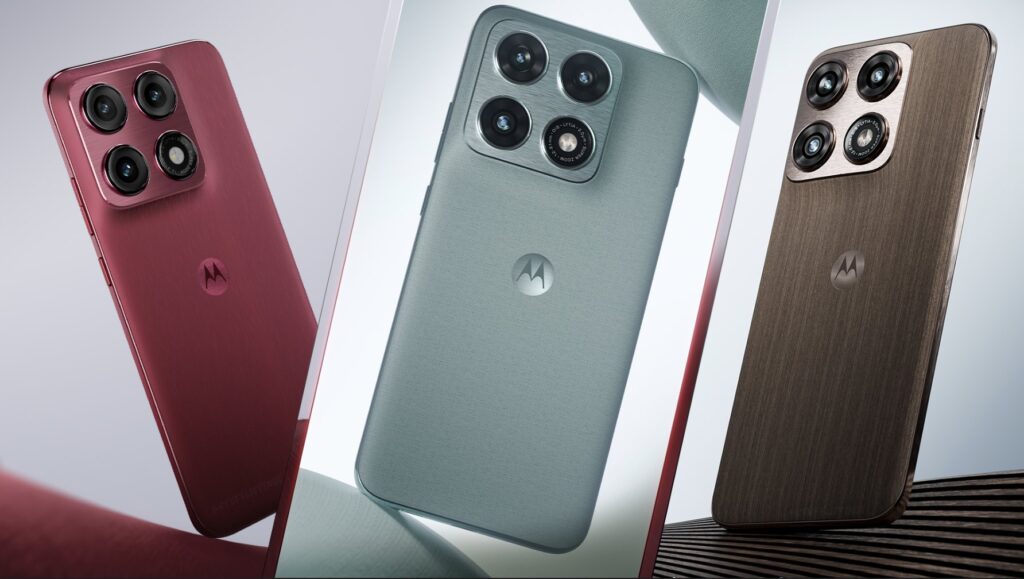
Motorola Edge 70 Pro is arriving with a specification sheet that looks unusually aggressive for the class, while Google Pixel 10a leans on a different kind of appeal. That contrast is making the Pixel 10a look expensive by comparison, even before buyers weigh the long software support Google promises.
The two phones are aimed at very different priorities. Motorola is targeting users who want more hardware for the money, while Pixel 10a is banking on software longevity, AI-driven photography, and ecosystem strength.
Premium design, but with different philosophies
Motorola Edge 70 Pro uses an eco-friendly leather finish that gives it a more luxurious look. It also carries IP68/IP69 certification and MIL-STD-810H durability testing, which makes it stand out on protection as well as style.
Google Pixel 10a goes for an aluminum frame with IP68 resistance. It remains durable, but its physical identity is more restrained than Motorola’s more premium and rugged approach.
Display advantage goes to Motorola
On the screen side, Motorola Edge 70 Pro ships with a 6.78-inch AMOLED panel and a 144 Hz refresh rate. It also reaches a peak brightness of 5,200 nits, with a 1272 x 2772 pixel resolution and 450 ppi density.
Google Pixel 10a features a 6.3-inch P-OLED display with a 120 Hz refresh rate. Its peak brightness tops out at 3,000 nits, alongside a 1080 x 2424 resolution and 422 ppi density.
Performance and memory are another clear split
Motorola relies on the MediaTek Dimensity 8500 Extreme, paired with up to 12 GB of RAM and UFS 4.1 storage. That combination gives it the edge in raw hardware power.
Google Pixel 10a uses Google’s Tensor G4, supported by 8 GB of RAM and UFS 3.1 storage. Its advantage lies less in raw speed and more in system optimization.
The software story is where Google pulls ahead decisively. Pixel 10a is promised seven generations of Android OS updates, while Motorola Edge 70 Pro is limited to three major updates.
Camera hardware gives Motorola more flexibility
Google Pixel 10a keeps things simpler with a 48 MP main camera with OIS and a 13 MP ultrawide lens. It does not include a dedicated telephoto camera.
Motorola Edge 70 Pro offers a triple rear camera setup consisting of a 50 MP OIS main camera, a 50 MP ultrawide camera, and a 50 MP periscope telephoto lens with up to 3.5x optical zoom. The front camera is also a 50 MP unit with autofocus.
For video, Motorola can record at 4K 120 fps, while Pixel 10a is capped at 4K 60 fps. That gives Motorola another advantage for users who care about flexible content creation.
Battery and charging keep the gap wide
Motorola Edge 70 Pro is also ahead in battery hardware, thanks to a 6,500 mAh cell. It supports 90W wired charging and 15W wireless charging.
Google Pixel 10a comes with a 5,100 mAh battery, 30W wired charging, and 10W wireless charging. The numbers remain competitive, but they do not match Motorola’s more aggressive approach to capacity and charging speed.
Connectivity and pricing add to the tension
Motorola Edge 70 Pro includes Wi-Fi 7, Bluetooth 5.4, reverse wireless charging, and Smart Connect for cross-device integration. Google Pixel 10a uses Wi-Fi 6E and Bluetooth 6.0, while also bringing Satellite SOS and AI features.
In global pricing, Motorola sits at around US$400 and is expected to enter Indonesia in the Rp6,5 juta to Rp7 juta range. Google Pixel 10a is priced globally at US$500 and is expected to land in Indonesia at Rp8 juta to Rp9 juta if it is sold there.
That price gap is enough to sharpen the comparison. Motorola Edge 70 Pro looks built to challenge premium mid-range rivals on hardware first, while Pixel 10a asks buyers to pay more for software support and Google’s long-term ecosystem advantages.