


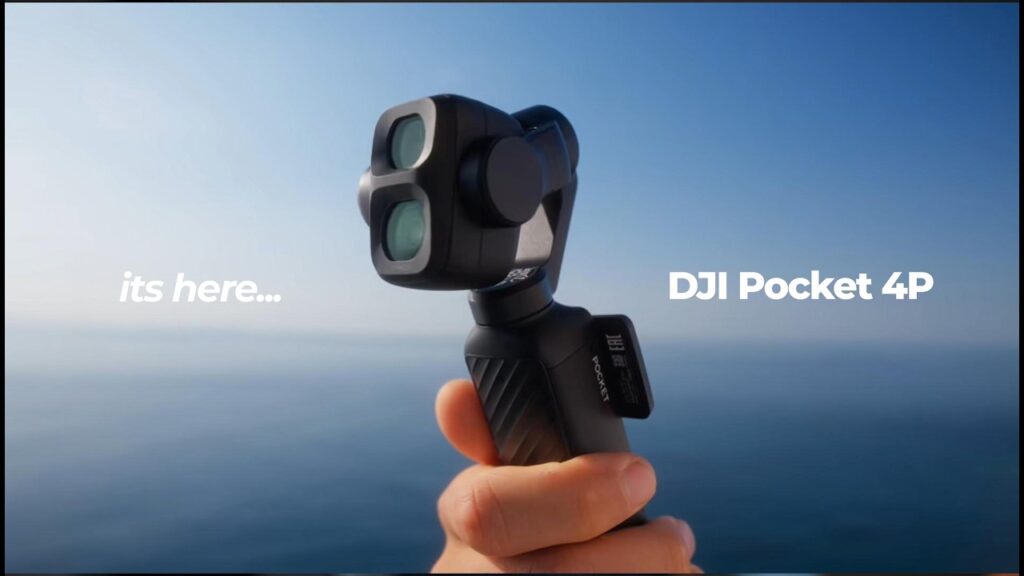
DJI has pushed the Osmo Pocket 4P into the Chinese market with a formula that is unusually ambitious for a camera this small. The compact gimbal camera is built for independent filmmakers, field journalists, and professional creators who want high-end image quality without giving up portability.
The headline numbers are hard to ignore. Starting at CNY 3,799, or around Rp8.3 million, the device combines dual cameras, a 1-inch sensor, 4K/240fps slow motion, 17 stops of dynamic range, and 10-bit D-Log2 color in a 230-gram body.
Dual cameras in one pocketable body
For the first time in the Pocket series, DJI has integrated a two-camera system. That move is the main difference and the reason behind the “4P” name, which stands for Pocket 4 Professional.
The main camera uses a 1-inch sensor with an f/2.0 aperture and a 20mm equivalent focal length. DJI says the LOFIC technology is designed to handle bright highlights without clipping, while the dynamic range is rated at 17 stops.
The telephoto camera uses a 1/1.28-inch sensor with an f/1.8 aperture and a 60mm equivalent focal length. It offers 3x native optical zoom and can be expanded to 12x digital zoom through AI algorithms.
Together, the two cameras give creators more flexibility in the field. Wide contextual shots and tighter dramatic close-ups can be captured without extra lenses or a second device.
Built around serious video work
Osmo Pocket 4P is not relying on compact design alone. DJI has equipped it with 4K recording up to 60fps and 4K/240fps slow motion, a feature set that remains rare in a pocket camera.
The device also supports 10-bit D-Log2 color, giving editors more room for grading during post-production. High bitrate support is also intended to keep non-linear editing workflows smoother and reduce distracting artifacts.
For many creators, the 4K/240fps capability is the main attraction. Many competing pocket cameras still stop at 1080p/240fps, which can make slow motion look less detailed once scaled to higher resolutions.
Portable enough for field work
DJI has kept portability at the center of the design. The Osmo Pocket 4P weighs 230 grams and remains compact enough to fit into a jacket pocket.
Its 2-inch rotating touchscreen reaches a peak brightness of 1,000 nits, an important detail for outdoor use when the display must stay readable under direct sunlight.
Battery capacity is listed at 1,545 mAh. Fast charging is aggressive as well, going from 0 to 80% in 18 minutes and to full in 32 minutes.
Internal storage is set at 103GB and is claimed to be enough for about 2.5 hours of 4K/60fps recording. When that is not enough, a microSD slot supports cards up to 1TB.
Audio, connectivity, and creator tools
For audio, DJI has included three built-in microphones with adaptive noise reduction. Connectivity is also upgraded with dual-band Wi-Fi 6 and Bluetooth LE 5.4 for accessories.
On the still-image side, the Osmo Pocket 4P can produce photos up to 37 megapixels. It also offers automatic panorama mode, AI Tracking, and ActiveTrack 6.0 to keep subjects stable while moving quickly.
The companion app adds remote control, live streaming, and basic editing from a phone. That makes the device more relevant for creators who want to capture, edit, and publish content within one ecosystem.
Price, colors, and availability
In China, the Osmo Pocket 4P is already open for pre-order through JD.com and DJI’s website. The standard version is priced at CNY 3,799, or around Rp8.3 million, while the Vlog Kit costs CNY 4,299, or around Rp9.4 million.
DJI is offering two color options, Classic Black and Pearl White. However, there is still no confirmed timeline for global availability.
There is also a major obstacle looming over the launch. The Osmo Pocket 4P cannot be sold legally in the United States because DJI remains on the FCC Covered List since December 2025.
That leaves the U.S. market without clarity on when the device could arrive officially. At the same time, rivals such as Insta360 Luna Ultra are also caught in legal pressure, keeping the premium pocket-camera segment tense and uncertain.