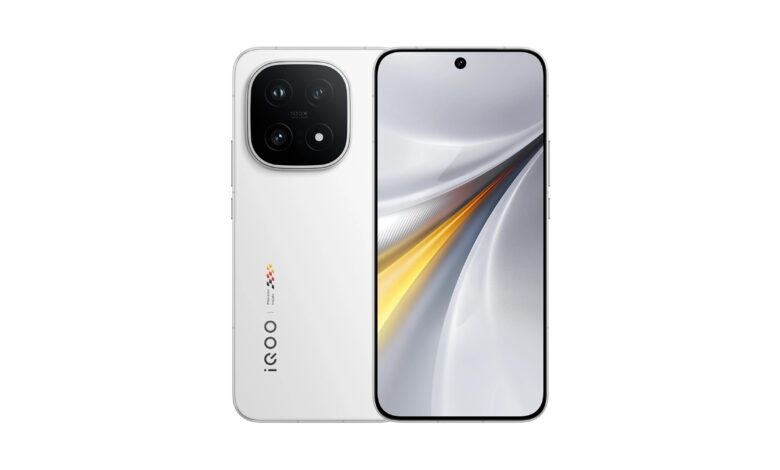
The Xiaomi 17T Pro and iQOO 15 are being positioned as two of the more compelling flagship choices, but they appeal to different buyers. The iQOO 15 pushes harder on raw value, while the Xiaomi 17T Pro answers with a stronger camera setup and richer video tools.
On price alone, the iQOO 15 has a noticeable edge. It is listed at around $800 or ₹74,000, while the Xiaomi 17T Pro sits closer to $900 or ₹75,000.
Performance gives iQOO 15 the first advantage
The biggest gap appears under the hood. iQOO 15 uses the Snapdragon 8 Elite Gen 5 3nm, while Xiaomi 17T Pro relies on the MediaTek Dimensity 9500 3nm.
That difference extends to graphics as well. iQOO 15 comes with Adreno 840, while Xiaomi 17T Pro uses Mali-G1 Ultra MC12, making the iQOO model the more convincing option for gaming-heavy users.
Software support also helps its case. Both phones run Android 16, but iQOO 15 ships with OriginOS 6 and promises up to five Android upgrades.
Display and everyday use
iQOO 15 also looks more ambitious on the display front. It features a 6.85-inch LTPO AMOLED panel with a 144Hz refresh rate, 1440 × 3168 resolution, and peak brightness rated at 6,000 nits.
Xiaomi 17T Pro is still well equipped with a 6.83-inch AMOLED display, 144Hz refresh rate, 1280 × 2772 resolution, and 3,500 nits of peak brightness.
That means the iQOO panel offers both higher resolution and stronger brightness, while LTPO gives it extra flexibility for efficiency. It also uses an ultrasonic in-display fingerprint sensor, compared with the optical in-display scanner on Xiaomi 17T Pro.
Durability slightly favors iQOO 15 too. Xiaomi 17T Pro is rated IP68 and uses Gorilla Glass 7i, but iQOO 15 goes further with IP68/IP69 protection.
Connectivity is another area where iQOO takes the lead. Both devices support Wi‑Fi 7 and Bluetooth 6.0, but iQOO 15 includes USB 3.2, while Xiaomi 17T Pro remains on USB 2.0.
Xiaomi 17T Pro fights back with a stronger camera system
Photography is where Xiaomi 17T Pro becomes the more interesting phone. Its main camera uses a 50MP sensor with a larger 1/1.31-inch size, OIS, and Leica tuning.
iQOO 15 also has a 50MP main camera with OIS, but its 1/1.56-inch sensor is smaller. Xiaomi’s advantage becomes more obvious in the telephoto setup, where it offers a 50MP periscope camera with 5x optical zoom.
By comparison, iQOO 15 uses a 50MP periscope camera with 3x optical zoom. Xiaomi 17T Pro also has an upper hand on video-focused features, including 8K recording, 4K at 120fps, HDR10+, and Log support.
iQOO 15 reaches 8K and 4K at 60fps, but Xiaomi’s broader video toolkit gives it a more creator-friendly profile overall. The front cameras are matched at 32MP, although iQOO 15 supports 4K at 60fps for selfies, while Xiaomi 17T Pro tops out at 4K at 30fps.
Not every camera-related spec leans toward Xiaomi. iQOO 15 carries a 50MP ultra-wide camera with autofocus, whereas Xiaomi 17T Pro uses a 12MP ultra-wide lens.
Battery and charging remain closely matched
Both phones use a 7,000mAh battery, so endurance should be one of the least controversial parts of the comparison. Wired charging is also identical at 100W.
The difference appears in wireless charging, where Xiaomi 17T Pro supports 50W wireless charging and iQOO 15 reaches 40W. Xiaomi also adds 22.5W reverse wired charging.
iQOO 15 answers with bypass charging, a feature that is especially useful for users who game while plugged in. Memory options are tied as well, with both phones available with up to 16GB RAM and 1TB UFS 4.1 storage.
Audio tuning brings a final slight edge to iQOO 15. Both phones include stereo speakers and Hi-Res Audio, but Xiaomi 17T Pro adds Dolby Atmos, while iQOO 15 supports Snapdragon Sound for wireless audio.
In the end, the split is clear: iQOO 15 looks like the more complete flagship for performance, display quality, software support, and price, while Xiaomi 17T Pro stands out for photography, stronger telephoto zoom, and a more advanced video package.