


Vivo’s X300 and X300 Ultra are aimed at very different buyers, even though both sit in the same flagship family. The price gap alone makes the decision meaningful, with the X300 listed at around $910 (₹76,000) and the X300 Ultra at about $1,500 (₹1,60,000).
That difference is not just about branding. It extends to the display, chipset, camera hardware, battery capacity, charging speed, and connectivity, while both phones still share several high-end basics such as up to 16GB RAM, up to 1TB UFS 4.1 storage, a 50MP autofocus front camera, Android 16, and OriginOS 6.
Where the Vivo X300 makes more sense
The standard X300 is the more rational pick for buyers who want a compact flagship without moving into ultra-premium pricing. It uses a 6.31-inch LTPO AMOLED display with a 120Hz refresh rate and a 1216 × 2640 resolution, so it still delivers a premium panel in a smaller body.
Performance is handled by the MediaTek Dimensity 9500 built on a 3nm process, paired with an Arm G1-Ultra GPU. That keeps it firmly in flagship territory, even if the Ultra has the more powerful platform for heavier graphics workloads.
The camera setup remains strong as well. The X300 includes a 200MP main camera with OIS, a 50MP periscope telephoto camera with 3x optical zoom, and a 50MP ultra-wide camera.
For video, the device supports recording up to 4K at 120fps. Its battery is rated at 6,040mAh for the global version, with 90W wired charging, 40W wireless charging, and reverse wired charging.
Why the X300 Ultra pulls ahead
The X300 Ultra is built for users who want the most capable package Vivo offers in this line, especially for photography, videography, and large-screen entertainment. It features a 6.82-inch LTPO AMOLED display with 1440 × 3168 resolution, a 144Hz refresh rate, and support for Dolby Vision, HDR10+, and HDR Vivid.
Under the hood, it runs on the Snapdragon 8 Elite Gen 5 made on a 3nm process, with an Adreno 840 GPU. That gives it the clear advantage in graphics performance and high-load gaming.
The rear camera system is where the Ultra separates itself most sharply. Its 200MP main camera uses a larger sensor and gimbal OIS, which should improve stabilization and image quality potential.
The telephoto upgrade is especially significant. Vivo equips the X300 Ultra with a 200MP periscope camera offering 3.7x optical zoom and macro capability, far beyond the 50MP 3x telephoto on the standard model.
The ultra-wide camera is also more advanced. It still uses a 50MP sensor, but the Ultra adds a larger sensor, Dual Pixel AF, and OIS, making it more flexible for shooting and more serious for video work.
Video features are similarly more ambitious, with 8K recording, 4K at up to 120fps, Dolby Vision HDR, and 10-bit Log included in the package.
Key differences at a glance
| Aspect | Vivo X300 | Vivo X300 Ultra |
|---|---|---|
| Display | 6.31-inch LTPO AMOLED, 120Hz | 6.82-inch LTPO AMOLED, 144Hz, Dolby Vision |
| Chipset | Dimensity 9500 | Snapdragon 8 Elite Gen 5 |
| Main camera | 200MP, OIS | 200MP, larger sensor, gimbal OIS |
| Telephoto | 50MP periscope, 3x | 200MP periscope, 3.7x, macro |
| Ultra-wide | 50MP | 50MP, larger sensor, Dual Pixel AF, OIS |
| Video | 4K 120fps | 8K, 4K 120fps, Dolby Vision HDR, 10-bit Log |
| Battery | 6,040mAh | 6,600mAh |
| Charging | 90W wired, 40W wireless | 100W wired, 40W wireless, reverse wireless |
| Price | Around $910 (₹76,000) | Around $1,500 (₹1,60,000) |
Features that further widen the distance
Both phones include Zeiss optics, an ultrasonic fingerprint sensor, and IP68/IP69 protection. That means the standard model still delivers a very strong premium foundation.
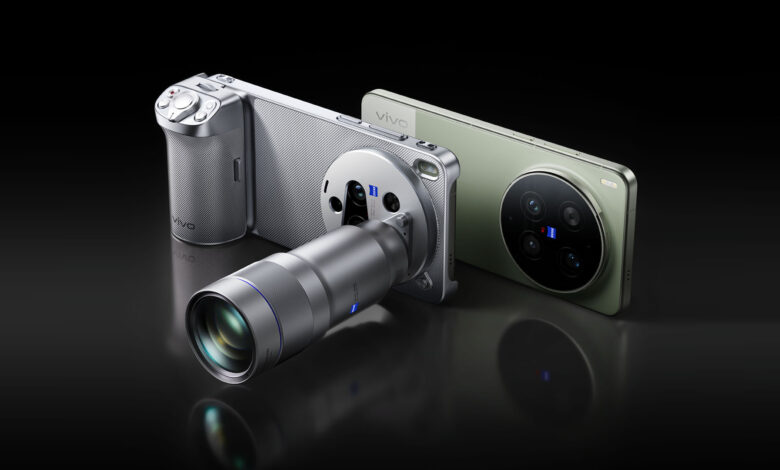
The Ultra adds several extras that the regular X300 does not offer. These include Satellite SOS on the 1TB model, DisplayPort output over USB-C 3.2, Bluetooth aptX Adaptive and aptX Lossless support, and support for external zoom lenses.
Battery life should also lean in the Ultra’s favor. Its 6,600mAh capacity and 100W wired charging make it the better choice for longer endurance, while reverse wireless charging adds more flexibility for accessories and other devices.
On software, the difference is modest. Both run Android 16 with OriginOS 6, and the X300 is said to support five Android upgrades, so the everyday experience is likely to feel familiar across both phones.
For buyers who want value, the X300 stands out as the more balanced option because it still offers a 200MP main camera, a periscope telephoto lens, wireless charging, and IP68/IP69 certification. For users who want the most complete Vivo flagship experience in camera hardware, display quality, video tools, and connectivity, the X300 Ultra is clearly the more ambitious device.
That is why the choice matters so much. The X300 can satisfy buyers who want flagship hardware without spending ultra-premium money, while the X300 Ultra is aimed at those who will actually use the extra imaging and connectivity features that justify the higher price.