


Snapdragon 8 Gen 3 remains the stronger chip when raw performance, gaming, and graphics matter most. In direct comparisons with Dimensity 8400, the Qualcomm platform still opens a clear gap in benchmark scores and connectivity support.
That gap matters because Snapdragon 8 Gen 3 is also seeing renewed interest even as it approaches three years in the market. Rising memory and RAM costs, together with chip production challenges, have helped keep it attractive while Dimensity 8400 positions itself as a powerful alternative for upper-tier phones.
Benchmark results favor Qualcomm
The comparison uses the iQOO 12 with Snapdragon 8 Gen 3 and the iQOO Z10 Turbo with Dimensity 8400. Across the test suite, Snapdragon keeps the advantage that many flagship buyers expect from a top-end chip.
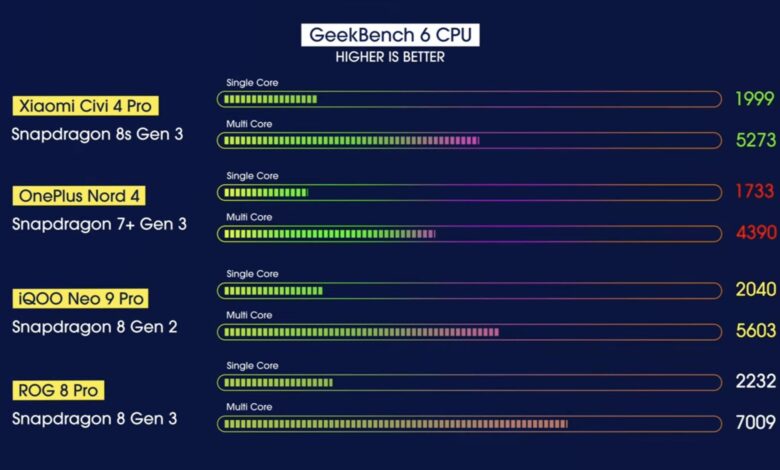
In Geekbench 6, Snapdragon 8 Gen 3 scored 2,216 in single-core testing, while Dimensity 8400 reached 1,629. That gives Qualcomm a lead of about 36 percent in single-threaded workloads.
The multi-core result is much closer. Snapdragon 8 Gen 3 posted 6,781, while Dimensity 8400 recorded 6,492.
AnTuTu v11 tells a similar story. Snapdragon 8 Gen 3 finished with 2,332,791 points, compared with 2,031,886 points for Dimensity 8400.
The largest difference came from graphics performance. Snapdragon 8 Gen 3 produced 818,651 GPU points, while Dimensity 8400 reached 645,958, leaving Qualcomm ahead by around 26 percent.
Memory and user experience scores also favored Snapdragon. It posted 348,240 in memory and 522,777 in UX, compared with 295,315 and 465,730 for Dimensity 8400.
Different CPU and GPU strategies
Snapdragon 8 Gen 3 uses a 1+3+2+2 CPU setup with one Cortex-X4 core at 3.3 GHz, three Cortex-A720 cores at 3.15 GHz, two Cortex-A720 cores at 2.96 GHz, and two Cortex-A520 cores at 2.27 GHz.
Dimensity 8400 takes a 1+3+4 all-big-core approach. Its layout includes one Cortex-A725 core at 3.25 GHz, three Cortex-A725 cores at 3 GHz, and four Cortex-A725 cores at 2.1 GHz.
That design gives Dimensity 8400 a distinctive profile, but the benchmark data still rewards Snapdragon’s higher-clocked prime core and broader flagship tuning. Qualcomm’s Adreno 750 also gives it an edge in graphics-heavy tasks.
For gaming and ray tracing, Snapdragon 8 Gen 3 relies on Adreno 750 with Snapdragon Elite Gaming support. Dimensity 8400 uses Mali-G720 MC7 alongside ray tracing support and MediaTek HyperEngine Adaptive Gaming Technology 3.0.
AI, imaging, and memory support
Both chips include on-device AI hardware, but they emphasize different goals. Snapdragon 8 Gen 3 uses Qualcomm Hexagon NPU, while Dimensity 8400 uses MediaTek NPU 880.
Qualcomm says Hexagon NPU supports generative AI models with up to 10 billion parameters and also assists the ISP with semantic segmentation, night shots, and photo expansion.
MediaTek describes NPU 880 as optimized for Generative AI and Agentic AI. The company positions it for more complex on-device AI agents that can operate in stages.
Camera handling also separates the two platforms. Snapdragon 8 Gen 3 features a Spectra triple AI ISP 18-bit that supports a single 200MP camera, a single 108MP camera with zero shutter lag, three 36MP cameras with zero shutter lag, and video recording up to 8K/30fps or 4K/120fps.
Dimensity 8400 uses MediaTek Imagiq 1080 ISP. Its support covers a single 320MP camera, three 32MP cameras at 30fps, semantic segmentation, and video recording up to 4K/60fps.
MediaTek focuses Imagiq 1080 on dynamic range, low-light noise reduction, and zero shutter lag in multi-camera setups. That makes its imaging pitch more practical than headline video resolution.
Memory and storage support are strong on both sides. Each chip supports LPDDR5x and UFS 4.0, but Snapdragon 8 Gen 3 goes up to LPDDR5x 4.8 GHz, while Dimensity 8400 tops out at 4.2 GHz and also includes UFS 4 plus MCQ.
Connectivity is another Qualcomm advantage
The clearest gap outside graphics appears in wireless support. Snapdragon 8 Gen 3 uses the Snapdragon X75 5G modem with download speeds of up to 10 Gbps and upload speeds of up to 3.5 Gbps.
Dimensity 8400 offers a 5G modem with download speeds of up to 5.17 Gbps. Both support Bluetooth 5.4, but Snapdragon already supports Wi‑Fi 7, while Dimensity 8400 remains on Wi‑Fi 6E.
Snapdragon 8 Gen 3 also supports sub-6GHz and mmWave, giving it a more complete flagship connectivity package. For users who care about performance ceilings, heavy gaming, and modern wireless standards, it still stands out as the more capable option.
Dimensity 8400, meanwhile, remains a strong choice for everyday speed, efficiency, and gaming at moderate settings. Its value also lies in its newer design and its focus on on-device agentic AI rather than purely chasing the highest benchmark numbers.