


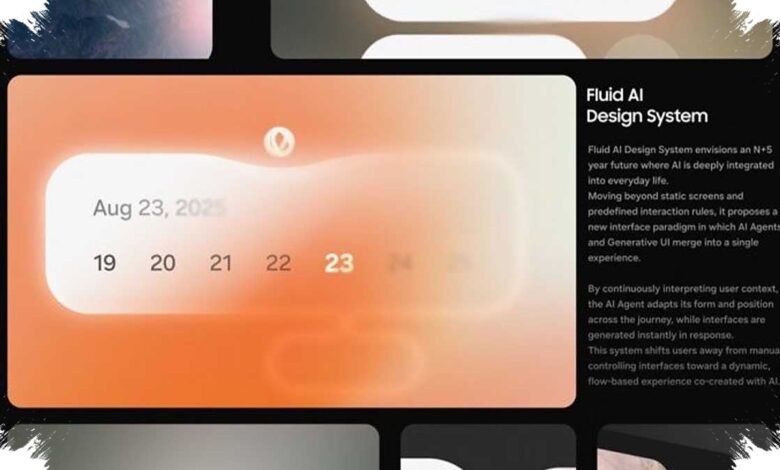
Samsung has offered a clear look at where its mobile software may be heading next with the Fluid AI Design System, a generative design concept built around AI. The system is not available as a real update yet, but it signals a major shift in how One UI could behave in the future.
Rather than keeping users locked into rigid app screens, Samsung is imagining an interface that can adjust itself in real time. The idea is to make the phone feel more responsive to context, with information and tools appearing in a single, smoother experience.
An interface that adapts to the task
Under the Fluid AI concept, information is no longer meant to sit inside fixed pages or static app windows. Samsung describes it as floating, flexible elements that can expand, shrink, shift, or change function depending on what the user is doing.
This approach is designed to reduce friction when handling everyday tasks. Instead of jumping between separate apps, the system could surface the most relevant information at the moment it is needed.
| Use Case | What Appears | Expected Result |
|---|---|---|
| Meeting reminder | Calendar, travel route, related contacts | One unified view without switching apps |
| Simple date picker | Turns into a full scheduling assistant when needed | Smarter, more adaptive interaction |
Samsung’s examples show how a meeting reminder could bring together a calendar, route suggestions, and relevant contacts in one display. A basic date picker could also evolve into a full scheduling assistant when the situation calls for it.
Built on the same direction as Galaxy AI
The concept fits neatly with Samsung’s recent push through Galaxy AI, which has steadily expanded across on-device and cloud-based features. Fluid AI takes that logic further by extending intelligence into the structure of the interface itself.
If earlier AI features acted as additions to the system, Fluid AI suggests a future where AI becomes part of the design foundation. In that model, the interface would not only display information, but also help guide the user toward the most relevant action.
Samsung has not confirmed that this concept will appear immediately in the next One UI version, and it may be more likely to surface in One UI 10 or later. Even so, the presentation makes the company’s design direction increasingly clear.
Promising, but still far from shipping
Fluid AI still faces several challenges before it could reach consumer devices. Support from third-party apps, performance across different hardware, and visual consistency are all issues that would need to be handled carefully.
That means the concept may still change significantly before it ever appears on a retail phone. Even so, the Red Dot Design Award 2026-winning design already suggests that Samsung is serious about making mobile experiences more intuitive and more intelligent.
The Fluid AI Design System also formed part of Samsung’s recognition at the Red Dot Awards, where the company earned several honors for AI-driven ideas focused on personalization. According to www.gizmochina.com, the recognition highlights how Samsung is not only building AI features, but also rethinking how AI shapes interface behavior and appearance.
For now, Fluid AI remains a design vision rather than a confirmed product feature. If it develops further, One UI could evolve from a place that simply runs apps into a system that actively understands usage context.