


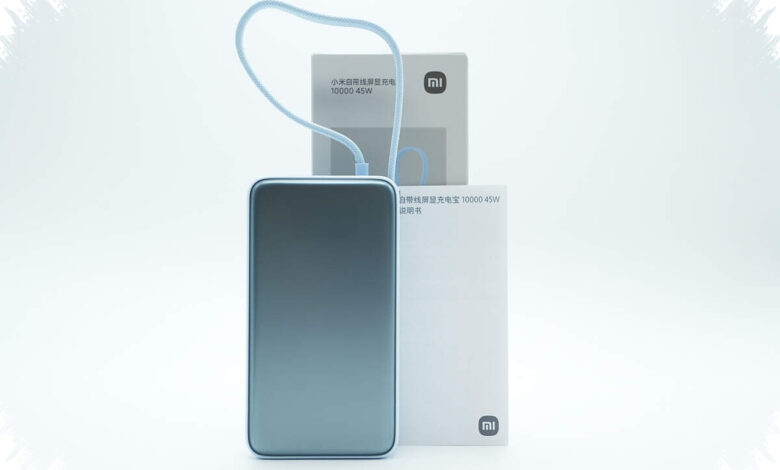
Xiaomi has introduced its first power bank designed to meet China’s new national safety standard, signaling that battery protection is becoming a headline feature rather than a quiet technical detail. The device, called the Xiaomi Power Bank 20000 22.5W, is set to go on sale in China on July 22.
The timing is notable because the product arrives well before the new rule becomes mandatory in 2027. That move gives Xiaomi an early position in a market where safety requirements are tightening fast.
Built around 20,000mAh and a safety-heavy design
The power bank carries a 20,000mAh capacity and supports 22.5W charging through its built-in cable. Instead of using a single large cell, Xiaomi has chosen two 10,000mAh cells inside the unit.
That design sits at the center of Xiaomi’s safety message. The company says the power bank has already passed a 4 mm needle penetration test, 135 °C heat exposure, overcharge testing at 1.3 times normal voltage, compression testing with a force of about 1.3 tons, and a 300-cycle aging test to check for lithium plating.
| Feature | Detail | Note |
|---|---|---|
| Capacity | 20,000mAh | Uses two 10,000mAh cells |
| Charging Output | 22.5W | Via built-in cable |
| Ports | 1 USB-A, 2 USB-C | 2C+1A layout |
Smart checks and battery traceability
Beyond its physical durability tests, the device also includes intelligent management features tied to its cable. Users can check battery health and view traceability information about the battery inside the power bank.
The port setup includes one USB-A port and two USB-C ports, giving the model broad compatibility for everyday use. Xiaomi has kept the layout close to what it has already been using across its newer power bank line.
Arriving ahead of China’s stricter timeline
The new model is based on the Xiaomi 20000 22.5W Power Bank 2026, which launched in June. Both products share the built-in cable, the 2C+1A port layout, and the 149 yuan price.
Gizmochina reports that China’s new national power bank safety standard was announced in April, but it will only become mandatory on April 1, 2027. The rule requires stronger protection against high heat, overcharge, and pressure, and it adds a new test for lithium buildup after repeated charging cycles.
The standard also requires devices to store and share data about abnormal events, and to carry a unique identification code so consumers can check details such as the battery brand. It further bans the use of recycled or refurbished lithium cells and adds mechanical tests including drops, compression, and impact.
With this release, Xiaomi appears to be moving ahead of the deadline rather than waiting for the final enforcement date. The result is a power bank that treats safety, traceability, and compliance as part of the product pitch itself.