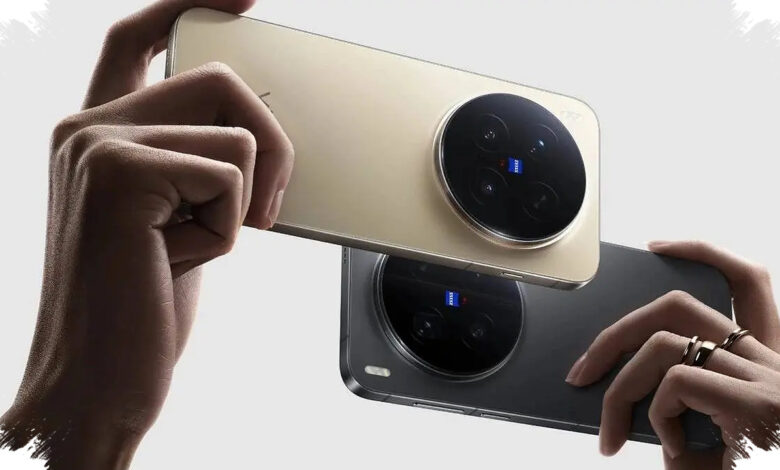
Vivo is reportedly abandoning a dedicated 10x zoom camera for the X500 Ultra and placing that role on a single 200MP periscope module. The decision raises the importance of a sensor choice that has not yet been finalized.
Digital Chat Station says Vivo is testing three sensor sizes through July 2026. The company must balance high-zoom image quality against camera thickness, industrial design, and component costs.
Why the Sensor Decision Matters
The X500 Ultra is expected to use in-sensor zoom, following an approach described as similar to the X300 Ultra. Its full 200MP resolution would allow high-precision digital cropping intended to deliver effective optical-equivalent zoom up to 10x.
That method could reduce mechanical complexity by eliminating an additional periscope camera. It could also avoid extra hardware components that may increase the risk of device failures.
However, a single-camera setup leaves less room for compromise at high magnification. A larger sensor could provide a stronger foundation for retaining detail and low-light performance after an image is cropped.
Three Sensor Paths Under Evaluation
| Sensor Size | Development Position | Key Trade-Off |
|---|---|---|
| 1/1.12-inch | Largest and most ambitious option | Better light capture potential, with a thicker camera module |
| 1/1.3-inch | Balanced option | Balances camera performance, body design, and component cost |
| 1/1.4-inch | More established hardware route | Lower technical risk, but less chance to surpass a rival |
The 1/1.12-inch sensor is the most aggressive candidate. It could improve light capture for distant subjects, particularly at zoom levels around 5x to 10x.
Its size could make the rear camera assembly thicker and more prominent. Production costs may also rise, although that consequence may be easier to absorb in an ultra-premium device expected to cost more than Rp20 million.
The 1/1.3-inch option sits between the two extremes. It is seen as a way to improve on industry standards without forcing Vivo into an excessively large rear-camera design.
Vivo could also use the 1/1.4-inch route, which is said to share the same basis as the Samsung HP9 used in the Xiaomi 17 Ultra. This path could reduce technical and manufacturing risks, but it may leave Vivo matching rather than exceeding its competitor.
Dedicated 10x Prototype Reportedly Ended
According to information published by gadget.viva.co.id, a prototype carrying a dedicated 10x zoom camera was discontinued in June 2026. The reported plan now centers on one 200MP periscope camera instead of two periscope modules.
The change makes the sensor selection more consequential than it would be in a dual-periscope configuration. Vivo’s final choice will directly affect how much image data remains available for high-zoom crops.
Launch Timeline Leaves Room for Testing
The X500, X500 Pro, and X500 Pro Max are scheduled to launch in September 2026. The X500 Ultra is expected later, with a launch projected for the first or second quarter of 2027.
The later schedule is consistent with the sensor decision remaining open. Camera components generally need to be locked several months before a handset enters mass production.
Vivo is expected to introduce the Ultra model in China and global markets at the same time. Until then, the company still has to decide whether its zoom ambitions require the largest sensor, a balanced alternative, or a more mature hardware platform.