


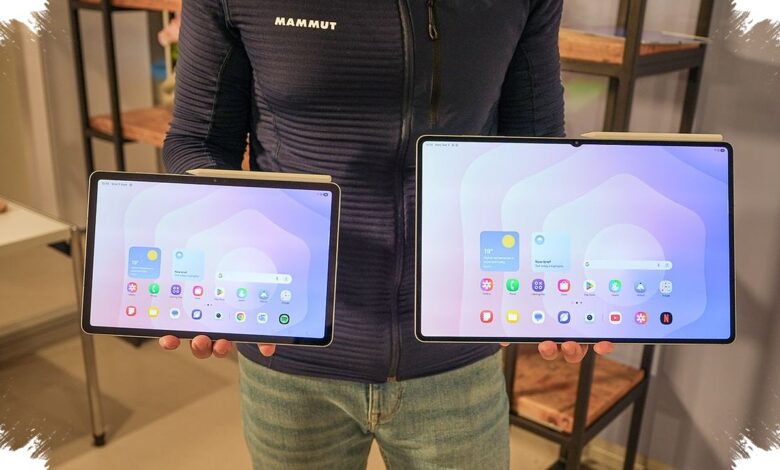
Samsung Galaxy Tab S11 Ultra and Huawei MatePad Pro Max take notably different routes in the premium tablet segment. Samsung prioritises a 14.6-inch display, IP68 protection and Android integration, while Huawei focuses on a thinner body, an anti-reflection display option and a bundled keyboard.
The contrast is especially clear in portability. At 509 grams, the MatePad Pro Max is 186 grams lighter than the 695-gram Galaxy Tab S11 Ultra, while also measuring 4.7 mm thick rather than 5.1 mm.
| Category | Galaxy Tab S11 Ultra | MatePad Pro Max |
|---|---|---|
| Display | 14.6-inch Dynamic AMOLED 2X, 2960 x 1848 | 13.2-inch Flexible OLED, 3000 x 2000 |
| Dimensions and weight | 5.1 mm, 695 g | 4.7 mm, 509 g |
| Battery and charging | 11,600 mAh, 45W | 10,400 mAh, 66W, 40W reverse charging |
| Included accessory | S Pen | Glide Keyboard and charger |
The lighter Huawei tablet may appeal to users who frequently carry a keyboard-equipped device for work or creative tasks. Huawei states that purchases through its official page include the HUAWEI Glide Keyboard and charger, whereas Samsung’s keyboard accessory is generally sold separately.
Samsung counters its larger and heavier form factor with stronger stated physical protection. The Galaxy Tab S11 Ultra has IP68 water- and dust-resistance certification and an Armor Aluminum body, according to Samsung Mobile Press global specifications.
Different display priorities
Samsung’s 14.6-inch Dynamic AMOLED 2X panel has a WQXGA+ resolution of 2960 x 1848 pixels. Its larger working area is intended to provide more room for multiple applications and layered views.
Huawei uses a 13.2-inch Flexible OLED display in a 3:2 aspect ratio with a 3000 x 2000-pixel resolution. It supports refresh rates of up to 144 Hz and is available with a PaperMatte Display option designed to reduce reflected light.
Both models offer peak brightness of up to 1,600 nits. The decision therefore extends beyond brightness, with Samsung favouring maximum display area and Huawei emphasising a more compact format and visual comfort.
Software and AI follow separate paths
The Galaxy Tab S11 Ultra runs One UI 8 based on Android 16 and uses the MediaTek Dimensity 9400+ chipset, with RAM options up to 16 GB. Its software includes Google Gemini Live and Writing Assist for text summarising, editing and drafting tasks.
The MatePad Pro Max runs HarmonyOS 4.3 with Cloud Falcon architecture. Huawei positions AI-Powered WPS Office, the GoPaint drawing application and Smart Antenna 2.0 as key parts of its productivity offering.
Huawei says Smart Antenna 2.0 can improve Wi-Fi reception stability by up to 40 percent in weak-signal areas. That claim may matter to users who work primarily over wireless connections, although software needs remain dependent on each device ecosystem.
Battery capacity versus charging speed
Samsung equips the Galaxy Tab S11 Ultra with an 11,600 mAh battery and 45W fast charging support. A newly shaped hexagonal S Pen is included with the tablet.
Huawei’s 10,400 mAh silicon battery supports 66W HUAWEI SuperCharge and 40W reverse charging for other devices. The Galaxy Tab S11 Ultra is positioned for users needing the biggest display, IP68 protection and Android-based Google Gemini integration, while the MatePad Pro Max targets those who value a slimmer tablet, reduced reflections and a keyboard included in the purchase package.