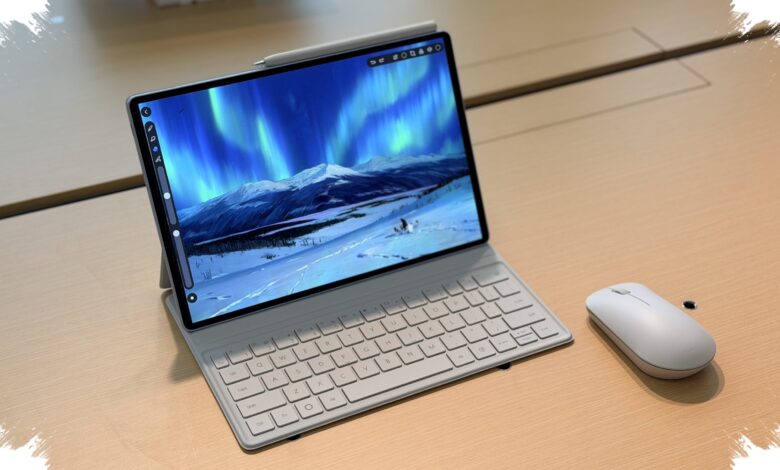
Huawei is positioning the MatePad Air 2026 as a lightweight work device rather than simply a media tablet. At 5.3 mm thick and 509 grams, it combines a portable form with tools designed for documents, notes, and multitasking.
Its productivity focus centers on HarmonyOS 4.3, which supports two application windows side by side. The feature gives users a PC-style working arrangement for tasks that require viewing more than one app at once.
A Tablet Designed Around Mobility
The MatePad Air 2026 is intended for users who want to reduce their reliance on a conventional laptop while travelling. Huawei supports that role with the slim Glide Keyboard and the HUAWEI M-Pencil Pro.
The keyboard expands the tablet’s role for document writing, while the stylus supports handwritten notes and drawing. The M-Pencil Pro also includes an air-mouse mode for controlling presentations or turning document pages from a distance.
Huawei Notes adds AI-based meeting tools to the package. Users can record meeting audio, generate an automatic transcription, and create a summary of key points from their notes.
| Feature | Specification | Purpose |
|---|---|---|
| Display | 12-inch OLED, 2,800 x 1,840 pixels | Sharp visuals for work and entertainment |
| Refresh rate | Adaptive up to 144Hz | Smoother on-screen movement |
| Memory and storage | 8 GB or 12 GB RAM, 256 GB storage | Supports daily multitasking |
| Battery | 10,100 mAh, 66W fast charging | Extended portable use |
OLED Replaces the Previous LCD Approach
The most visible hardware change is the move from LCD to a 12-inch OLED display. The panel has a 2,800 x 1,840-pixel resolution, an adaptive refresh rate of up to 144Hz, and peak brightness of 1,200 nits.
Those specifications are intended to keep text and visuals clear in both indoor and outdoor use. They also make the screen a central part of Huawei’s effort to present the device as a workstation for mobile users.
An OLED PaperMatte Display version is available for people who spend extended periods reading documents or writing notes. Its nano-level etched surface is said to reduce reflections from lamps and sunlight by up to 99 percent.
The PaperMatte treatment is also designed to produce a more paper-like writing feel. That can be useful for students, workers, and creators who use a stylus for long sessions.
Hardware, Software, and a Key Limitation
According to Huawei’s specifications page, as cited by techno.viva.co.id, the tablet uses the Kirin T93C chipset. The processor is designed for high efficiency and AI processing.
The device comes with either 8 GB or 12 GB of RAM and 256 GB of internal storage. However, prospective buyers should note that it operates without Google Mobile Services, or GMS.
Huawei instead relies on AppGallery as its application distribution platform. The company says the ecosystem includes alternative office applications for productivity needs.
Battery Life and Entertainment Features
Huawei states that the 10,100 mAh battery can provide up to 16 hours of local video playback or up to 10 hours of HDR video streaming. A full charge using 66W fast charging is said to take about 85 minutes.
The tablet also includes a six-speaker system certified by HUAWEI SOUND for spatial audio. This allows the device to serve entertainment needs after work, including video viewing.
Huawei introduced the MatePad Air 2026 globally in mid-July 2026, with global sales scheduled to begin in August 2026. It will be offered in Sakura Pink, Airy Blue, and White with a high-strength premium frame.