


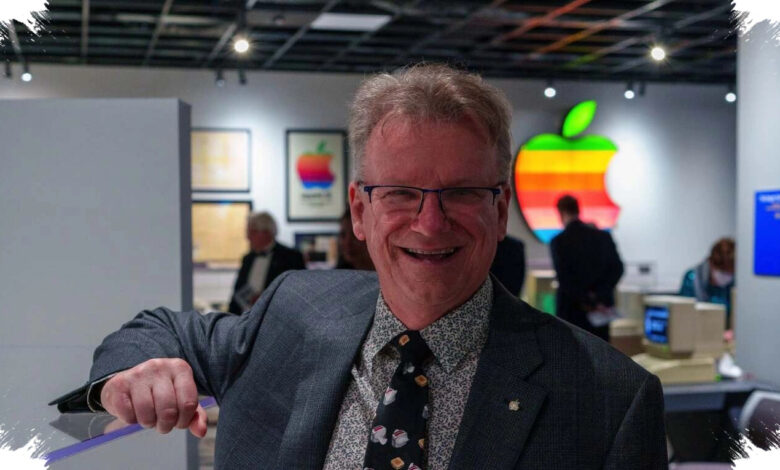
Long before the iPhone became Apple’s defining product, Chris Espinosa was already helping the company build its early computer business. Apple employee No. 8 has now spent 50 years with the company, a tenure that began in 1976 when he was 14.
Espinosa’s career reaches back to the period when Apple was a small startup assembling computers by hand. At 64, he remains with a company that has grown from Steve Jobs’ childhood-home garage into a global technology giant.
From After-School Work to Apple II Demonstrations
In Apple’s early days, Espinosa went to the office every Wednesday afternoon after school. His responsibilities ranged from creating demonstration programs to testing Integer BASIC software for the Apple II ROM.
He also demonstrated the Apple II to prospective customers, combining technical and customer-facing work. The range of those duties reflected the small scale of Apple’s workforce at the time.
The Apple II work came after Espinosa was recruited to write programs in BASIC, a programming language widely used during that period. The programs were intended to run on the Apple II.
His entry into the company began at Byte Shop, where he encountered Steve Jobs installing an Apple I computer. That brief meeting led to his recruitment by Apple.
Espinosa later met Steve Wozniak through the Homebrew Computer Club in Menlo Park, California. His interest in Apple persisted even after teachers at Homestead High School in Cupertino cautioned him about it.
An Employee Number From Apple’s Earliest Structure
Espinosa’s official employee number was 8, placing him among Apple’s earliest staff members. The numbering record illustrates how limited the company’s organization was in its formative years.
| Employee Number | Associated Person | Detail |
|---|---|---|
| 1-3 | Steve Jobs, Steve Wozniak, and other founders | Reserved but ultimately unused |
| 7 | Mike Scott | Selected by Apple’s first CEO, inspired by James Bond |
| 8 | Chris Espinosa | Espinosa’s official employee number |
Numbers 1 through 3 were reserved for Jobs, Wozniak, and other founders, but were not used. Mike Scott, Apple’s first chief executive, took No. 7 after being inspired by James Bond.
Espinosa’s No. 8 remains a marker of a time when a single employee could contribute to software testing, programming, product demonstrations, and other essential tasks. Apple’s workspace was also far removed from its present scale.
The company operated from an ordinary home in Los Altos, California, using simple worktables in Jobs’ garage. That setting preceded the arrival of the iPhone by decades.
A Career That Predates the iPhone by Decades
Apple released the first iPhone on June 29, 2007. The device emerged more than three decades after Espinosa had started assisting the company’s technical work.
The iPhone has since become one of Apple’s key products, while Espinosa’s career has spanned both the Apple I and Apple II eras. His path also included a period of university study without a complete separation from Apple.
After graduating from high school in 1978, Espinosa entered the University of California, Berkeley. It was the only period in which he was not employed by Apple on a full-time basis.
He nevertheless continued working for Apple as a part-time employee while attending Berkeley. The New York Times highlighted his history in connection with Apple’s 50th anniversary.
Espinosa’s 50-year tenure links Apple’s hand-built early computers with the era in which the iPhone became central to the company. It also offers a rare view of how Apple’s earliest employees worked across multiple roles as the business was taking shape.