


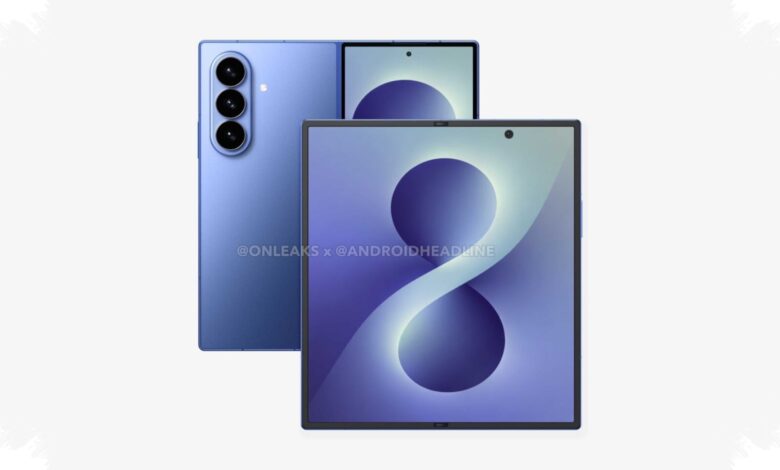
Samsung is separating its foldable lineup into two distinct directions with the Galaxy Z Fold8 and Galaxy Z Fold8 Ultra. The Ultra model takes the premium position with a 200MP main camera, while the standard Fold8 adopts a wider format aimed at a different style of use.
The Galaxy Z Fold8 Ultra appears to be the direct successor to the company’s most premium book-style foldable approach. The Galaxy Z Fold8, meanwhile, is positioned between a clamshell foldable and a larger conventional Fold device.
Two Foldable Formats, Different Priorities
When closed, the Galaxy Z Fold8 uses a 5.5-inch LTPO OLED cover screen with a 10:16 aspect ratio. Samsung’s design gives it a portrait-oriented form that resembles a compact phone rather than a narrow secondary display.
Opening the Fold8 reveals a 7.6-inch internal display with a 4:3 aspect ratio. That shape is intended for photos, documents, books, and text-heavy websites.
The cover display can also be used in landscape orientation at a 16:10 ratio. This format is commonly associated with laptops and tablets, making it more suitable for video, gaming, and social media browsing.
The Fold8 cover screen has a resolution of 1,248 x 1,972 pixels and a pixel density of 428ppi. Its internal panel reaches 1,848 x 2,448 pixels, supports a 1-120Hz refresh rate, delivers brightness of up to 3,000 nits, and includes a low-reflection layer.
| Model | Cover Display | Battery | Main Camera |
|---|---|---|---|
| Samsung Galaxy Z Fold8 | 5.5-inch LTPO OLED, 1-120Hz | 4,800mAh | 50MP with OIS |
| Galaxy Z Fold8 Ultra | 6.5-inch | 5,000mAh Si-C | 200MP with OIS |
The standard Fold8 measures 81.9mm wide, 123.9mm tall, and 9.7mm thick when closed. It weighs 201 grams, while the wider design is intended to make the top section of the display easier to reach.
Ultra Focuses on Imaging and Endurance
The Galaxy Z Fold8 Ultra uses a 200MP main sensor paired with an f/1.7 lens and optical image stabilization. It also supports 8K recording with the APV codec and on-device Cine LUT use.
Its ultra-wide camera has a 50MP sensor, an f/1.9 lens, and a 120-degree field of view for landscapes and macro photography. The telephoto camera remains a 10MP unit with 3x optical zoom, an f/2.4 lens, and OIS.
Both models include two 10MP selfie cameras, one on the cover display and another on the internal screen. The outer camera has an 85-degree field of view, while the internal camera provides a wider 100-degree field of view.
The Ultra also receives a 5,000mAh Silicon-Carbon battery, compared with the 4,800mAh battery in the Fold8. Samsung says this is the first time it has used a Si-C battery in one of its phones.
Both devices support 45W wired charging, 20W wireless charging, and reverse wireless charging. Samsung says the Fold8 can reach 63% in 30 minutes, while the Ultra can reach 67% over the same period using a new dual-path charging architecture.
Shared Platform and Revised Materials
Both foldables are powered by the Snapdragon 8 Elite Gen 5 for Galaxy, the same chipset used in the Galaxy S26 series. The 256GB and 512GB versions have 12GB of RAM, while the 1TB version includes 16GB.
GSMArena reports that the Ultra retains a closed width of 72.8mm and a weight of 215 grams from the previous generation. It measures 8.9mm thick when closed and 4.1mm when opened.
The Ultra uses a larger graphite sheet to help distribute heat. Both models run Android 17 with One UI 9, support Wi-Fi 7 and Bluetooth 6.0, and carry an IP48 dust and water resistance rating.
Samsung has also introduced Flex Titanium technology, combining a titanium alloy film with an enhanced titanium plate. The material is intended to reinforce the display, absorb impacts and pressure, and improve durability around the fold.
The Fold8 is offered in Graphite, Cream, Lavender, and Samsung.com-exclusive Pistachio. The Ultra comes in Graphite, Cream, Violet Shadow, and Samsung.com-exclusive Green Shadow.
Both phones are already in the pre-order period and include a six-month Google AI Pro trial. The package includes 5TB of cloud storage and normally costs US$20 per month.