


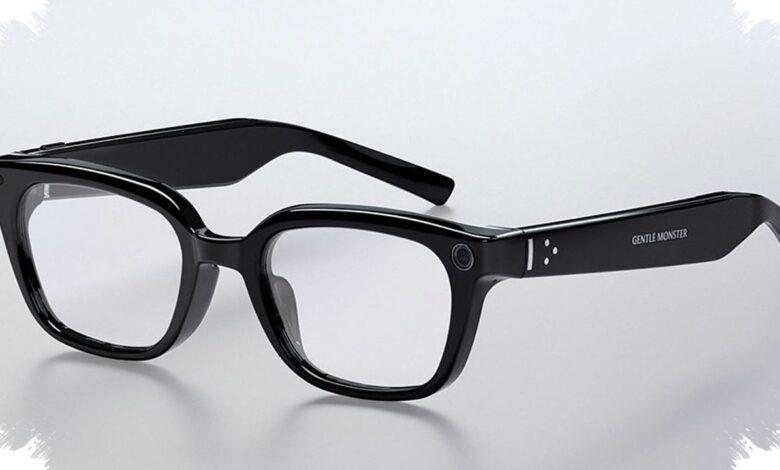
Samsung is positioning its upcoming AI glasses as a wearable designed to reduce reliance on screens rather than add another display in front of the user’s eyes. The device combines audio feedback, hands-free controls and Gemini-powered context awareness for everyday activities.
The approach separates the glasses from conventional augmented reality products that place visual information directly in the wearer’s field of view. Samsung instead intends the device to provide assistance while people move, work, communicate and explore their surroundings.
Designed as an Everyday Accessory
Samsung has partnered with Gentle Monster and Warby Parker for the physical design of the glasses. The partnerships indicate that the company wants the product to function as a wearable accessory rather than solely as a piece of technology.
| Design partner | Frame appearance | Character |
|---|---|---|
| Gentle Monster | Thin black frame with a straight upper edge and rounded lower section | Fashion-oriented |
| Warby Parker | Brown frame | Suitable for everyday wear |
Users will be able to interact with the glasses through voice commands when hands-free operation is appropriate. A touch area on the frame arm provides an alternative method, while connected devices can offer additional controls.
Those control options may be useful in settings where voice commands are not suitable. Samsung’s design therefore combines spoken input, touch input and connected-device interaction rather than relying on a single control method.
Gemini Uses the Camera for Context
An integrated camera allows the wearable version of Gemini to understand elements of the user’s surroundings. It can photograph a whiteboard and help organise the visible information in the Notes application.
The camera also supports first-person video recording and can show nearby conditions during video calls. Gemini can summarise lengthy messages and read important information aloud to the wearer.
Samsung is also preparing real-time translation for people travelling in areas where another language is spoken. The glasses can provide real-time navigation to a selected destination and share information about nearby surroundings during walks or tours.
Sameer Samat, President of Android Ecosystem at Google, said Samsung and Google share a vision of bringing helpful, context-aware intelligence into everyday life. He highlighted the combination of glasses design and Gemini assistance that responds to what users see for hands-free support throughout the day.
Android XR Without a Display
The glasses run on Android XR through a collaboration involving Samsung, Google and Qualcomm. Samsung said Android XR fully supports a screenless design and distinguishes this product as AI glasses.
The company is separately developing AR glasses that will include a display. That distinction places the screenless model in a different category from Samsung’s Galaxy XR headset.
| Aspect | Samsung AI Glasses | Galaxy XR |
|---|---|---|
| Platform | Android XR | Android XR |
| Chipset | Snapdragon AR1 Gen 1 | Snapdragon XR2+ Gen 2 |
| Primary focus | Audio- and context-based AI assistance | Gaming and professional use |
| Display | None | Not specified |
Samsung’s AI glasses use the Snapdragon AR1 Gen 1, a processor designed specifically for thin and lightweight smart glasses. Galaxy XR uses the Snapdragon XR2+ Gen 2, reflecting its different emphasis on gaming and professional applications.
Won-Joon Choi, Chief Operating Officer of Samsung Electronics’ Mobile eXperience Business, said agentic AI is changing mobile experiences and requires more intuitive forms of interaction. He said smart glasses can offer more personal AI assistance in daily moments without making every interaction begin with a screen.