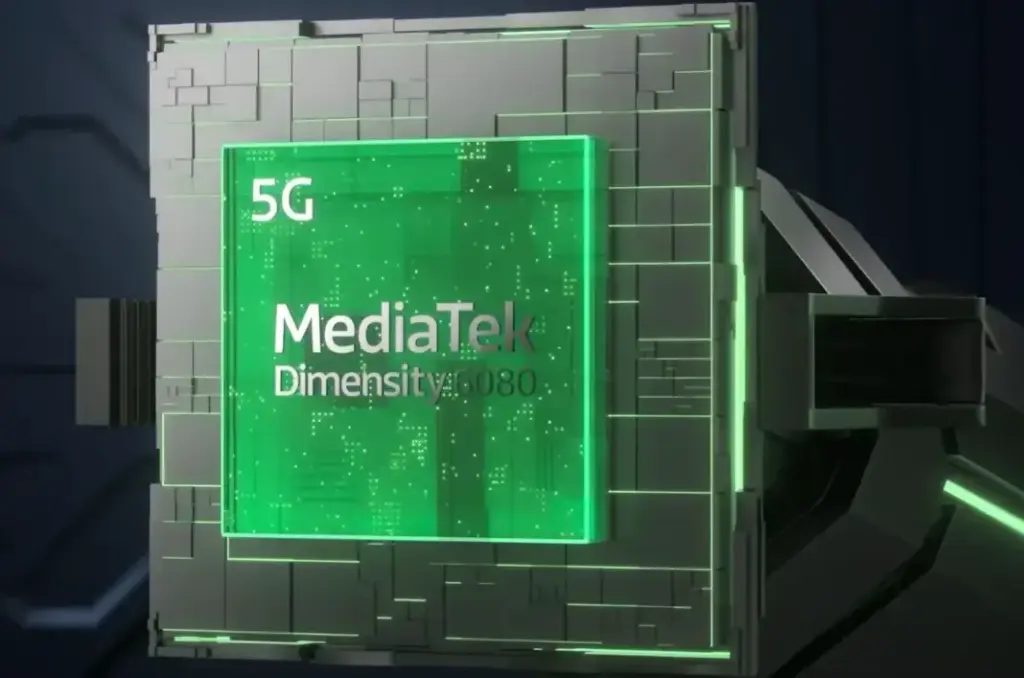
MediaTek offers two strong chipsets for smartphones that cater to entry-level and mid-range segments: Helio G100 and Dimensity 6080. Both chipsets share similar architectures but differ significantly in network capabilities, with Helio G100 relying on 4G connectivity and Dimensity 6080 supporting 5G technology.
Helio G100 was introduced in 2024, following Dimensity 6080’s launch in 2023. Despite the newer release, both compete closely within the same performance class. Popular smartphones like Tecno POVA 7 and Infinix Note 50 adopt the Helio G100, while Redmi Note 13 5G and Tecno POVA 6 Pro use the Dimensity 6080.
CPU and GPU Architecture
Both chipsets feature an octa-core CPU consisting of two Cortex-A76 performance cores and six Cortex-A55 efficiency cores. However, Dimensity 6080’s performance cores run at up to 2.4 GHz, faster than Helio G100’s 2.2 GHz. The GPUs in both chipsets use Mali-G57 MP2, but Dimensity 6080 clocks at 1068 MHz compared to Helio G100’s 1000 MHz, theoretically delivering a 5-7% advantage in graphics performance.
This slight edge in speed is often negligible in daily use, as both chipsets perform similarly for gaming and multitasking tasks. Thus, users get competent performance from either option.
Efficiency and Manufacturing Process
Both chipsets are manufactured using a 6nm process, which helps optimize power consumption and thermal performance. Each uses six Cortex-A55 cores to handle light tasks efficiently, contributing to better battery life.
Dimensity 6080 includes MediaTek’s 5G UltraSave technology, designed to reduce power usage during 5G connectivity. Helio G100, lacking a 5G modem, naturally consumes less power when using mobile data. In regions with limited 5G reach, the 5G chipset switches to 4G, leveling power consumption differences between the two.
Multimedia Capabilities
MediaTek’s Helio G100 supports up to a 200 MP camera resolution, surpassing Dimensity 6080’s 108 MP limit. Both chipsets support Full HD+ displays with resolutions up to 2520 x 1080 pixels and UFS 2.2 storage. This makes Helio G100 an attractive choice for smartphones emphasizing high-megapixel cameras, while Dimensity 6080 still offers solid imaging performance for mid-range devices.
Connectivity Features as Key Differentiator
The largest distinction lies in connectivity. Helio G100’s Cat-13 4G LTE modem offers theoretical download speeds up to 650 Mbps and upload speeds of 150 Mbps. It supports advanced 4G features like 4×4 MIMO, carrier aggregation, and Dual 4G VoLTE.
Conversely, Dimensity 6080 supports multi-mode 5G sub-6 GHz with download speeds reaching 2770 Mbps and uploads over 1250 Mbps under Cat-18 LTE standards. It also supports Dual 5G SIM with Voice over New Radio (VoNR) for clearer calls. Helio G100 uses Bluetooth 5.4, slightly newer than Dimensity 6080’s Bluetooth 5.1, though the difference minimally impacts daily usage.
Benchmark Performance Comparison
Benchmark results show marginal differences in performance. On AnTuTu v10, Helio G100 scores around 430,000 points, while Dimensity 6080 slightly exceeds with 436,000 points. Helio G100 excels in CPU and memory tests, whereas Dimensity 6080 performs better in GPU and user experience benchmarks.
Geekbench 6 scores further demonstrate close results, with Helio G100 achieving 733 (single-core) and 2028 (multi-core), and Dimensity 6080 obtaining 767 and 2057 respectively. These minor gaps indicate nearly identical real-world performance for everyday apps and casual gaming.
Choosing Between Helio G100 and Dimensity 6080
Ultimately, the decision depends on user priorities. Dimensity 6080 suits those seeking 5G connectivity and faster data speeds to future-proof their devices. Helio G100 remains a strong candidate for users valuing longer battery life, higher camera resolution support, and cost savings on a 4G device.
MediaTek showcases consistent capability with these chipsets, delivering efficient and balanced options for different consumer needs. Both Helio G100 and Dimensity 6080 demonstrate that 4G and 5G solutions can each hold their ground in the competitive smartphone market today.