


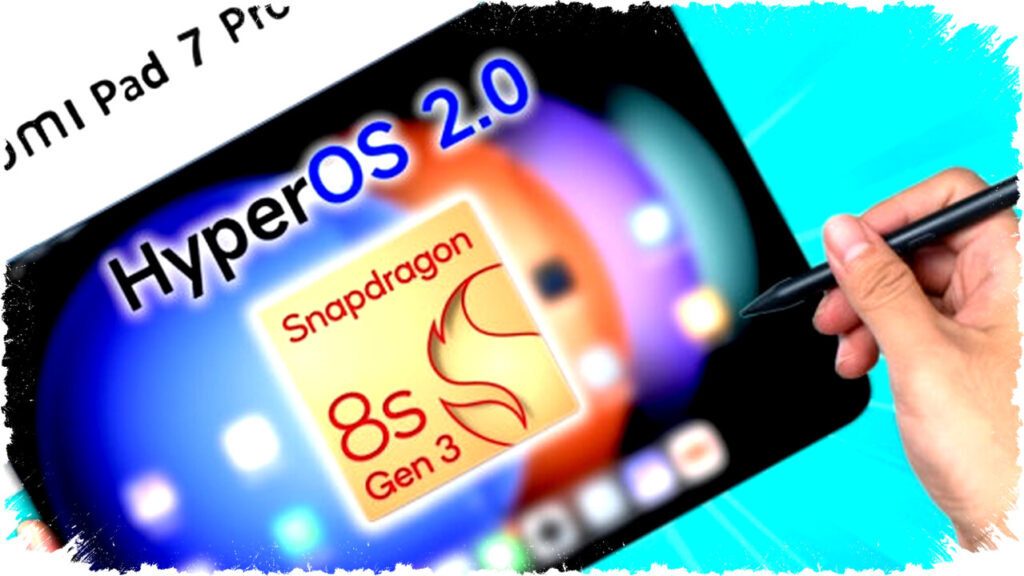
Xiaomi Pad 7 Pro introduces a new era for tablets by leveraging the powerful Snapdragon 8s Gen 3 chipset. This 4 nm octa-core processor runs at speeds up to 3.0 GHz, combined with a robust Adreno GPU that excels in handling demanding graphical tasks. The device achieves an impressive AnTuTu benchmark score of 1,534,057, indicating a 16% CPU improvement, 17% GPU boost, and a remarkable 42% increase in AI capabilities over its predecessor. These specifications clearly position the Xiaomi Pad 7 Pro beyond standard tablets and within the realm of devices capable of outperforming entry-level laptops.
Supporting the chipset is a generous 12 GB of LPDDR5X RAM and 512 GB of UFS 4.0 storage, ensuring lightning-fast data read-write speeds. This configuration allows users to effortlessly run multiple applications simultaneously without performance degradation. Xiaomi’s HyperOS 2 optimizes multitasking efficiency by about 10%, enhancing productivity for professionals who rely on smooth workflow transitions and resource-intensive applications.
Display Technology That Enhances Productivity
The Xiaomi Pad 7 Pro features an 11.2-inch display with a sharp resolution of 3200 x 2136 pixels, delivering a pixel density of 345 PPI. This ensures text and images appear crisp, which is essential for detailed work such as document editing, graphic design, or video editing. A 144 Hz adaptive refresh rate guarantees smooth visual transitions and responsive touch interactions, minimizing motion blur and latency.
Eye comfort has been prioritized through TÜV Rheinland certifications for low blue light, flicker-free display, and circadian rhythm protection. These features reduce visual fatigue during prolonged usage. The screen also reaches a peak brightness of 800 nits and supports HDR10 plus Dolby Vision, providing vivid colors and contrast suitable for both creative and multimedia tasks. For users frequently working outdoors, a matte glass option reduces reflections by 99% and ghosting by 65%, improving visibility under direct sunlight.
Battery Life and Fast Charging Tailored for Extended Use
Equipped with an 8,850 mAh battery, the Xiaomi Pad 7 Pro offers endurance capable of supporting nearly 20 hours of continuous video playback. Music playback can last up to 262 hours, providing extended usability for various media consumption scenarios. When the battery drains, its 67 W HyperCharge technology can fully recharge the device in under 80 minutes via a USB-C port.
This USB-C port supports USB 3.2 Gen 1 with transfer speeds of up to 5 Gbps, enabling quick file transfers—a vital feature for professionals managing large multimedia projects. Such efficient charging and transfer capabilities underline the device’s suitability for demanding work environments, matching—or even surpassing—some entry-level laptops in terms of convenience and uptime.
Connectivity and Ecosystem Integration for Modern Workflows
Xiaomi Pad 7 Pro supports Wi-Fi 7 with 2×2 MIMO and 8×8 sounding, delivering high throughput and low latency required for seamless remote collaboration, cloud computing, and streaming. Advanced Bluetooth codecs such as LDAC and LHDC 5.0 enhance wireless audio quality, important for virtual meetings and multimedia editing.
The device integrates well within the Xiaomi ecosystem through HyperConnect. This allows features like phone screen mirroring, NFC-based collaboration, and easy cross-device workflows. An IR remote control functionality also adds versatility by letting the tablet substitute various remote controls, streamlining workspace setups.
Design, Camera System, and Market Price
Crafted from an aluminum alloy unibody, the tablet measures 6.18 mm thick and weighs 500 grams, balancing portability with durability. It is offered in three colors: Gray, Blue, and Green, catering to different style preferences. The primary camera is a 50 MP sensor with f/1.8 aperture, phase detection autofocus (PDAF), and 4K video recording at 60fps—adequate for casual photography and documentation in professional contexts. The front camera is a 32 MP shooter supporting 1080p video and AI enhancements such as voice recognition and AI-powered utilities.
In Indonesia, the 12 GB RAM and 512 GB storage variant is priced approximately at $500 USD. This pricing places the Xiaomi Pad 7 Pro competitively within the professional tablet segment, especially considering its high-end hardware and advanced features.
Evaluating the Tablet vs. Entry-Level Laptop Performance
Entry-level laptops often face limitations in processing speed, graphics capability, and portability. The Xiaomi Pad 7 Pro, however, breaks these molds by delivering desktop-grade performance, a high-resolution display with excellent color accuracy, and long-lasting battery life. These factors make it a viable alternative to budget laptops for many professional use cases such as content creation, document processing, and media consumption.
Moreover, the adaptive refresh display combined with an optimized OS delivers interactions as fluid as laptop touchpads or external monitors. The integration of Wi-Fi 7 and fast data transfer options further blurs the line between tablet and laptop use.
Summary of Core Xiaomi Pad 7 Pro Features:
- Snapdragon 8s Gen 3 chipset with octa-core 3.0 GHz CPU and Adreno GPU.
- 12 GB LPDDR5X RAM and 512 GB UFS 4.0 storage.
- 11.2-inch 3200 x 2136 pixel display, 144 Hz adaptive refresh rate, HDR10, Dolby Vision.
- TÜV Rheinland certified for blue light and flicker reduction.
- 8,850 mAh battery with 67 W fast charging (full charge ~79 minutes).
- Wi-Fi 7 with 2×2 MIMO and Bluetooth advanced codecs.
- Aluminum alloy body, three color variants.
- 50 MP rear camera and 32 MP front camera with AI features.
- Price around $500 USD for high-end configuration.
The Xiaomi Pad 7 Pro proves that tablets can match or even exceed the performance and usability of entry-level laptops. With its combination of high-end hardware, quality display, and robust battery life, it enables professionals to accomplish tasks previously reserved for traditional laptops. This device sets a new standard, showing that modern tablets are not just consumption devices but powerful tools for serious work.