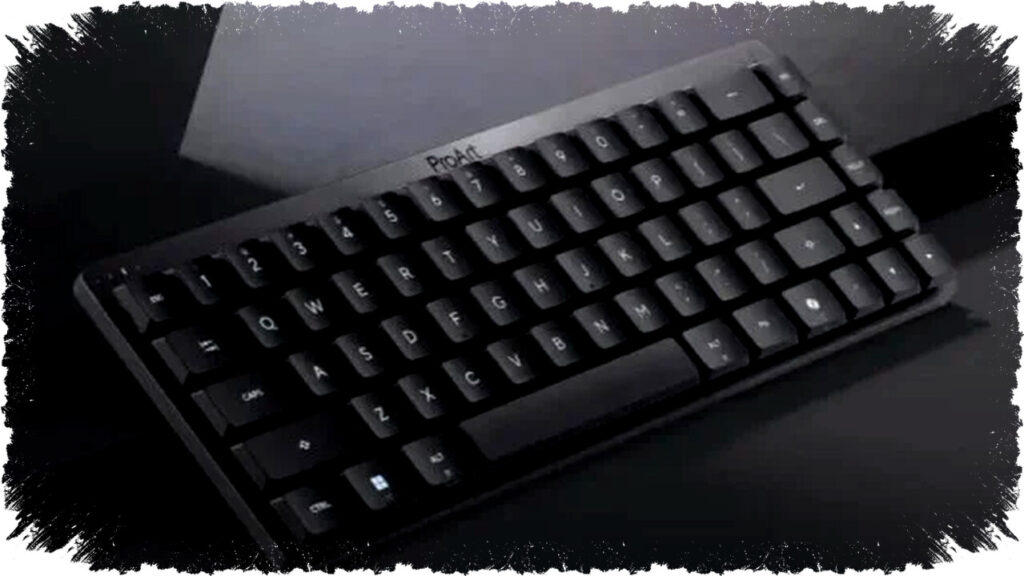
ASUS has introduced the ProArt KD300, a wireless keyboard that combines compact design with advanced features tailored for creative professionals. Targeted at designers, editors, and developers, this keyboard promises exceptional battery life alongside innovative input options, including a unique touch panel on its backside.
The ProArt KD300 adopts a 65% layout, a popular format that balances space-saving with functional completeness. Unlike smaller 60% keyboards, this layout retains essential keys such as arrow keys, Home, End, Page Up, Page Down, Delete, and Insert. This makes it particularly suitable for users who require precise document navigation, coding, or detailed editing without sacrificing desk space. Its compact size also enhances portability for digital nomads and professionals often on the move.
One of the standout features of the ProArt KD300 is its lithium 4,000 mAh battery, which ASUS claims can last up to 16 months under 2.4 GHz wireless mode without backlighting. This endurance far exceeds the average 3 to 6 months offered by most premium wireless keyboards. ASUS achieved this by optimizing firmware for power efficiency, employing low-power optical switches, and implementing intelligent sleep modes. Even when using Bluetooth connectivity or backlit keys, the battery life remains impressive compared to typical models. When depletion occurs, the keyboard supports USB Type-C charging and can function wired during charging, ensuring uninterrupted use.
ASUS equips the ProArt KD300 with its custom ASUS Red optical switches. These linear switches feature an actuation force ranging from 40 to 55 gf with 3.5 mm travel distance. They benefit from optical actuation technology, which eliminates metal contact to reduce latency and noise. This design makes extended typing sessions comfortable and quiet, ideal for writers, programmers, and editors working in shared or noise-sensitive spaces. Additionally, these switches are rated for up to 100 million keystrokes, offering greater durability and resistance to environmental factors such as dust and moisture.
Perhaps the most innovative aspect of the ProArt KD300 is the touch panel integrated on the back of the keyboard body. This multi-functional panel is configurable via the Gear Link web app to serve various productivity roles. Users can control media playback, adjust system volume and screen brightness, scroll documents with finger gestures, perform simulated mouse clicks, and assign custom shortcuts for software like Adobe Photoshop or Premiere. Video editors can use the panel as a timeline scrubber, graphic designers as a scrolling tool, and developers for quick tab navigation. This feature transforms the keyboard into a versatile control hub rather than a simple typing device.
Connectivity options on the ProArt KD300 are flexible, supporting three modes:
1. 2.4 GHz wireless via a USB dongle for ultra-low latency suitable for real-time tasks.
2. Bluetooth 5.3 capable of maintaining connections with up to three devices, enhancing multitasking convenience.
3. Wired connection through USB Type-C for stable connections without battery concerns.
Switching between these modes is streamlined through shortcut key combinations, allowing seamless transitions between laptops, tablets, and smartphones without swapping cables.
Priced at approximately 999 yuan (around $140 USD), the ProArt KD300 is currently available in China through official ASUS outlets and e-commerce platforms. Although a global release timeline has not been officially announced, market availability outside China is expected by early 2026. Its price point positions it competitively against products like the Keychron Q Pro, Logitech MX Mechanical, and Razer BlackWidow V3 Mini. However, the KD300’s combination of a long-lasting battery and the innovative rear touch panel differentiates it in the premium wireless keyboard segment.
In summary, the ASUS ProArt KD300 highlights a shift towards integrating advanced, productivity-enhancing features in compact peripherals aimed at creative professionals. Its balance of durability, ergonomic design, advanced optical switches, and a customizable touch interface reflects ASUS’ strategic focus on the professional creative market. This keyboard offers an attractive option for users seeking reliability, efficiency, and novel interaction methods in their workflow tools.