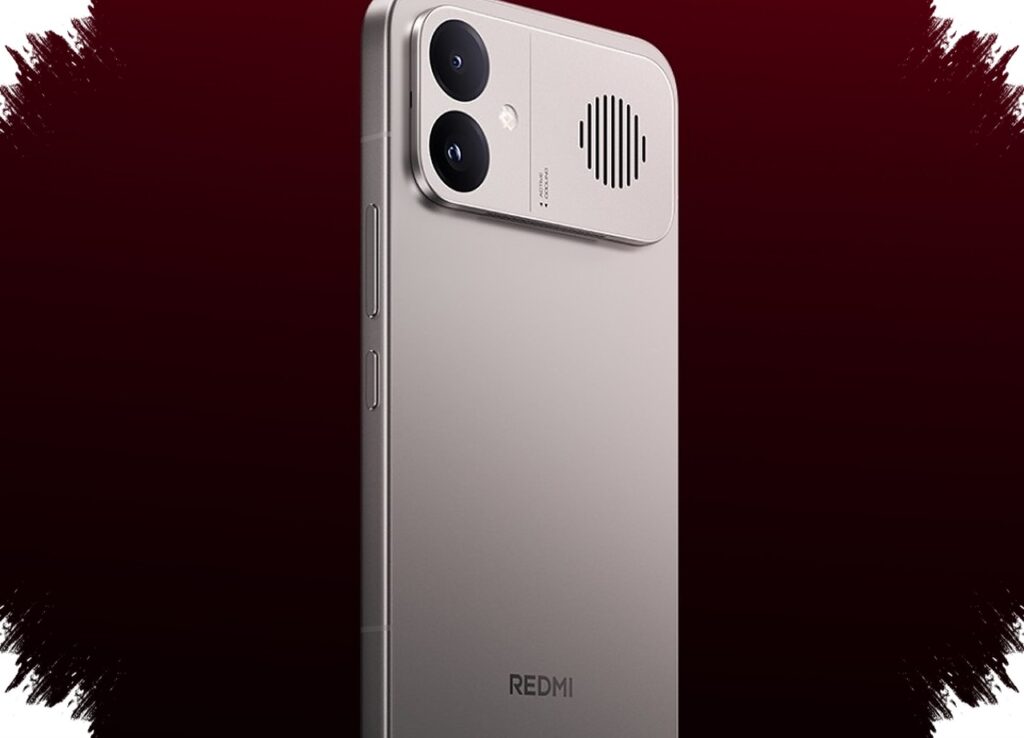
Redmi has started building momentum around its next performance-focused phone, and the first official teasers leave little doubt about the direction it is taking. The Redmi K90 Max is shaping up to be a bold device aimed at gamers and power users, with an unusual active cooling setup, a futuristic rear design, and a 165Hz display that signals speed from the moment the screen lights up.
The company has not revealed everything yet, but the early details already make the phone stand out in a crowded flagship market. Based on Redmi’s own teaser shared in China, the K90 Max appears to mix aggressive gaming-style hardware with a more refined industrial design, and that combination could help it attract buyers looking for more than just raw specs.
A design that looks ready for performance
Redmi’s official render shows a rear panel that does not follow the usual smartphone formula. The camera module is shaped like a rectangular island, but the layout inside it is what grabs attention first. The left side holds a dual-camera setup, while the right side houses the active cooling fan, a feature more often associated with dedicated gaming phones than mainstream models.
The phone is shown in a “Space Silver” finish, which gives it a clean but high-tech look. The frame uses an aluminum alloy, and Redmi has paired it with ultra-thin bezels and subtle grille-like detailing on the body, creating a device that looks engineered rather than decorated. The side profile appears relatively slim, although the camera bump remains prominent, much like earlier K-series performance models.
Active cooling becomes the headline feature
The most important hardware story on the Redmi K90 Max is its built-in cooling system. Redmi says it has developed a new airflow mechanism with an internal fan that is 6% larger than conventional solutions, a claim that suggests the company wants to push sustained performance rather than only peak benchmark numbers.
The fan uses forward-leaning blades and a vertical air channel to improve circulation inside the phone. Redmi also claims the system remains quiet, with noise levels of about 32dB at full speed, which is low enough that it should not become distracting in everyday use. That matters because active cooling often brings concerns about noise, dust, and durability, especially in a phone that is not positioned purely as a niche gaming device.
What Redmi is promising for durability
Redmi is also trying to reassure users that the cooling system will not come at the expense of toughness. The K90 Max is said to carry IP66, IP68, and IP69 certifications, which point to strong protection against dust and water exposure.
The company has also claimed that the cooling-related component can last up to 50,000 hours and comes with a six-year warranty for the metal bearing system. Redmi even says it will provide lifetime cleaning and maintenance support for the cooling system, which is a notable promise if it reaches consumers in the final retail package.
Why the 165Hz display matters
The other major selling point is the display refresh rate. Redmi has confirmed that the K90 Max will feature a 165Hz screen, a specification that immediately puts it in the territory of high-end gaming-focused phones.
A higher refresh rate can make scrolling feel smoother and gameplay look more responsive, especially in fast-moving titles. For gamers, the target is not only visual fluidity but also input responsiveness, and Redmi appears to be aiming at that exact audience with this panel.
Here is a simple breakdown of the key confirmed and reported points so far:
- 165Hz display for high-refresh gaming and smoother navigation.
- Active cooling fan built into the rear body.
- Aluminum alloy frame with a futuristic silver variant.
- IP66, IP68, and IP69 protection ratings.
- Quiet cooling operation claimed at around 32dB.
- Lifetime cooling-system maintenance support, according to Redmi.
A phone built for a specific audience
The Redmi K90 Max is not trying to look like a standard all-purpose flagship. It looks designed for users who care about heat management, sustained frame rates, and a display that can keep up with demanding games and fast-touch interactions.
That approach also reflects a broader trend in the smartphone market, where brands are trying to differentiate premium devices not only through camera hardware and chipset power, but also through thermal design and screen technology. In that sense, Redmi’s teaser is strategic, because it positions the K90 Max as a phone with mechanical personality, not just a spec sheet.
What is still missing before launch
Even with the official teaser out, Redmi has kept several major details under wraps. The chipset has not been confirmed, and the camera specifications remain undisclosed for now.
Previous reports suggest the phone will sit in Redmi’s high-performance lineup, and some industry chatter points to a possible global rebrand as the Xiaomi 17T in select markets, including India. That detail is still unconfirmed, but it would fit Xiaomi’s history of using different names for similar hardware across regions.
Redmi has also teased another device alongside the phone, the Redmi K Pad 2, which is expected to use the Dimensity 9500 chip and an 8.8-inch 165Hz display, but the K90 Max remains the more eye-catching product thanks to its active cooling fan and more dramatic design language. For now, the next update from Redmi is likely to bring the missing core specifications, and that will tell whether the K90 Max is simply a striking concept made real or a genuinely new benchmark for performance-first smartphones.