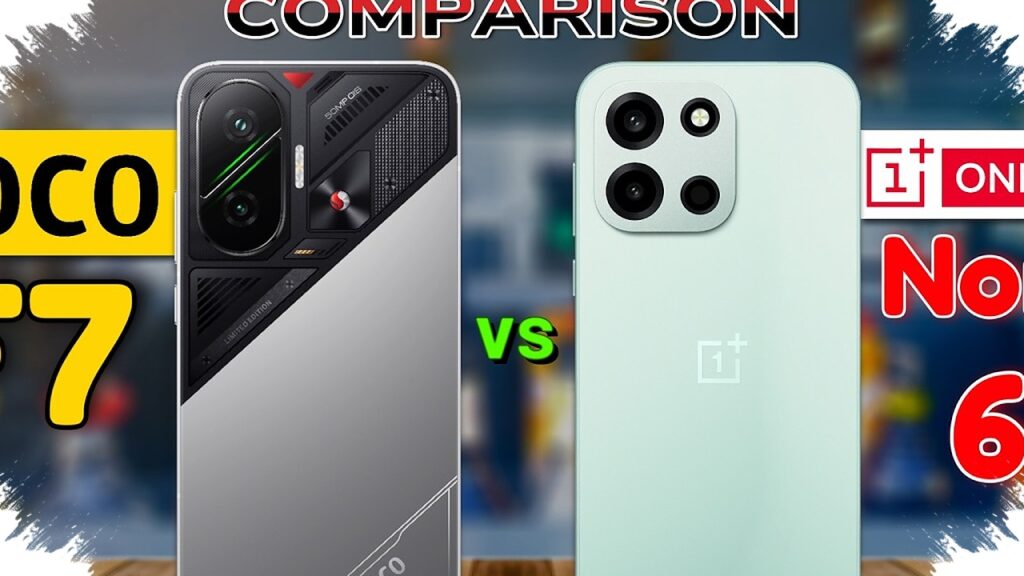
The gap between OnePlus Nord 6 and Poco F7 is not only about price. It also changes what matters most to a buyer, because both phones share the Snapdragon 8s Gen 4, Adreno 825 GPU, and UFS 4.1 storage, yet they target daily use in noticeably different ways.
That difference becomes clearer once the comparison moves beyond raw performance. One model leans on premium styling and fast charging, while the other tries to justify a higher price with stronger durability, a faster display, and a more capable selfie camera.
A split between appearance and toughness
Poco F7 goes first on visual appeal. Its aluminum frame and dual-glass body give it a more premium feel in hand, which makes it easy to understand why it grabs attention quickly.
Nord 6 chooses a more practical build. It uses a plastic frame and back, but it adds IP68 and IP69K certification, giving it stronger protection against dust, water, and even high-pressure water jets.
The display is where daily use feels most different
Nord 6 stands out with a 165Hz AMOLED panel. It also reaches a peak brightness of 3600 nits and supports HDR10+, so the screen should feel very smooth and remain readable outdoors.
Poco F7 answers with Dolby Vision support. That makes it appealing for users who care about video playback, since movies and series can look more cinematic and visually rich on the device.
Shared chipset, different software character
Because both phones use the same chipset, their core performance is expected to be evenly matched. Heavy games such as Genshin Impact and Call of Duty: Mobile are described as running smoothly on both devices with similar results.
The software experience sets them apart instead. OxygenOS 16 on the Nord 6 is described as cleaner, more minimal, and more stable, while HyperOS 2 on the Poco F7 offers more features but can feel heavier after months of use.
Battery life versus speed at the charger
Nord 6 pushes its advantage in endurance. It is said to last up to two full days for heavy users, which makes it more suitable for long schedules and people who do not want to keep searching for a charger.
Poco F7 takes the opposite route by focusing on very fast charging. It can go from 0 to 100 percent in around 35 minutes, which is practical for users who need a quick top-up before leaving.
The camera difference is sharper at the front
On the rear camera side, Poco F7 uses an f/1.5 aperture that helps it capture more light. The output is said to look brighter and more contrasty, although the AI processing can sometimes feel aggressive.
Nord 6 uses an f/1.8 aperture and aims for a more natural look. Its photos are described as having subtler detail, which may suit users who prefer a calmer and more flexible image style.
The biggest gap appears in the selfie setup. Nord 6 brings a 32MP front camera and 4K recording, while Poco F7 uses a 20MP front camera with a 1080p recording limit.
The price gap changes the buying logic
Nord 6 is priced at around ~US$460, or around Rp7 juta. Poco F7 sits at around ~US$350, or around Rp5,3 juta, leaving a difference of about Rp1,7 juta.
That gap makes Poco F7 look like the stronger value choice on paper. It delivers a premium design and flagship-level performance for less money, which is hard to ignore in the mid-to-upper class segment.
Nord 6 still has its own argument. It asks for more money, but it responds with longer battery life, a 165Hz display, 4K selfie recording, and tougher body protection.
For buyers who prioritize style, fast charging, and a lower entry price, Poco F7 remains the easier pick. For users who need stronger durability, smoother screen performance, longer endurance, and a more serious front camera, Nord 6 offers the more practical direction.