


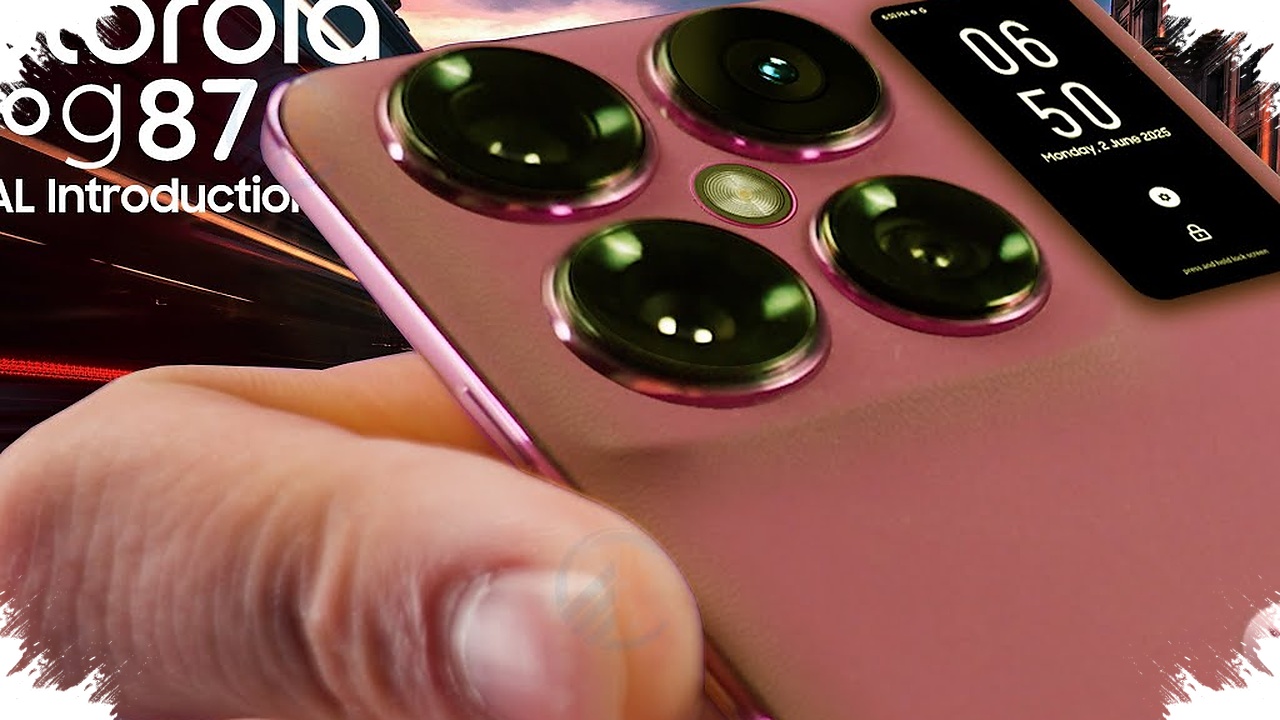
Motorola’s Moto G87 arrives with a specification mix that is hard to ignore. The phone pairs a 200 MP main camera with an AMOLED display that reaches a claimed peak brightness of 5,000 nits, while also putting durability and battery life into the spotlight.
That combination makes the device stand out in the midrange segment, but one detail keeps it from looking like a pure upgrade. The chipset moves down compared with its predecessor, so the G87 does not deliver a full leap forward across every area.
A camera setup built around 200 MP
The biggest headline on the Moto G87 is its 200 MP main camera with an f/1.8 aperture, OIS, and 2x lossless zoom. Motorola is clearly positioning imaging as the phone’s strongest selling point, especially since the Moto G86 used a 50 MP primary sensor.
On paper, the jump looks substantial and places the G87 among the more aggressive midrange models in terms of camera resolution. Motorola also includes Ultra Pixel technology, which is said to improve light sensitivity by up to 16 times to help in low-light scenes.
The rear camera system is completed by an 8 MP ultrawide camera. For selfies, the phone offers a 32 MP front camera, along with Pro mode, live filters, and AI-based editing tools through Google Photos.
A brighter AMOLED panel for outdoor use
The display is another area where Motorola has pushed the hardware forward. Moto G87 uses a 6.78-inch AMOLED panel with 1.5K resolution and a 120 Hz refresh rate, aiming for a sharp and smooth viewing experience.
Motorola says the panel is the brightest in the Moto G family, with peak brightness reaching 5,000 nits. That is a notable increase over the Moto G86, which was claimed to reach 4,500 nits, making the newer model better suited to bright outdoor conditions.
The screen is also protected by Gorilla Glass 7i. That adds an extra layer of reassurance to a large display that is clearly one of the device’s main attractions.
Performance takes a step back
The most debated change sits in the performance section. Moto G87 uses MediaTek’s Dimensity 6400 built on a 6 nm process, while the previous model came with the Dimensity 7300 on 4 nm.
Both chipsets are said to reach CPU speeds of up to 2.5 GHz, but the shift to a lower-generation platform remains a clear note of caution. As a result, the camera and display upgrades are not matched by an equivalent improvement in raw performance.
Motorola does keep memory options generous. The phone offers up to 12 GB of RAM and 256 GB of internal storage, and it also includes a microSD slot for expansion of up to 2 TB.
Battery life and durability stay front and center
Moto G87 also aims to appeal to users who want a phone that can last through heavy daily use. It comes with a 5,200 mAh battery and supports 30-watt fast charging, which fits well with its large screen and high-resolution imaging focus.
Durability is another major part of the package. The phone carries IP66, IP68, and IP69 ratings, alongside MIL-STD 810H military-grade certification, reinforcing Motorola’s claims about resistance in a variety of usage conditions.
Software, audio, and market availability
The device runs Android 16 out of the box and includes Bluetooth 5.4, NFC, WiFi 5, dual SIM support, a fingerprint sensor, and stereo speakers. Motorola says the stereo speaker system is 280 percent more powerful than the previous generation, so audio is also part of the upgrade story.
Moto G87 comes in two Pantone color options, Blue Atoll and Overture. In Europe, pricing starts at 399 euro, and Motorola is also preparing to bring the phone to regions including the Middle East, Turkey, and Africa.
With a 200 MP camera, a 5,000 nits AMOLED display, a large battery, and an unusually complete durability package, Moto G87 enters the midrange class with strong hardware appeal. The trade-off is just as clear, because the Dimensity 6400 gives the phone a performance step down that keeps its overall proposition from being an across-the-board upgrade.