


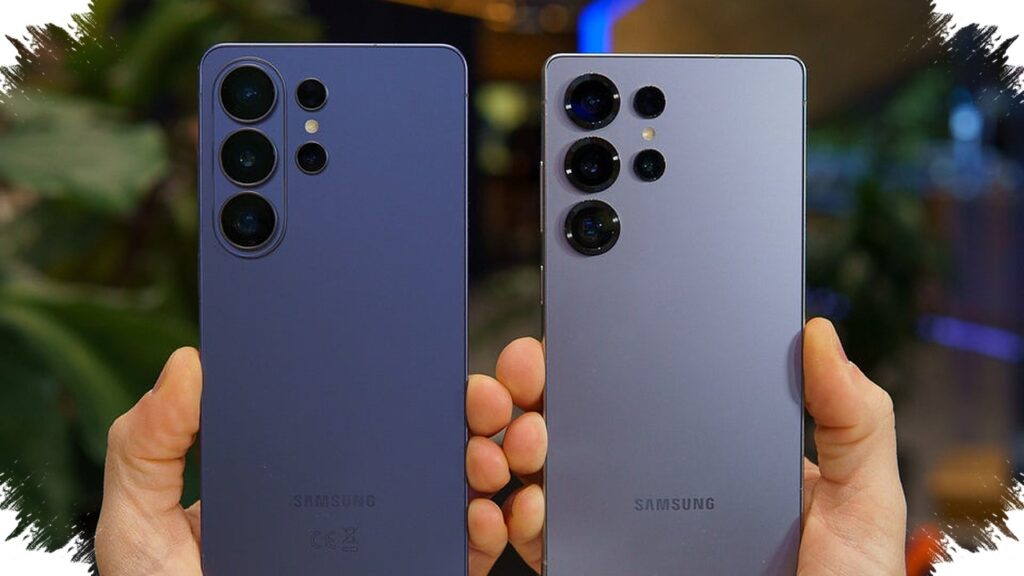
For shoppers weighing Samsung’s newest compact flagship against last year’s model, the Galaxy S26 does not create a clear-cut upgrade case. The newer phone improves several key areas, but the overall experience remains close enough to the Galaxy S25 that price may end up mattering more than the spec sheet.
That is why the roughly €150/$150 gap becomes so important. The Galaxy S26 is ahead in battery life, charging speed, performance, speakers, and the selfie camera, yet the Galaxy S25 still looks like the more sensible purchase for buyers who care about value and are satisfied with mostly similar everyday results.
Battery life is where the newer model opens the most visible gap
The Galaxy S26 comes with a 4,300 mAh battery, up from 4,000 mAh on the Galaxy S25. That change has a real effect on endurance, especially during heavier use such as browsing and video streaming.
In testing, the two phones were closely matched for calls and gaming. The Galaxy S26 then pulled ahead more clearly in web browsing and video playback, although the difference was still not large enough to change the overall character of the device.
Charging also favors the newer phone, even though both support 25W wired charging through Power Delivery. The Galaxy S26 reached 34 percent after 15 minutes and 62 percent after 30 minutes, while the Galaxy S25 hit 28 percent and 56 percent at the same checkpoints.
A full charge took 64 minutes on the Galaxy S26 and 77 minutes on the Galaxy S25. That gives the newer model a practical advantage in daily use, even if the charging standard itself looks unchanged on paper.
The performance lead exists, but it is not a dramatic one
Samsung’s chip strategy is one of the biggest differences between the two phones. The Galaxy S25 uses the Snapdragon 8 Elite for Galaxy worldwide, while the Galaxy S26 again splits the lineup by market.
In Europe and South Korea, the Galaxy S26 uses Exynos 2600. In the US, China, and Japan, Samsung equips the Galaxy S26 series with Snapdragon 8 Elite Gen 5 for Galaxy.
The Exynos 2600 is built on a 2nm process and uses the AMD-designed Xclipse 960 GPU. By contrast, the Snapdragon 8 Elite uses a 3nm process and the Adreno 830 GPU.
Benchmark numbers place the Galaxy S26 ahead, but only by a moderate margin. It scored 2,441,481 in AnTuTu 10, 10,824 in Geekbench 6, and 7,230 in 3DMark Wild Life. The Galaxy S25 recorded 2,193,701, 10,050, and 6,703 in the same tests.
That translates to gains of about 8 percent in Geekbench 6, 8 percent in 3DMark Wild Life Extreme, and 11 percent in AnTuTu 10. Both phones also come with 12GB of RAM.
Storage is another small but relevant difference. The Galaxy S25 starts at 128GB, while the Galaxy S26 in many markets begins at 256GB, although a 128GB version still exists in limited availability.
Design and display changes stay subtle
Visually, the two phones are very close. Both use Gorilla Glass Victus 2 on the front and back, along with an Aluminum Armor 2 frame.
The Galaxy S26 is slightly larger at 149.6 x 71.7 x 7.2 mm and 167 grams. The Galaxy S25 measures 146.9 x 70.5 x 7.2 mm and weighs 162 grams.
Most of that difference comes from the slightly bigger screen on the newer model. Even so, the gap is only 0.1 inch, which is easy to miss in real-world use.
The Galaxy S26 uses a 6.3-inch LTPO OLED display with a 120Hz refresh rate, 1080 x 2340 resolution, and 1,383 nits of brightness. The Galaxy S25 uses a 6.2-inch LTPO OLED panel with the same refresh rate and resolution, but a measured brightness of 1,395 nits.
In practice, display quality is nearly the same. The S26 has 411 ppi, while the S25 reaches 416 ppi, making the difference too small to matter for most users.
Cameras stay close on the back, while the selfie camera gets the clearest update
Samsung did not overhaul the rear camera system on the Galaxy S26. The main camera remains a 50MP unit with a 1/1.56-inch sensor, a 23mm-equivalent lens, and stabilization.
The telephoto camera still uses the 3K1 sensor, and the ultrawide camera continues with a 1/2.55-inch RGB sensor without autofocus. In daylight photos, the two phones produce very similar results, though the Galaxy S26 tends to show warmer colors and slightly smoother detail.
At 2x and 3x zoom, the quality gap remains small. The ultrawide camera is also closely matched in daytime shooting.
Low-light performance does not produce a clear winner either. The Galaxy S26 uses a new processing approach without an immediately available dedicated night mode, while the Galaxy S25 is described as a bit more dependable in some situations.
The most noticeable camera upgrade appears on the front. The Galaxy S26 uses a wider 23mm-equivalent selfie lens, compared with the 25-26mm range on the older model. That makes it sharper and more flexible for front-facing shots.
Video, audio, and charging accessories round out the comparison
Video capabilities are broadly similar. Both phones support 4K60 on all cameras, 8K30 on the rear main camera, and equally capable Pro video modes.
The Galaxy S26 adds Horizon lock stabilization and LUTs for real-time preview when recording in Log. In daylight video, the two phones look almost identical. At night, the Galaxy S26 has the edge on ultrawide, while the Galaxy S25 performs better at 3x.
Speaker performance tilts in favor of the Galaxy S26 as well, even though it is slightly quieter than the Galaxy S25. Its output is described as fuller, with stronger bass and clear vocals.
Both phones support wireless charging up to 15W through Qi2. For magnetic wireless charging accessories, both still require a magnetic case.