


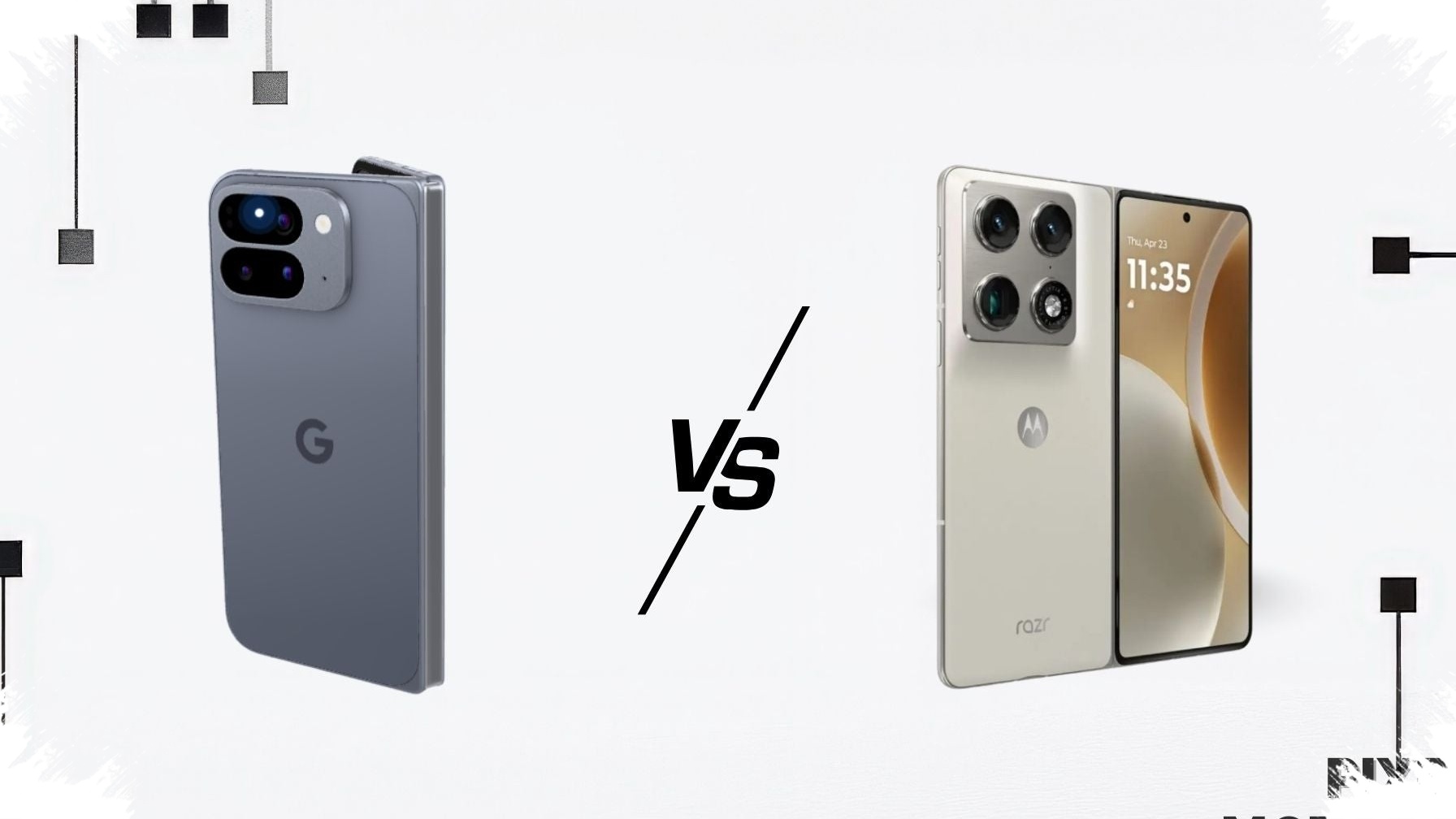
Motorola’s Razr Fold enters the book-style foldable race with a package that immediately forces the Pixel 10 Pro Fold onto the defensive. It is thinner, lighter, faster on paper, and armed with a larger battery and a more ambitious camera setup, making it one of the most serious challengers to Google’s premium foldable yet.
That pressure matters because the book-style foldable market has still felt relatively narrow. Motorola is not just adding another option; it is trying to win buyers with raw specifications while Google leans on stronger durability and a more established software reputation.
A slimmer body, but Google keeps the durability edge
The Razr Fold measures 4.55 mm when open and 9.89 mm when folded, with a weight of 243 grams. The Pixel 10 Pro Fold is slightly thicker and heavier at 5.2 mm unfolded, 10.8 mm folded, and 258 grams, so Motorola clearly has the advantage in pocketability and hand feel.
Google still holds an important advantage in protection. The Pixel 10 Pro Fold is the first foldable to carry an IP68 rating for dust and water resistance, while the Razr Fold comes with IP48/IP49 certification.
Motorola’s water protection remains strong, but its dust resistance does not match Google’s. Google has also redesigned the hinge on the Pixel 10 Pro Fold to improve durability, and that change helped make room for a 6.4-inch cover display.
Big, bright displays give Motorola a strong opening
Motorola equips the Razr Fold with a 6.6-inch pOLED outer screen and an 8.1-inch 2K OLED foldable main display. The cover panel supports a 165Hz refresh rate, while the inner display runs at 120Hz, and both use 10-bit technology.
Brightness is another area where Motorola pushes hard. The outer screen reaches 6,000 nits at peak brightness, while the foldable panel climbs to around 6,200 nits, which is far above the Pixel 10 Pro Fold’s roughly 3,000-nit displays.
Google’s panels are still described as comfortable in direct sunlight, and the Pixel 10 Pro Fold uses Gorilla Glass Victus 2 on the cover screen. Motorola counters with Gorilla Glass Ceramic 3 on the outer display and adds a stylus option through the Moto Pen Ultra, sold separately for $99.
Performance and battery tilt the matchup toward Qualcomm
Inside the Razr Fold is Snapdragon 8 Gen 5, paired with 16GB of LPDDR5X RAM and 512GB of storage. The Pixel 10 Pro Fold uses Tensor G5 with 16GB of RAM and storage choices of 256GB, 512GB, and 1TB.
That difference gives Motorola the stronger theoretical edge for heavy multitasking, gaming, and demanding apps. Tensor G5 is faster than its predecessor, but it still does not reach Snapdragon’s level in this class.
Battery capacity adds more separation. The Razr Fold carries a 6,000mAh battery, while the Pixel 10 Pro Fold uses a 5,015mAh unit.
Charging is also faster on Motorola’s side. The Razr Fold supports 80W TurboPower wired charging and 50W wireless charging, compared with the Pixel 10 Pro Fold’s 30W wired charging.
Google does retain one notable charging advantage. The Pixel 10 Pro Fold supports Pixelsnap Qi2 with full magnets for chargers and accessories, a feature the Razr Fold does not offer.
Cameras look more aggressive on Motorola’s spec sheet
Motorola outfits the Razr Fold with three 50MP rear cameras. The setup includes a 50MP Sony LYTIA main camera, a 50MP telephoto lens with 3x optical zoom, and a 50MP ultrawide camera with autofocus.
The Pixel 10 Pro Fold takes a more modest approach in raw numbers with a 48MP main camera, a 10.8MP telephoto, and a 10.5MP ultrawide. Motorola also looks stronger on the front, with a 32MP camera on the cover screen and a 20MP camera on the inner display, while Google uses 10MP cameras on both sides.
Still, Google’s image processing remains a major factor. The Pixel 10 Pro Fold also offers 5x optical zoom, which may produce better zoom results than Motorola’s 3x telephoto despite the lower-resolution hardware.
Software parity on paper, but trust still matters
Both phones run Android 16 and are promised seven years of OS updates. That makes this an important moment for Motorola, which is matching Google’s long-term update commitment for the first time.
The open question is timing and consistency. Google is still more trusted for day-one updates and for a software experience that tends to feel more polished and predictable.
Pixel buyers also get Google’s AI features and regular Pixel Drop updates. Motorola responds with Hello UX and flexible layouts, including Laptop Mode when the device is half-open on a desk for typing with a split on-screen keyboard.
Pricing keeps the gap close
Motorola lists the Razr Fold at $1,899.99 for the 16GB/512GB model. Google prices the Pixel 10 Pro Fold 512GB version at $1,919, although it also offers 256GB and 1TB options, giving it a wider spread of entry points.
Motorola arrives with a very strong first impression for a new entrant, especially in design, displays, performance, battery life, and camera hardware. Google still answers with IP68 protection, Qi2 magnetic support, and a software experience that remains easier to trust over time.