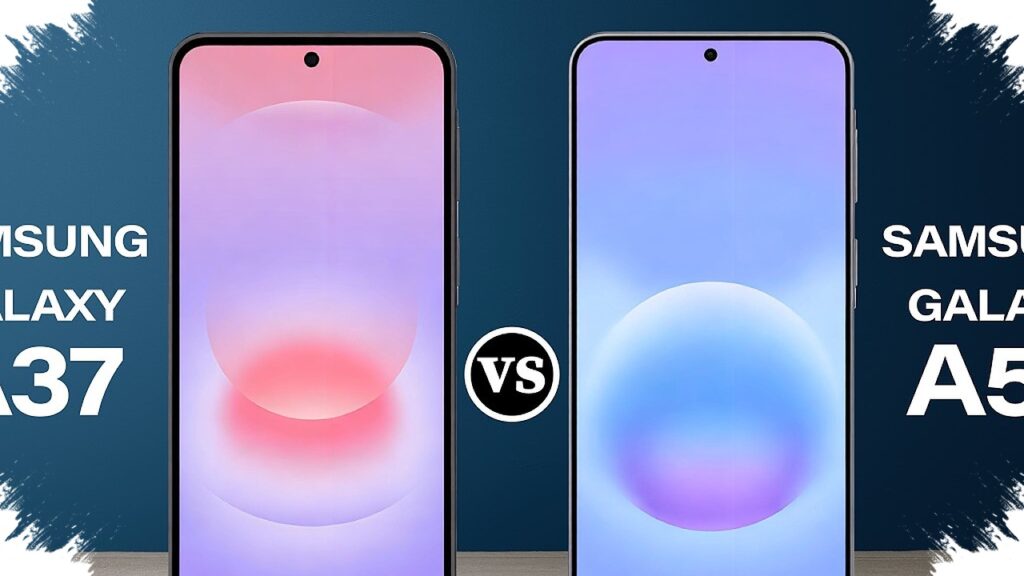
Samsung’s latest midrange pair, the Galaxy A57 and Galaxy A37, puts buyers in a familiar dilemma: save money or pay more for the premium model. The price gap stands at €100, or about Rp1.7 million in estimate, with the Galaxy A57 set at €480 and the Galaxy A37 at €380.
At first glance, both phones look closely related, but the A57 clearly aims for a more upscale feel. Samsung gives it Gorilla Glass Victus+ on the front and back, plus an aluminum frame, while the A37 uses plastic for the frame and rear panel.
Design and in-hand feel
The physical difference is not only about materials, but also about the way each phone sits in the hand. The Galaxy A57 feels lighter and slimmer, which makes it easier to hold for longer use.
Samsung also equips the A57 with a 6.7-inch Super AMOLED Plus display, which helps reduce the bezels. The A37 uses a standard Super AMOLED panel, so the visual gap is not dramatic, but the premium model does look more refined.
Display quality: close, but not equal
On paper, the two screens share a lot in common. Both can reach a peak brightness of 1,250 nits, so outdoor visibility should remain strong on either device.
The A57 still holds a technical edge because its RGB subpixel arrangement can produce sharper output in theory. In everyday use, however, that difference is difficult to spot with the naked eye, especially when compared with the Diamond Pentile layout on the A37.
Performance is where the gap widens
The clearest reason to choose the Galaxy A57 is performance. It runs on the Exynos 1680 built on a 4nm process, and Samsung claims a 12.5 percent CPU improvement along with a 70 percent graphics boost in benchmark testing.
That puts the A57 in a much stronger position for heavy apps and demanding games. The A37 uses the older Exynos 1480, and its base version comes with 6GB of RAM, which can make day-to-day use feel less smooth at times.
The A57 starts with 8GB of RAM, and that extra memory helps multitasking stay more stable. Apps are less likely to close in the background, which matters for users who jump between messaging, browsing, and productivity tasks.
Camera differences matter in specific use cases
Both phones share a 1/1.56-inch main camera sensor, so daylight photos should look solid on either model. The separation becomes clearer on the ultrawide camera, where the A57 uses a 12MP sensor with a wider field of view.
The A57 also supports 4K video recording on the ultrawide camera, while the A37 does not offer that feature. For users who care about more flexible video capture, that is a meaningful upgrade.
Battery and charging stay evenly matched
Samsung does not separate the two models on battery hardware. Both the Galaxy A57 and Galaxy A37 carry a 5,000 mAh battery and support 45W fast charging.
Testing shows similar endurance for both phones, and both need around 70 minutes to charge from empty to full. That means buyers do not need to pay extra just to get better battery life.
Audio and connectivity add smaller differences
Sound output gives the A37 a slight advantage in volume, but the A57 delivers fuller and richer audio. That makes the premium model a better fit for users who value texture and depth in music playback.
The A57 also gets more modern connectivity with Wi-Fi 6E. For buyers who want a more future-ready package, that adds another point in its favor.
In practical terms, the Galaxy A57 looks like the better-rounded phone because it combines stronger performance, lighter design, premium materials, and a more capable feature set. The Galaxy A37 still makes sense for users who want the core Samsung experience at a lower price and can live without gaming power, advanced materials, or the extra camera and connectivity upgrades.