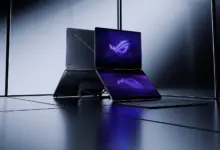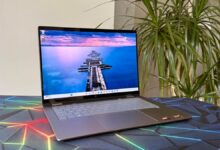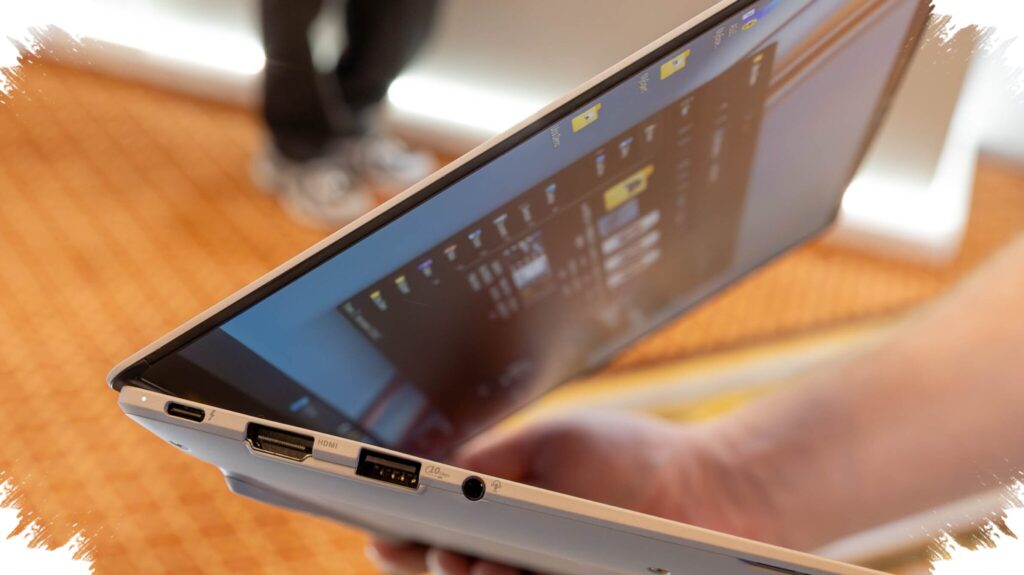
A business laptop weighing just 0.99 kg does not usually invite dramatic treatment. Asus ExpertBook Ultra does, because its thin chassis was shown surviving being dropped, splashed with water, and pressed under as much as 100 kg during its launch event in Jakarta.
That durability is not the result of a single protective layer. Asus built the device with reinforced materials, a strengthened internal frame, and a series of tests that go far beyond ordinary daily use.
A tougher surface than its size suggests
The outer shell of ExpertBook Ultra uses nano-ceramic technology created through a Plasma Electrolytic Oxidation, or PEO, process. That process forms a hard oxide layer on the laptop body that Asus says feels similar to ceramic.
Asus rates the surface hardness at 9H. The company says this makes it five times more scratch-resistant than the 3H industry standard, which helps the body withstand friction during heavy use.
The coating was also put through more than 60,000 hand-pressure cycles. That testing is meant to show the surface can handle repeated contact without wearing down quickly.
Internal reinforcement without adding bulk
The strength story does not stop at the exterior. Inside the device, Asus uses an AZ31B magnesium-aluminum frame to maintain structural rigidity without making the laptop heavier.
The material is widely known in aerospace and Formula 1 applications because of its efficient strength-to-weight ratio. Asus says this choice helps the device become 34% lighter while preserving body integrity.
That approach allows ExpertBook Ultra to stay thin while still being positioned for high-mobility work. It is designed for users who need a light machine that does not feel fragile in transit.
Protection also extends to the screen, ports, and keyboard
The display receives special treatment as well. ExpertBook Ultra uses a Tandem OLED panel that Asus describes as very bright, and it is protected by Gorilla Glass Victus.
That screen protection is said to withstand pressure of up to 100 kg, matching the high-pressure demonstration shown at launch. Asus also reinforces the I/O port area with thick metal protection so the motherboard is less vulnerable if a cable is pulled forcefully.
The keyboard is built to handle liquid spills too. Asus designed drainage paths to direct fluid away from sensitive components, which matters for people who often work quickly and move between locations.
Built to pass demanding endurance checks
ExpertBook Ultra is not only supported by materials and design choices. It has also passed 24 MIL-STD-810H certification procedures covering 11 test categories.
Those tests include operation at extreme altitude up to 15,000 feet. The laptop was also tested against temperature shocks ranging from -51 degrees Celsius to 60 degrees Celsius within a matter of hours.
Asus says the device went through 18 hard physical shocks as part of the process. That kind of validation is aimed at ensuring reliability when the laptop is used for business travel or in less-than-ideal working conditions.
Beyond military certification, Asus also carried out 157 internal tests. These checks focused on parts most likely to wear out in real-world use rather than only extreme scenarios.
The hinge was tested through 50,000 extreme open-close cycles. The C-part went through 60,000 wool-rub cycles, while the keyboard keycaps were tested with 250,000 rubs.
Thin, light, and still built for confidence
Despite all of that reinforcement, the laptop remains compact. ExpertBook Ultra measures 10.9 mm thick and weighs 0.99 kg.
Asus also claims it as the world’s smallest-footprint 14-inch laptop. That positioning reflects a clear focus on professionals who want strong mobility without giving up confidence against impact, pressure, or spills.
The appeal of ExpertBook Ultra lies in its layered approach to toughness. Asus strengthened the exterior, internal frame, display, keyboard, and ports, then pushed the device through military-level and internal testing to match its slim design with durability.
Source: inet.detik.com