


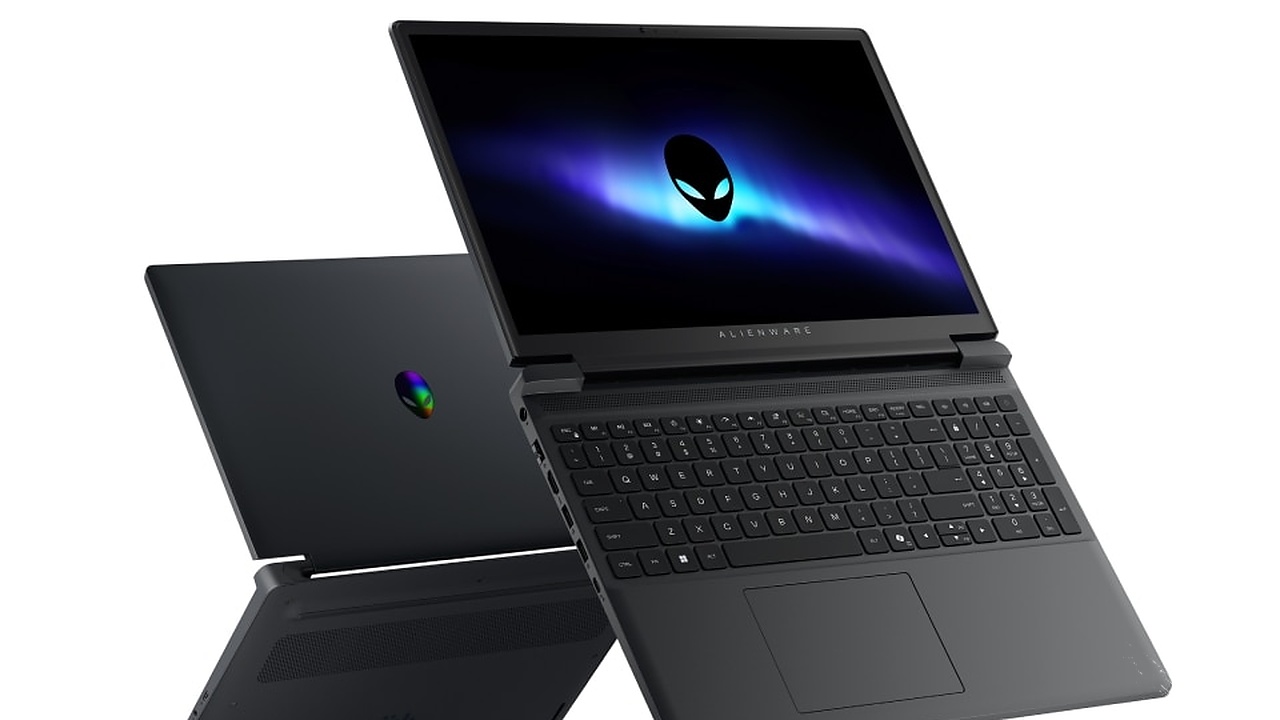
Dell’s newest laptop push splits clearly into two directions: a smaller Alienware model for gamers, and two AI-focused Dell notebooks for everyday work. The lineup shows that portability, on-device intelligence, and display quality are now being treated as equally important selling points.
Among the three, Alienware 15 stands out as the compact gaming option. It uses a 15.3-inch WUXGA panel with a 165Hz refresh rate, but Dell still positions it for serious modern gaming rather than casual play.
A smaller Alienware, but still built for demanding games
Alienware 15 comes with several processor choices, including AMD Ryzen 7 260 or Ryzen 5 220, as well as Intel Core 7 240H or Core 5 210H. For graphics, Dell offers NVIDIA GeForce RTX 5060, RTX 5050, or RTX 4050, all with DLSS support.
The laptop also reaches up to 110W TPP and supports up to 32GB DDR5 5,600MT/s memory through two user-accessible SO-DIMM slots. Storage is handled by a 1TB PCIe Gen 4 NVMe SSD that users can replace.
Dell adds Cryo-tech cooling with two fans and copper heat pipes. The machine also includes a stealth mode hotkey, a full-size keyboard with numpad, and ports such as HDMI, USB-C, USB-A, and RJ45.
Built for mobility without dropping durability
The 15.3-inch Alienware model can open 180 degrees, and Dell says it has undergone durability testing that covers hinge open-close cycles, drop resistance, and spill tolerance. That places it as the smallest model in Dell’s new gaming family, sitting below Alienware 16, 16X Aurora, and Area 51.
Pricing for the Alienware 15 starts at USD 1,299 for the AMD version. The Intel version starts at USD 1,349.
Dell 14S and 16S lean hard into on-device AI
Dell 14S and Dell 16S take a different route by focusing on productivity with local AI acceleration. Both use Intel Core Ultra Series 3 processors, with configurations going up to Core Ultra 9 386H.
Dell says AMD Ryzen AI 400 Series versions will arrive in the next few days. The main appeal here is the built-in NPU, which reaches up to 50 TOPS, allowing AI tasks to run directly on the device.
Dell is clearly pitching these models as AI productivity laptops rather than standard notebooks with newer chips. The target use cases include video calls, faster system responsiveness, and better day-to-day efficiency.
Dell also claims major multitasking gains over the previous generation. The Dell 14S is said to improve multitasking performance by up to 97%, while the Dell 16S is claimed to rise by up to 59%.
Thin aluminum bodies, premium panels, and long battery claims
The Dell 14S weighs 1.45 kg, while the Dell 16S weighs 1.76 kg. Both use an aluminum body with a 15.3 mm chassis and come in Celestial Blue and Frost Blue.
Display options include an FHD+ panel with up to 400 nits, a QHD+ panel with up to 120Hz refresh rate and 500 nits brightness, and an OLED option with 100% DCI-P3 coverage and Dolby Vision support. Audio is handled by speakers tuned with Dolby Atmos and Smart Amplifier technology.
Battery life is another major selling point. Dell says the Dell 14S can last up to 24 hours for productivity and up to 18 hours for streaming.
The Dell 16S is claimed to last up to 26 hours for streaming and up to 14 hours for productivity. In the US, the Dell 14S starts at USD 1,269.99, while the Dell 16S starts at USD 1,319.99.
With Alienware 15, Dell 14S, and Dell 16S, the company is covering two distinct buying motives at once. One path targets gamers who want a more manageable Alienware, while the other aims at work users who want AI features, premium screens, and long battery life built into a thinner chassis.