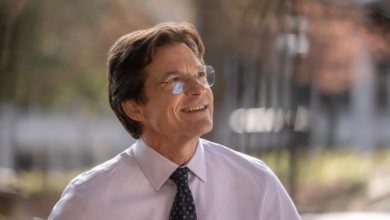
Jason Bateman is leaning into two very different limited series at once, and both are drawing serious awards attention. In HBO Max’s DTF St. Louis, he plays Clark, a guileless weatherman pulled into a murder mystery. In Netflix’s Black Rabbit, he steps into the role of Vince, a gambler whose chaos helps drag down a New York restaurant.
Bateman also produced both projects, and he directed Black Rabbit, a job that has already brought him DGA and Actor Award nominations. He says the next stretch of his directing work will move from TV to film, starting with The Cackling of the Dodos and then The Partner.
A very different kind of character
Bateman says DTF St. Louis gave him a part unlike the cynical figures that have defined much of his recent work. He describes Clark as warm, kind, vulnerable, and without artifice, and says he wanted to play him in a softer, more “aw shucks” way.
That approach also meant leaning into Clark’s naivete rather than the more polished version on the page. Bateman said the character’s contrast with David Harbour’s role became more interesting when Clark was played as someone in awe of the people around him instead of someone looking down on them.
Lessons from early sets
Asked about his first lesson on set, Bateman pointed to the importance of not being disruptive. He said he learned early that stressful productions can be made worse by one person’s bad behavior, and he credits his parents with helping him see how crews react to that kind of conduct.
He also remembered his first year on Little House on the Prairie with Michael Landon, whom he described as kind to everyone while serving as writer, director, producer, and star. That experience, he said, showed him a model for leadership before he encountered more typical sets with plenty of yelling.
Katharine Hepburn’s blunt advice
Bateman also recalled a formative moment with Katharine Hepburn while they worked together on the CBS movie This Can’t Be Love. In a scene where he was trying hard to cry, Hepburn stopped the take and told him, “Oh, stop acting!”
He said the comment was crushing in the moment, but she clarified that he did not need to push so hard. Her advice was simple: “Just be human and say the words,” and avoid acting emotional instead of simply being emotional.
The sets he enjoyed most
For Bateman, Arrested Development remains the most fun he has had on set. He said the cast and writing created a nonstop stream of laughter, with the work itself becoming part of the joke as everyone tried not to break during takes.
He also called the show a career-saver, which made the experience even more meaningful. The same title comes up again when he talks about his most quoted role, though Ozark eventually overtook it in public memory.
What still gets a reaction
Bateman said Ozark resonated because it centered on a relatable family and a relatable protagonist in an extraordinary situation. That combination, he said, kept the show plausible even as the story became increasingly unsettling.
He noted that people often mention scenes and moments from the series rather than quoting lines directly. For him, that response reflects how deeply the show landed without needing a catchphrase-driven character.
What makes him emotional now
Bateman said fatherhood changed what can make him cry. Anything involving little kids now hits harder, and he admitted that even commercials with infants learning to walk can get him emotional.
He also still turns to Kramer vs. Kramer, and he said classical music can pull him into the emotional space he needs, both as a viewer and when preparing to cry in a scene. That, he said, remains a reliable way to reach the right place quickly.
Why these roles fit him
When asked which part feels most like him, Bateman said he tends to shape every role into some version of himself. He pointed again to Arrested Development, as well as the characters he played in Horrible Bosses and Game Night.
He said he enjoys playing opposite eccentric people, even if it requires patience and a firm grip on reality. In those roles, the humor often comes from a character thinking he is surrounded by people who are less capable, only to have his own flaws exposed.
That same balance of confidence, vulnerability, and comic self-importance has carried across much of Bateman’s career. With DTF St. Louis and Black Rabbit, he is now showing just how far that range can stretch.