


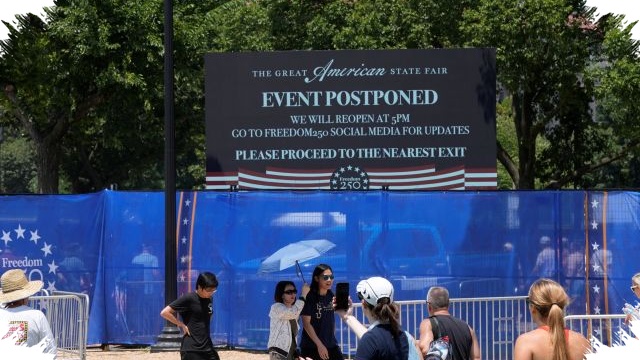
A punishing heat wave is pushing across the eastern United States just as millions head outdoors for July Fourth weekend, and the health risks are rising fast. The CDC said regions in the Northeast are seeing “extremely high rates of heat-related illness,” while cities are canceling events, opening cooling centers and bracing for overloaded power systems.
Friday brought more record-breaking temperatures from the Mid-Atlantic to the Northeast, with Washington, DC, reaching 102 degrees and topping a record set in 1872. More than a dozen locations tied or broke their daily high records, and several cities were hotter than Phoenix as triple-digit heat returned to places including Philadelphia, Boston and parts of New York City.
Heat danger is spreading quickly
The combination of heat and humidity is making conditions feel even more severe, with heat index values forecast to climb above the actual air temperature. Heat is already the deadliest weather hazard in the US, and overnight lows are staying high enough to limit the body’s chance to recover.
That risk is especially sharp for older adults, children, outdoor workers and people without reliable air conditioning. Officials are urging people to drink water often, avoid intense activity, take frequent breaks in shade or indoors, and never leave children or pets in parked cars.
| Location | Heat Impact | Action Taken |
|---|---|---|
| Washington, DC | Forecast high of 102 degrees; heat alert through July 5 | Cooling centers, hydration stations and emergency medical resources expanded |
| Philadelphia | Near 100 degrees with heat indices near 105 | Heat health emergency declared through Sunday evening |
| New York City | Near 100 degrees with high humidity | Hundreds of cooling centers and mobile medical vans deployed |
| Boston | Record-breaking temperatures in the region | Cooling centers opened |
Events are being reshaped by the weather
In Washington, the July Fourth parade planned for Saturday morning was canceled because of the extreme heat. Philadelphia also canceled its Friday Independence Day parade, and organizers in the city moved a ceremony with a live virtual address from the pope indoors.
Other holiday gatherings are changing too. President Donald Trump’s Great American State Fair is opening two hours late at 12 p.m., and organizers of National Mall celebrations are adding water stations, cooling tents and air-conditioned buses for visitors.
Power systems are under pressure
The heat is driving up demand for electricity as homes and businesses run air conditioners harder. In New York, thousands of customers lost power Friday, and Con Edison said heat, humidity and higher electricity demand are straining its system mainly in the Bronx and Queens.
Con Edison said crews have restored service to more than 60,000 customers affected by scattered outages since the heat wave began. Mayor Zohran Mamdani also urged residents to set air conditioners to 78 degrees and unplug appliances to help ease pressure on the grid.
Outside the New York City metro area, more than 19,000 Con Edison customers lost power Thursday, according to the utility’s outage map. Voltage reductions were reported earlier in the day across parts of Staten Island, Queens, the Bronx, Brooklyn and Westchester.
Energy Secretary Chris Wright also ordered data centers in the Mid-Atlantic to use backup power instead of drawing from the public grid, partly to preserve electricity for residential air conditioning. His directive covered large electricity users served by PJM, the country’s biggest grid operator, which spans 13 states.
Health warnings are turning into real-world cases
In Bethel Township, Pennsylvania, a 68-year-old man died after trimming bushes on July 2 during temperatures above 100 degrees. The Berks County Coroner’s Office told CNN that the cause of death was a heart attack from strain “due to heat exhaustion.”
The CDC’s warning came as emergency rooms reported unusually high numbers of heat-related visits across the Northeast on Thursday. Public health officials say the pattern is becoming more dangerous because fossil fuel pollution is intensifying the heat and humidity that fuel these events.
World Weather Attribution said the combination of heat and humidity this week would have been “virtually impossible” without the effects of fossil fuel pollution. The group published its analysis early Friday, adding scientific weight to the warning that the current stretch of weather is not just uncomfortable, but increasingly dangerous.
Amtrak has also canceled at least 26 trains in the Northeast since July 2, including service to major cities such as Baltimore, Philadelphia, New York City and Boston, because of temperature-related conditions. With the hottest stretch landing during a major holiday weekend, officials across the region are still trying to keep people safe while keeping critical systems running.