America’s roadside stops are getting bigger, busier, and far more ambitious. What used to be a quick fuel stop is increasingly turning into a destination with food, shopping, and enough room to keep travelers lingering.
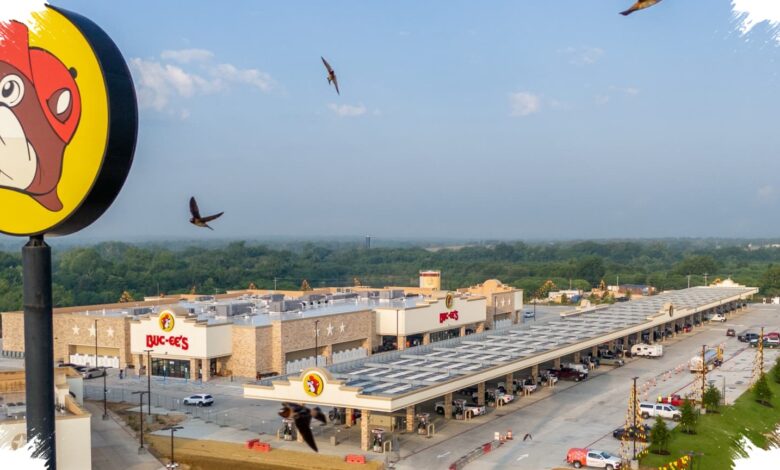
Buc-ee’s sits at the center of that shift. The chain now has more than 50 locations across 13 states, and its huge stores and spotless bathrooms have helped define the new mega-gas-station model.
Buc-ee’s keeps drawing the biggest crowds
At the Dayton, Ohio, opening of Buc-ee’s first location in the state, almost all 120 pumps were occupied on a recent summer evening. Inside, customers lined up for brisket sandwiches, three-meat sandwiches, and other food as employees chanted “Brisket on the Booooard” when fresh brisket hit the carving station.
Some fans even traveled long distances for the opening. Sally McQuinn drove from near Roanoke, Virginia, and called herself a “super fan of Bucs,” even posing for a photo with the chain’s owner at the event.
The numbers show how far the model has stretched. Buc-ee’s largest store in Texas is more than 75,000 square feet, while stores like Sheetz and Wawa are usually around 7,000 square feet. A low-end Walmart, by comparison, is about 150,000 square feet.
How the biggest chains compare
| Chain | Average Dwell Time | Notes |
|---|---|---|
| Buc-ee’s | 20.8 minutes | Longest dwell time among listed convenience chains |
| Wawa | 11.7 minutes | Prepared-food focused chain |
| Sheetz | 11.7 minutes | Prepared-food focused chain |
| 7-Eleven | 9.8 minutes | Convenience store chain |
| Circle K | 9.3 minutes | Convenience store chain |
| Casey’s General Store | 8.7 minutes | Convenience store chain |
| Cumberland Farms | 8.5 minutes | Convenience store chain |
Placer.ai data cited in the report shows Buc-ee’s has the longest dwell time of any convenience store chain listed, roughly double that of the nearest competitors. That longer stay is a key reason the format has become so valuable for operators.
The new playbook is food, experience, and scale
Sudip Mazumder, senior vice president and retail industry lead for North America at Publicis Sapient, said the traditional gas station is moving from a fuel stop into a “sprawling, multi-faceted retail and travel destination.” He said thin gasoline margins push operators to use fuel as a way to bring customers into higher-margin food and convenience sales.
Other pressures are helping drive the change, including cleaner and more experiential stops, longer charging times for electric vehicles, and the need to serve truckers well on long highway routes.
The format is spreading beyond Buc-ee’s. Wally’s has opened three 50,000-square-foot locations in the Midwest and plans more, with offerings that include a popcorn bar and a wide selection of jerky designed to compete with the Buc-ee’s style of stop.
Dolly’s joins the race with a different spin
Dolly Parton’s Dolly’s Tennessean Travel Stop enters the category with a different balance of fuel and entertainment. The Cornersville, Tennessee, location spans 18 acres and 25,000 square feet, but it has only 16 pumps and adds a dog park, a theater, a restaurant and bar, trucker showers, and a lounge.
Gregory H. Sachs, partner of Dolly’s Tennessean Travel Stop, said Parton and her team were involved in all aspects of the project. He said the plan is to open more locations across the country in a deliberate, measured way.
Elizabeth Lafontaine, director of research at Placer.ai, said the category is evolving beyond its name into a full-service one-stop shop. She said social media has helped regional offerings reach a national audience and pushed chains to pay closer attention to what resonates with shoppers.
That shift has also changed what customers expect. Lafontaine said people now see some c-stores as must-visit destinations on weekdays and on vacations, especially when they offer prepared food or something distinctive.
Big stores are popular, but they still face limits
The larger-format strategy is not without constraints. Lafontaine said Buc-ee’s has added general merchandise and private-label goods that make up close to 50% of store floor space, but that approach may not translate cleanly to every chain.
Marbue Brown, CEO and founder of the Customer Obsession Advantage, said the real lesson is not just size. He argued that competitors need to copy the feeling Buc-ee’s creates, including the kind of merchandise people want to show off after a stop.
There are practical limits too. Mazumder said physical expansion runs into land, zoning, and operational challenges, and that future growth may focus more on improving services and space than simply building larger stores.
Tom Seng, a professor of professional practice at Texas Christian University, said these stores usually avoid major urban areas and instead sit along interstates in rural settings. He said that benefits small towns connected to the highway system, but he does not expect shops much larger than the current leaders.
For Dolly’s, Sachs said the challenge is keeping the right feeling inside the building. “In general, bigger is not always better,” he said, adding that there will be some maximum size where the “home” feeling begins to fade.
For all the brisket, fudge, beef jerky, and highway trinkets, Brown said one detail may matter most to the chains that want travelers to stay and spend: clean bathrooms. “The idea is that spotless facilities make people feel comfortable,” he said. “If they are comfortable using the bathroom, they feel comfortable eating there and spending more money. If bathrooms aren’t clean, we don’t eat here.”
That is the core lesson behind the mega-gas-station boom now spreading along America’s highways. The biggest winners are the chains that can turn a pit stop into a place people want to enter, browse, eat, and remember.