


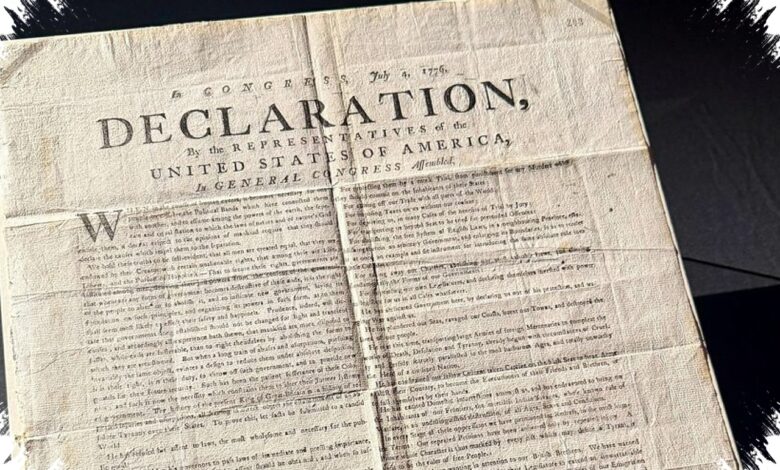
A rare early copy of the Declaration of Independence has turned up in Britain, hidden among papers tied to a captured American privateer ship. The find matters not only because of its age, but because it links the founding document directly to the naval war that helped carry news of American independence across the Atlantic.
The document was discovered by volunteer Michael Scurr while he was cataloging letters from an 18th-century Royal Navy captain at the National Archives in Britain. He found it attached to a report on the capture of the American privateer Dalton on Christmas Eve 1776, with the enclosure described only as “another paper.”
What makes this copy unusual
Researchers at the National Archives have now identified it as one of just 11 known original copies of the so-called Exeter printing of the Declaration of Independence. It is also the only copy known to be identified outside the United States, the archive said as it revealed the discovery ahead of the 250th anniversary of American independence.
| Detail | Information |
|---|---|
| Printing | Exeter printing |
| Place printed | Exeter, New Hampshire |
| Printing dates | July 16 to 19, 1776 |
| Known copies | 11 original copies |
| Known location | The only identified copy outside the United States |
Amanda Bevan, head of the National Archives project cataloging Royal Navy captain correspondence from the American Revolution, said the document was especially significant because it was captured from a ship operating under the direction of the Continental Congress. Its orders were signed by John Hancock, who was president of the Congress.
Why the ship capture matters
The Dalton was a privately owned privateer, not a regular navy vessel, and it sailed under the authority of the Continental Congress to help supplement the small American navy. On Christmas Eve 1776, HMS Raisonnable chased the 18-gun vessel for seven hours before capturing it off the coast of Portugal, according to the archive.
Captain Thomas Fitzherbert commanded the 64-gun HMS Raisonnable, while the Dalton’s crew of 120 was later imprisoned in Plymouth, England, under harsh conditions. One of those captured, 19-year-old Charles Hebert, later described hunger, illness and repeated punishment in journals he kept during more than two years of captivity before being released in a prisoner exchange.
Bevan said finding a copy of the Declaration aboard a ship also suggests how the document may have been used. She believes the captain likely read out both his orders and the declaration itself, as was customary.
“They know why they’re fighting, but this puts it in a language which makes it greater than them,” Bevan said. “They’re not fighting because they’re aggrieved in particular. They’re fighting for an ideal. And I think that just to find the declaration in a theater of war where people are committing themselves to fight for their country on the wide ocean is really something special.”
A tangible link to 1776
Historians in the United States say the discovery adds a fresh link to the story of independence. Matthew Skic, director of collections and exhibitions at the Museum of the American Revolution in Philadelphia, said the copy is more than a document because it is an artifact that connects the present to the people who carried news of independence to the world.
“It’s not just a document, it’s an artifact,” Skic said. “It’s a tangible connection to the past, because holding that piece of paper in the archivist’s hand today is a way to transport us back to 1776. The baton being passed, in a way.”
He added that the discovery shows how much of the American Revolution remains to be uncovered, even 250 years later. The National Archives’ find suggests that important pieces of the story can still surface in unexpected places.
Source note
This article is based on reporting from www.pbs.org.