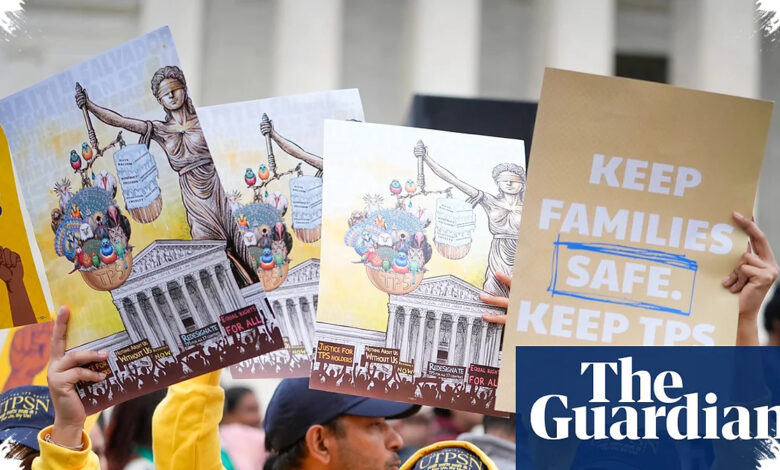
The US Supreme Court has made it much easier for the Trump administration to end Temporary Protected Status for hundreds of thousands of immigrants, with wider consequences for about 1.3 million people who rely on the program. The ruling strips away most judicial review of TPS decisions, leaving affected families with far less room to challenge them in court.
That matters because TPS has long functioned as a shield for people who were already in the US when disaster, war, or other extraordinary conditions made return unsafe. For many holders, it is also what allows them to keep working legally while their home countries remain too dangerous to return to.
What TPS Is, and Why It Exists
Temporary Protected Status was created by Congress in 1990. It can be granted for six to 18 months at a time to nationals of countries facing natural disasters, epidemics, armed conflict, or similar temporary crises.
People granted TPS can receive work permits and protection from deportation. Those with serious criminal records are generally ineligible, and the homeland security secretary decides whether a designation should be extended, redesignated, or terminated before it expires.
What the Court Decided
In a 6-3 ruling, the conservative majority said TPS determinations made by the homeland security secretary, and the process used to reach them, will generally not be subject to judicial review. Constitutional claims remain an exception, but the court signaled that the one claim before it was unlikely to succeed.
Justice Elena Kagan’s dissent warned that the ruling leaves the courts powerless even if a secretary did not consult anyone or evaluate country conditions before acting. She also argued that Donald Trump’s remarks about Haitians carried racial undertones and overtones that should have mattered in the case.
Who Faces the Most Immediate Impact
The case before the court directly involved more than 300,000 people from Haiti and several thousand from Syria. Once the ruling takes effect, they are expected to lose TPS and work authorization even while the legal fight continues.
Among those named in the case are Fritz Emmanuel Lesly Miot, a Haitian Alzheimer’s researcher in California with type 1 diabetes, and Laila Doe, a Syrian behavioral technician in Illinois. Their situations highlight how losing TPS can quickly become a health and safety issue, not just an immigration one.
| Country | People Directly Affected in the Case | Key Risk After TPS Ends |
|---|---|---|
| Haiti | More than 300,000 | Loss of TPS and work authorization |
| Syria | Several thousand | Loss of TPS and work authorization |
Why the Ruling Matters Beyond Haiti and Syria
The broader effect is likely to reach every nationality with TPS, because the new precedent makes it easier for the administration to end protections with less court oversight. The decision is also expected to influence ongoing challenges to other TPS terminations that have so far been blocked by court orders.
According to www.theguardian.com, that could leave many long-term residents with very little time or legal room to respond if their status is revoked. If they do not qualify for another form of relief, the path forward can narrow quickly to detention and deportation proceedings.
What Countries Are Covered Right Now
Active TPS designations currently include people from Myanmar, El Salvador, Ethiopia, Haiti, Lebanon, Somalia, South Sudan, Sudan, Syria, Ukraine, and Yemen, with a small subset of Venezuelans also retaining protections through early October.
Since returning to office, the Trump administration has moved to unwind previous TPS designations for Afghanistan, Cameroon, Honduras, Nepal, and Nicaragua, while hundreds of thousands of Venezuelans have already lost their status.
Why Return Can Be So Dangerous
The US State Department lists both Syria and Haiti at its highest travel warning level and says Americans should not travel there. For Syria, it cites terrorism, unrest, kidnapping, hostage taking, crime, and armed conflict.
For Haiti, the warning says violent crime is rampant, gang activity has driven widespread violence, and there is a substantial risk of stray bullets even for people not directly involved. The department also says local law enforcement in serious-crime cases has extremely limited ability to respond.
The Economic Stakes Are Large Too
TPS holders pay an estimated $7.8 billion in taxes each year and have contributed about $262 billion to the US economy since 2001, according to Fwd.us. Many work in construction, leisure and hospitality, and healthcare, all of which face labor shortages.
Among Haitian TPS holders alone, there are an estimated 13,000 nursing assistants caring for 65,000 patients each day, 3,000 school assistants working with 57,000 students daily, and 22,000 cooks and servers providing 880,000 meals every day.
| Economic Indicator | Estimated Figure | Source |
|---|---|---|
| Annual taxes paid by TPS holders | $7.8 billion | Fwd.us |
| Contribution to US economy since 2001 | $262 billion | Fwd.us |
| Haitian nursing assistants | 13,000 | Fwd.us |
The elder care sector may feel the impact quickly, with Axios reporting that in some areas TPS holders make up 8% or more of caregiving professionals. Losing them could limit nursing home admissions, close units, or force providers to turn away home care requests.
On the same day, the court also backed a previous asylum practice known as metering at the US-Mexico border, even though the policy had already been rescinded. The justices also upheld birthright citizenship for children born in the US to immigrant parents, but the close nature of that ruling showed how fragile immigration protections have become at the highest level.