


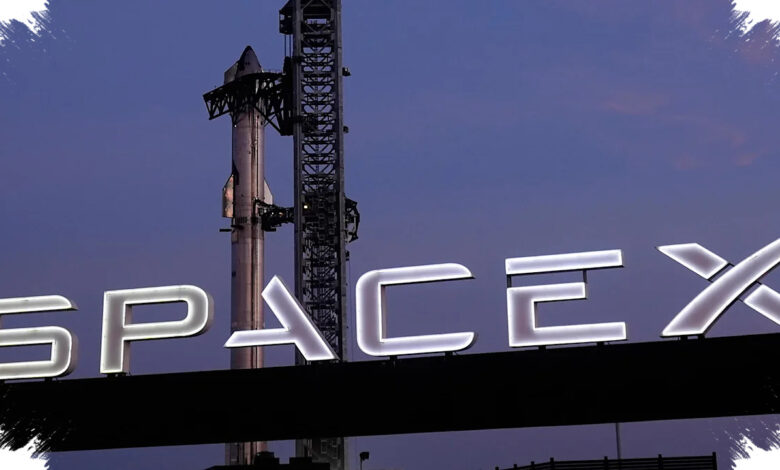
SpaceX stock fell to an all-time low on Wednesday, briefly dropping below its $150 market debut price as rival Blue Origin moved to strengthen its own capital position. The decline added a fresh layer of pressure to a stock that had already lost momentum after its Nasdaq-100 inclusion.
Shares touched an intraday low of $145.20 before closing at $149.29, still below the level tied to SpaceX’s market debut. In premarket trading on Thursday, the stock was up 1.4%, which would put it back above $150 if the gain holds at the open.
Why the stock is under strain
SpaceX fell 7% on Tuesday even after being added to the Nasdaq-100, a move that would normally attract buying from index-tracking funds and ETFs. Some analysts and market strategists said the inclusion may already have been priced in, while weakness across the Nasdaq also weighed on sentiment.
| SpaceX Trading Snapshot | Level | Change |
|---|---|---|
| Intraday low | $145.20 | All-time low |
| Close | $149.29 | -1.17 (-0.78%) |
| Market debut price | $150 | Below debut at close |
Finance.yahoo.com noted that a wave of analyst coverage on Tuesday also failed to lift the stock. Of the 17 underwriters for SpaceX’s IPO, 12 issued new coverage, and all 12 rated it Buy or equivalent.
One of the most bullish calls came from Morgan Stanley’s Adam Jonas, who initiated SpaceX with an Overweight rating and a $300 price target. Jonas said SpaceX could transform energy into intelligence through data centers using solar power, combining “near-monopoly launch economics, the world’s largest LEO (Low Earth Orbit) network, and a fast-scaling AI infrastructure business” into “one infrastructure stack.”
Even so, most Wall Street price targets remain above $200, and the stock has struggled to move back above that level since it was last seen there on June 16.
Blue Origin looks for outside capital
While SpaceX settles into what the article described as its “post-honeymoon” phase with markets, Blue Origin is seeking new money. The private rocket company backed by Amazon founder Jeff Bezos is reportedly raising funds at a $130 billion valuation in what would be its first public fundraise.
According to the New York Times DealBook report cited in the article, the $10 billion raise includes $4 billion from Coatue Management, $4 billion from other large investors, and $2 billion from Bezos himself. Bezos had been funding Blue Origin personally over the past 25 years.
The fundraising is small compared with the $85 billion raised by SpaceX, but it still signals confidence in Blue Origin’s prospects and position in the space industry. That comes even after a major setback earlier this year, when one of Blue Origin’s New Glenn rockets exploded during a static engine test and destroyed the company’s only launch pad.
Bezos said in May that the timing was finally starting to make sense for outside capital. “We finally have enough visibility into our future and our financial success,” Bezos told CNBC. “It’s a good time actually to start thinking about the future and bring on some other outside investors.”
Blue Origin also plans to expand beyond launches with an enterprise satellite connectivity service called TeraWave. The company said New Glenn rockets will eventually launch those satellites into medium Earth orbit and low Earth orbit.
That satellite push overlaps with plans at Amazon, which will soon offer consumer satellite internet through Amazon LEO. The service would eventually rival SpaceX’s Starlink, although Starlink already has a far larger number of satellites in orbit. Amazon LEO is aimed at consumers, while TeraWave is designed for large enterprise customers.
In the future, Blue Origin rockets would also be able to launch LEO satellites at a cost-competitive price, creating another area where Starlink currently benefits from being under the SpaceX umbrella.