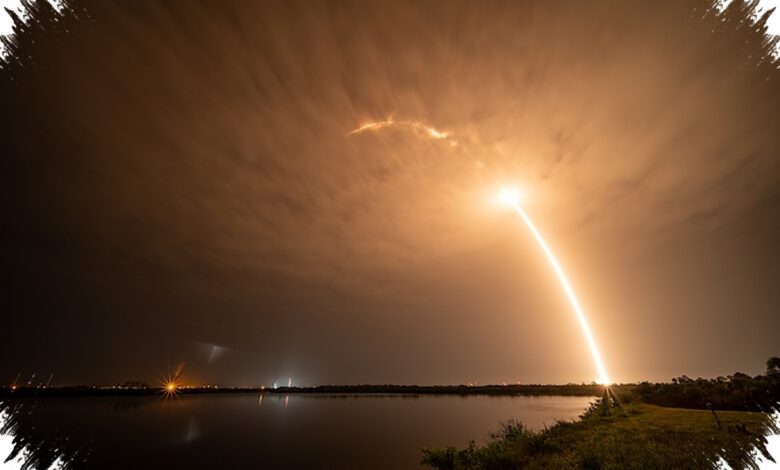
SpaceX hit another major reuse milestone on Tuesday morning when it launched a flight-proven Falcon 9 booster for the 600th time. The mission carried 29 Starlink satellites into low Earth orbit and pushed the company’s booster reuse record even further.
The launch lifted off from Space Launch Complex 40 at Cape Canaveral Space Force Station at 5:10 a.m. EDT (0910 UTC) on the Starlink 10-45 mission. The rocket flew to the northeast after leaving the pad, continuing SpaceX’s fast pace of Starlink deployments.
B1080 Returns for Its 28th Flight
The first stage used on the flight carried the tail number B1080, which completed its 28th mission on this launch. SpaceX has now flown that booster on missions for Axiom Space, the European Space Agency’s Euclid observatory, and Northrop Grumman’s NG-21, among others.
That reuse history made the booster part of a larger benchmark for the company, which has now logged 638 booster landings in total. The landing on this mission also marked the 161st touchdown on the droneship A Shortfall of Gravitas.
Weather Looked Favorable Through the Window
The 45th Weather Squadron forecast a 90 percent chance of acceptable weather at the opening of the launch window, improving to 95 percent later in the period. Meteorologists said lingering thick clouds from evening convection could briefly affect the start of the window, though overall conditions were expected to be good.
“Some lingering thick clouds left over by the evening convection may be present at the beginning of the launch window but should gradually dissipate through the window,” launch weather officers wrote. “As a result, we have raised the POV slightly at the beginning of tonight’s launch window, but overall good weather is expected.”
Another Small Step for Starlink’s Large Constellation
The 29 satellites added on this flight brought more capacity to SpaceX’s broadband network, which now includes more than 10,800 spacecraft in low Earth orbit. spaceflightnow.com reported that the booster landed on the droneship about 8.5 minutes after liftoff.
The mission added another entry to SpaceX’s reuse tally while showing how routine these flights have become for the company. Even so, the 600th flight of a Falcon booster remains a notable marker in a program that continues to reshape launch operations.
| Key Mission Detail | Value |
|---|---|
| Mission | Starlink 10-45 |
| Launch Site | Space Launch Complex 40, Cape Canaveral Space Force Station |
| Liftoff Time | 5:10 a.m. EDT (0910 UTC) |
| Booster | B1080 |
| Booster Flight Number | 28th flight |
| Satellites Deployed | 29 Starlink satellites |
| Drone Ship Landing | A Shortfall of Gravitas |
| Total Booster Landings | 638 |
The flight reinforced the scale of SpaceX’s Falcon 9 reuse program while adding more satellites to the company’s expanding network. With the booster back on the droneship and the payload successfully delivered, the mission became another marker in a launch system that keeps setting new internal records.