


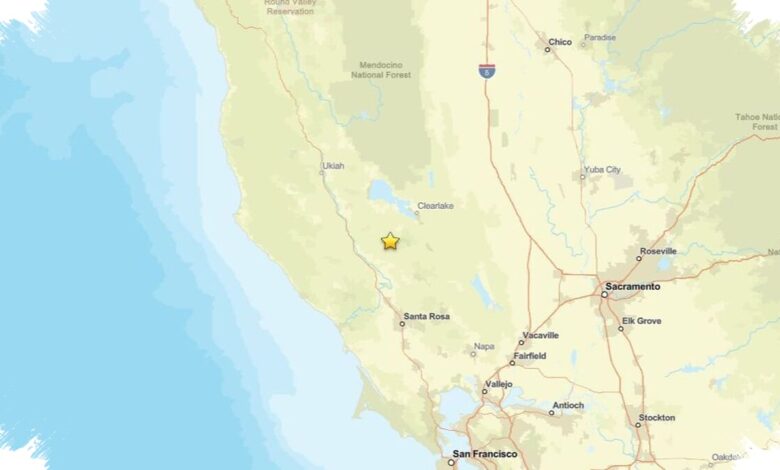
A preliminary 2.3-magnitude earthquake struck near Cobb in Lake County on Thursday afternoon. The small tremor followed two nearby earthquakes measuring 2.7 magnitude within the past week.
The quake was reported at 3:51 p.m. at a shallow depth of about 1 mile. Its epicenter was approximately 4 miles west of Cobb.
Recent tremors around the region
The latest event was smaller than two 2.7-magnitude earthquakes recorded nearby in the days before it. One occurred near The Geysers on July 10, while the other was centered near Cloverdale on July 15.
| Date | Location | Magnitude |
|---|---|---|
| July 10 | Near The Geysers | 2.7 |
| July 15 | Near Cloverdale | 2.7 |
| Thursday | About 4 miles west of Cobb | 2.3 |
www.mercedsunstar.com reported the preliminary measurement using information from the U.S. Geological Survey. People who felt the shaking can submit an observation through the USGS Felt Report form.
What a 2.3-magnitude quake means
Magnitude measures the energy released at an earthquake’s source, according to the U.S. Geological Survey. The modern magnitude system replaced the older Richter scale.
Earthquakes below magnitude 2.5 are seldom felt by most people, while quakes between 2.5 and 5.4 are often felt but rarely cause significant damage. Even so, earthquakes can trigger hazards including fires, landslides, tsunamis, and avalanches.
California is among the U.S. locations where earthquakes occur most often, along with Alaska, Hawaii, Oregon, Puerto Rico, and Washington. Worldwide, an estimated 500,000 earthquakes are detectable each year, with about 100,000 felt and roughly 100 causing damage.
How to respond if shaking starts
Officials advise people to protect themselves immediately by following the “Drop, Cover, and Hold On” guidance. Drop to hands and knees, cover the head and neck, and hold onto something sturdy.
Indoors, stay inside rather than running outside, avoid doorways, and move away from windows. If possible, crawl beneath a sturdy table and hold on with one hand so it can be followed if it moves.
People outdoors should stay away from buildings and should not go inside during shaking. Drivers should pull over, stop, and set the parking brake.
Anyone in bed should turn face-down and cover their head with a pillow. Wheelchair or walker users with a seat should lock the wheels and remain seated until the shaking stops.
Hazards can remain after an earthquake, including building damage, leaking gas or water lines, and downed power lines. Aftershocks can follow the main quake, so people should be ready to use earthquake safety measures again if shaking resumes.