

The ancient city widely identified as Troy can still be explored in northwestern Türkiye, where a hill known as Hisarlik overlooks the plains linked to Homer’s Trojan War. Its ruins offer a rare view across several eras of settlement, destruction, and rebuilding.
The site is not presented as a reconstructed fantasy of the Bronze Age. Visitors walk among excavated walls, streets, passages, and other remains that archaeologists say preserve an exceptional record of the Late Bronze Age Mediterranean.
A City Built on Many Cities
Hisarlik contains the remains of nine successive cities, each layered over the last through thousands of years. Archaeologists commonly associate Troy 6 and Troy 7 with Priam’s Ilium, the city described in Homer’s Iliad.
There is no inscription that conclusively identifies the hill as Troy. However, later Greek and Roman visitors called the place New Ilium, while its geography, archaeology, and destruction layers make it the strongest candidate.
Eric Cline, a professor of Classical and Ancient Near Eastern Studies at George Washington University, has noted that the site fits both the landscape and archaeological expectations for Troy. Excavations have revealed burned material, skeletons, arrowheads, and slingstones in layers associated with the period of the legendary conflict.
Rüstem Aslan, a professor at Çanakkale Onsekiz Mart University who has spent 40 years excavating the site, points to the surrounding landscape as another compelling clue. “If you put the Homeric epic on the landscape,” he said, “he couldn’t write in more detail.”
What to See at the Troy Archaeological Site
About 90 percent of the main site has been excavated, according to Aslan. Unlike some ancient destinations, the structures have not been extensively rebuilt, leaving visitors to see the remains largely as archaeologists found them.
A marked route through the ruins explains the different settlement layers and leads past major structures. The most imposing remains for visitors interested in the Trojan legend are the large stones and substantial walls associated with Troy 6 and Troy 7.
Schliemann’s Trench is another significant stop, although it carries a difficult legacy. In 1871, Heinrich Schliemann cut a 56-foot trench through the hill and damaged parts of the later Bronze Age layers while searching for the city.
The site has remained an active area of study for more than 160 years. Aslan says the long excavation history has not exhausted its potential, adding, “There are still treasures.”
Start With the Troy Museum
The Museum of Troy, beside the ruins, provides essential context before entering the archaeological site. Its exhibits trace the city’s multiple layers and display about 2,000 Bronze Age artifacts, while another 40,000 artifacts remain in storage.
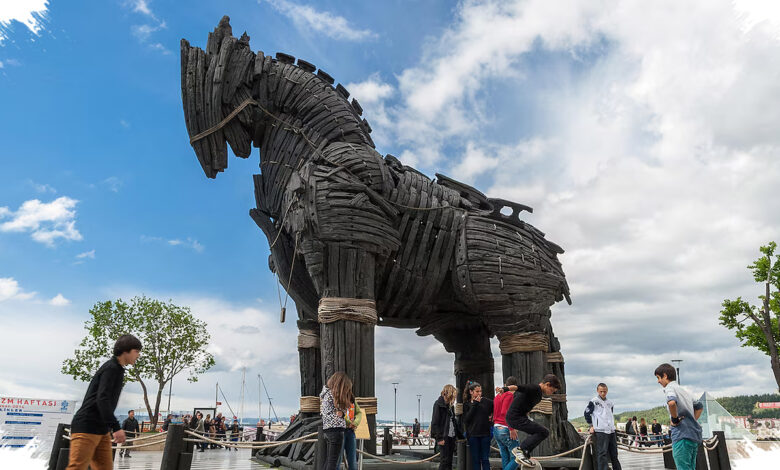
A towering wooden horse near the museum evokes the famous story, though the original horse is either lost to history or may never have existed. www.nationalgeographic.com reports that archaeologists and scholars recommend the museum as the best introduction to the complex site.
Using Çanakkale as a Base
Çanakkale lies about 30 to 45 minutes from the ruins and offers a convenient base for a Troy visit. Its marina also displays the wooden horse used in the 2004 film Troy, while the nearby Gallipoli peninsula preserves museums and stories from the First World War battlefield.
Hotels near the marina place travelers close to the ferry terminal, pedestrian streets, shops, and seafood restaurants. Kule Hotel has a rooftop restaurant overlooking the terminal, while Liman Paşa Müdavim and Sardalye are among the dining options mentioned for regional seafood and Turkish dishes.
| Starting Point | Travel Method | Approximate Travel Time to Çanakkale |
|---|---|---|
| Istanbul | Car / Bus | 3.5 hours / 4.5 hours |
| Izmir | Car / Bus | 4 hours / 5.5 hours |
Getting From Çanakkale to Troy
Minibuses leave hourly from Cuma Pazarı Dolmuş Station in Çanakkale, beneath an overpass. Travelers should look for vehicles marked “Truva” or “Troy.”
The journey to the Troy Archaeological Site takes about 30 to 45 minutes and costs about 30 lira each way. The short ride makes it possible to pair a visit to the ruins and the Troy Museum with time along Çanakkale’s waterfront.