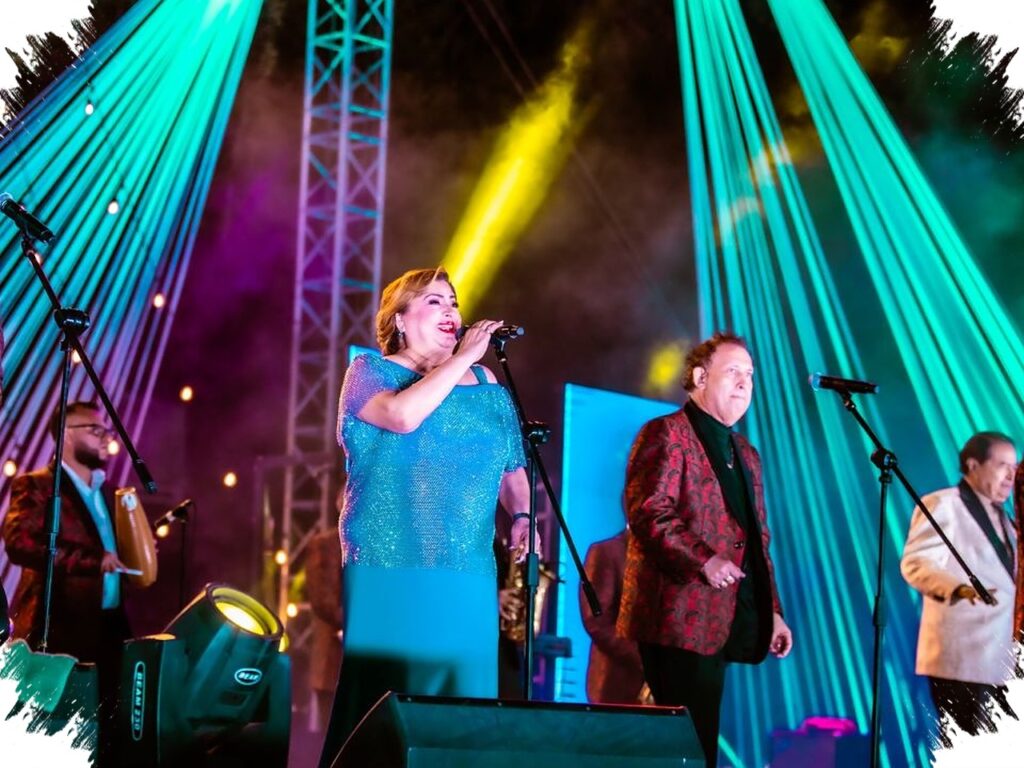
Hoy marks a historic moment for Salvadoran music as Orquesta Internacional Los Hermanos Flores makes its Coachella debut, bringing cumbia from San Vicente to one of the world’s most watched festival stages. The group’s appearance is more than a performance slot; it is a major cultural milestone for a band whose story began more than six decades ago in a small town with family discipline, local dances, and a growing musical vision.
Their presence at Coachella also reflects how far the orchestra has traveled from its earliest days at patron saint festivals and community celebrations. At the festival, the ensemble will perform on the Outdoor Theatre, the second-largest stage at Coachella, a venue reserved for acts with broad audience reach and a large-scale production.
A Salvadoran group steps onto a global stage
The move to the Outdoor Theatre signals the scale of the opportunity and the technical demands behind it. The orchestra did not travel with musicians alone, but with a 35-person team that includes sound engineers, lighting specialists, dancers, photographers, and audiovisual staff documenting the milestone.
Three sound engineers were added specifically to meet the stage’s technical requirements, while lighting support was also expanded to match the demands of a venue built for major international acts. In a setting like Coachella, the performance must do more than sound good; it must deliver a full visual and sonic experience to thousands of festivalgoers.
The production shift shows how carefully the group prepared for a stage that operates with advanced systems and high expectations. For a Salvadoran orchestra rooted in popular celebration, the debut places its music in a global festival environment without losing the identity that built its audience.
From San Vicente to international recognition
Los Hermanos Flores were not formed through a record-label strategy or a commercial launch. Their origin began in San Vicente, where music became a way of life inside a family led by Andrés Rodríguez, a tailor by profession and musician by calling.
He trained his children from a young age in music theory and performance. That foundation included solfège, daily practice, and early instruments such as trumpets, saxophones, and percussion, which shaped the orchestra’s first sound.
At the time, marimba dominated much of El Salvador’s musical landscape. The Rodríguez family also listened to Mexican and Caribbean tropical orchestras on the radio, and those influences helped create a new style that blended training, curiosity, and rhythm.
The decisive idea came from the eldest brother, José Ángel, who asked their father, “Dad, what if we form an orchestra?” That simple question helped start a family project that would later cross generations and borders.
Key milestones in the orchestra’s rise
- Early performances took place at fairs, patron saint festivals, and popular dances in local communities.
- The group began recording in the 1960s with simple but effective songs.
- The song La Bala became a turning point in 1970 and later reached popularity in Mexico.
- Their catalog expanded with songs such as Amor de pobre, Cumbia folclórica, and El ausente.
- The orchestra later performed in the United States, Canada, Central America, Europe, and Australia.
Those milestones helped turn the group into one of the most recognized names in Salvadoran popular music. Their cumbia, driven by brass instruments and danceable arrangements, became known for its festive energy and strong connection to everyday community life.
Music tied to memory and migration
Over time, Los Hermanos Flores built a songbook that became part of Salvadoran social life. Tracks such as Amor de pobre, Cumbia folclórica, and El ausente became common at family gatherings, celebrations, and moments of nostalgia.
For the Salvadoran diaspora, especially in the United States, the orchestra’s music has long served as a link to home. Their songs often function as a cultural bridge, carrying memories of El Salvador across borders and helping listeners reconnect with their roots.
That emotional connection gives the Coachella debut added meaning. The performance does not only showcase a musical group; it also places Salvadoran identity in front of one of the most diverse audiences in global live music.
Why the Coachella debut matters
Coachella is known for hosting some of the biggest artists in the world, and its second-largest stage brings both prestige and pressure. For Los Hermanos Flores, the debut places a Salvadoran orchestra inside a space usually associated with global mainstream acts.
The moment also highlights the durability of a project that began in small-town celebrations and grew through consistency, family discipline, and audience loyalty. What started as a local orchestra in San Vicente now reaches a festival platform watched closely by international media, music fans, and Salvadorans abroad.
As the group takes the stage, the performance carries decades of history, from early brass rehearsals and neighborhood dances to the largest festival stages in the United States. The orchestra’s appearance at Coachella stands as a rare crossover moment for cumbia from El Salvador, with the sound of San Vicente now set to echo before a worldwide audience.
Read more at: www.elsalvador.com