


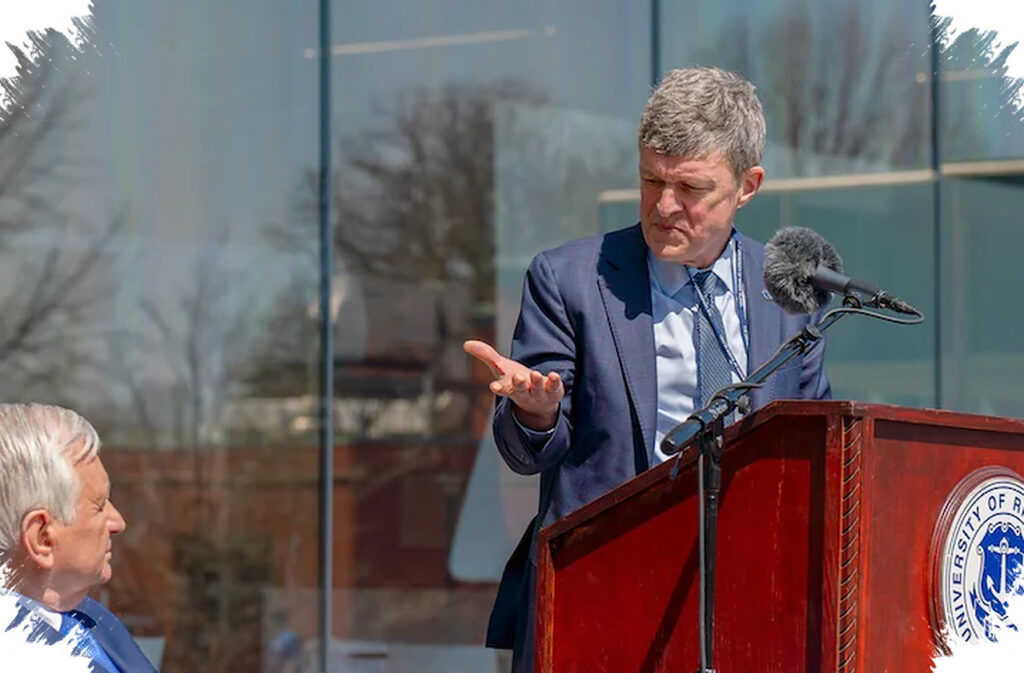
During the University of Rhode Island’s World Quantum Day event on the Kingston Campus, speakers focused on a question that is gaining urgency across academia and industry: how quantum computing will affect society, culture, and the humanities. The program also introduced a new mini-grant effort designed to support student research on the links between quantum science and fields such as the arts, social sciences, and humanities.
The public event, held as part of a global World Quantum Day initiative, brought together elected officials, technology leaders, faculty, and students for discussions that went beyond the technical side of quantum science. Organizers said the goal was to deepen public understanding of quantum physics while exploring its wider implications for innovation, policy, ethics, and communication.
Quantum science reaches beyond the lab
World Quantum Day at URI examined several topics that sit at the intersection of science and society. Discussions included whether quantum computers need guardrails, how quantum computing connects to the arts, whether reality can be fully understood through physics alone, and how post-quantum encryption can protect sensitive information from future attacks.
The event was hosted by URI’s Department of Physics and featured presenters from government and industry, including Rhode Island state Sen. Victoria Gu, who chairs the Senate Committee on Artificial Intelligence and Emerging Technologies, Ishann Pakrasi of Amazon Web Services, SiC Systems founder and URI alum Christopher Savoie, and Charles Robinson of IBM. Suhail Zubairy, the Munnerlyn/Heep Endowed Chair in Quantum Optics at Texas A&M University, delivered the keynote address.
Political and industry leaders back URI’s quantum push
U.S. Sen. Jack Reed joined university leaders and guests for the event and said URI’s work in quantum science has importance for the state and the country. He said quantum computing and information sciences will be essential for U.S. competitiveness, economic growth, national security, and defense.
Reed also pointed to the value of collaboration among government, industry, and higher education. “I anticipate the capability being established here at URI will set a solid foundation for state leadership and quantum computers, and quantum technology,” Reed said. “As with our other technological advances, the best path forward is a partnership between government, industry and academia, and we’re seeing that partnership today.”
The university’s quantum computing research and workforce development effort began in 2021 and received support from a $1 million federal earmark secured by Reed.
New mini-grants aim to connect quantum research with the humanities
URI’s physics department announced a new mini-grants program during the event to support student research on quantum computing and its broader social impact. The initiative is backed by Amazon Web Services and URI’s Institute for AI and Computational Research.
The program is open to undergraduate and graduate students across the university, and leaders said proposals from students outside STEM fields are strongly encouraged. According to URI, the awards are structured as follows:
| Student level | Student award | Faculty advisor support | Research focus |
|---|---|---|---|
| Undergraduate | $1,000 | $250 | Quantum computing and the arts, social sciences, or humanities |
| Graduate | $2,000 | $1,000 | Societal impact of quantum computing |
Leonard Kahn, chair of the URI Physics Department, said the effort is meant to produce guidance for developers and policymakers. “We anticipate that the results of these mini-grants will generate roadmaps for those developing quantum computing to better harness our products for the benefit of society,” Kahn said.
AWS will also give mini-grant recipients access to Amazon Braket, the company’s quantum computing service that allows researchers and developers to use quantum computers and simulators to build quantum algorithms.
Campus tour highlights future quantum facility
Before the main program, officials including Reed toured the future Laboratory for Quantum Computing and Technology in URI’s Fascitelli Center for Advanced Engineering. The lab is expected to open in 2028 and will include a low-temperature facility for quantum computing, a clean room for producing components that are highly sensitive to environmental conditions, and a space for reviewing controlled unclassified information.
URI leaders say the event reflects a broader effort to position the university as a regional hub for quantum research, workforce training, and cross-disciplinary study. The mini-grant deadline is Friday, May 1, at 5 p.m., with awards planned for announcement on Thursday, May 7, and student research presentations scheduled for the 2027 World Quantum Day event at URI.
Read more at: www.uri.edu