


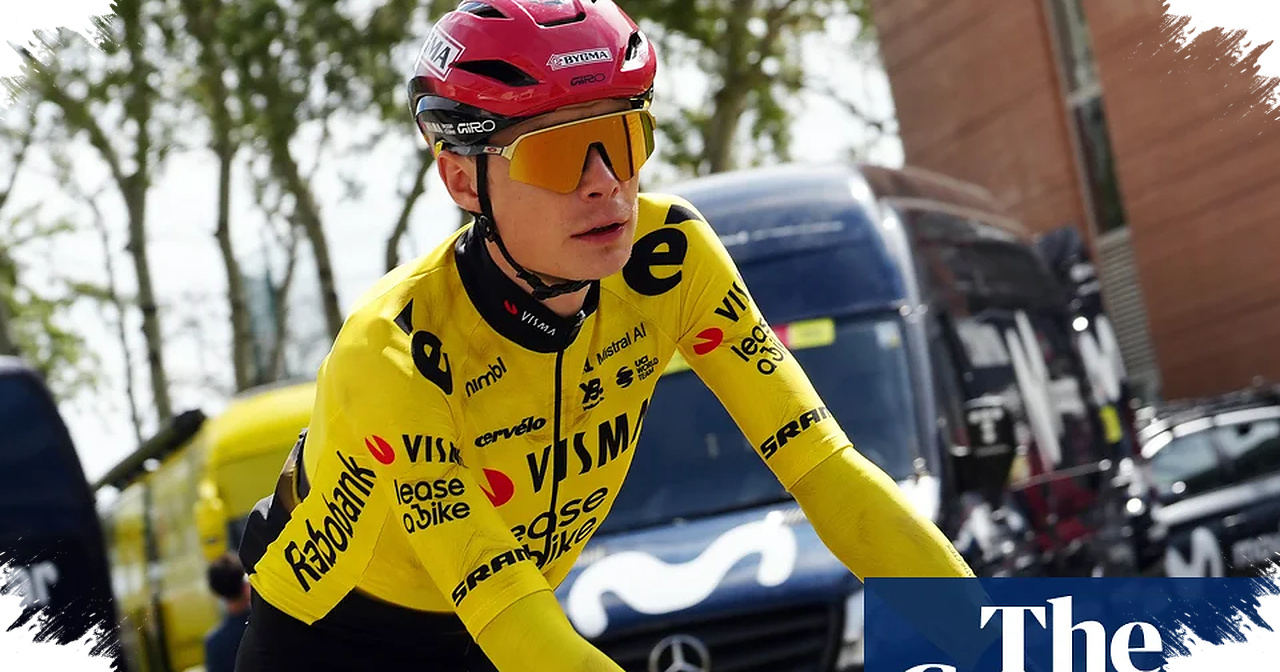
Jonas Vingegaard begins his first Giro d’Italia on Friday in Bulgaria, with the chance to become only the eighth rider in history to win all three Grand Tours. The double Tour de France champion is the clear favourite on paper, even though the race starts without several of the sport’s biggest names.
The Danish rider has arrived with strong form and a route that appears to suit his climbing strengths. But the Giro is rarely straightforward, and the absence of top rivals does not remove the risk of crashes, weather disruption or tactical surprises.
A rare chance to complete the Grand Tour set
Vingegaard has already won the Tour de France in 2022 and 2023, and a Giro victory would complete cycling’s most exclusive trio. That target gives extra weight to this debut appearance in Italy’s biggest stage race, especially with the finish set for Rome on 31 May.
His path looks open because Tadej Pogacar is not racing, despite dominating much of the season and winning nine races in 11 days of racing. The Slovenian’s absence, along with the withdrawal of other major contenders, has turned the Giro into a race where Vingegaard is expected to set the pace from the start.
A field missing several key rivals
The start list lacks not only Pogacar but also Remco Evenepoel, the double Olympic champion, and Paul Seixas, the French teenager who has chosen to focus on his first Tour de France in July. Tom Pidcock, Florian Lipowitz and Isaac del Toro are also missing, removing more riders who could have changed the shape of the general classification.
That does not mean the race will be simple for Vingegaard. The Giro has a reputation for punishing even the strongest riders, and the route includes both difficult mountains and the possibility of sudden race chaos.
Vingegaard’s return to top form
Vingegaard’s bid also carries a wider personal dimension, as he looks to confirm that he remains one of the sport’s dominant stage racers. At 29, he faces a generation shift in the peloton, with Seixas emerging as a serious future rival and already showing he can follow explosive attacks from Pogacar.
His recent results suggest the Danish rider is close to his best again after a life-threatening crash in 2024. He won the disrupted 2025 Vuelta a España, then added Paris-Nice and the Volta a Catalunya this spring, underlining that his climbing and race management remain at a very high level.
Why the route suits him
The 2026 Giro includes almost 49,000 metres of climbing and five summit finishes, which points toward a race decided in the mountains. There is only one individual time trial, and although it is more than 40km long, it is flat and should not be a major threat to a rider built on climbing power.
The first major mountain finish comes on stage seven at Blockhaus after the race moves from Bulgaria into Italy and then south through Calabria and Campania. That early test should help reveal whether Vingegaard can control the race before the hardest week of the Giro unfolds.
Bulgaria hosts a historic start
This is the first Giro Grande Partenza in Bulgaria and only the 15th foreign start in the race’s 109 editions. The opening has not been free of tension, however, with political unrest in the host country and disagreements over travel costs affecting the build-up.
After three days in Bulgaria, the race convoy will travel to the south of Italy before continuing north through the rest of the route. The unusual start gives the Giro extra visibility, but it also adds another layer of uncertainty to an already demanding race.
Ineos look to combine data and instinct
Vingegaard’s main opponent may be the course itself, but one team also sees the Giro as a test of modern race management. The rebuilt Ineos setup has added artificial intelligence to its strategy and appointed Geraint Thomas as director of racing, while also securing a €20m a year boost through the Netcompany partnership.
Thomas has stressed that data alone will not decide races. “I think there’s still a need for the art,” he said at the launch, adding that bike racing is about “how you ride, the craft, and consistency” as much as numbers.
Ineos will rely heavily on Egan Bernal, the 2021 Giro champion and former Tour de France winner, who remains one of the most experienced climbers in the peloton. Yet Bernal has not reached a Grand Tour podium since returning from a severe crash, which leaves Vingegaard as the rider most likely to shape the battle for the maglia rosa.