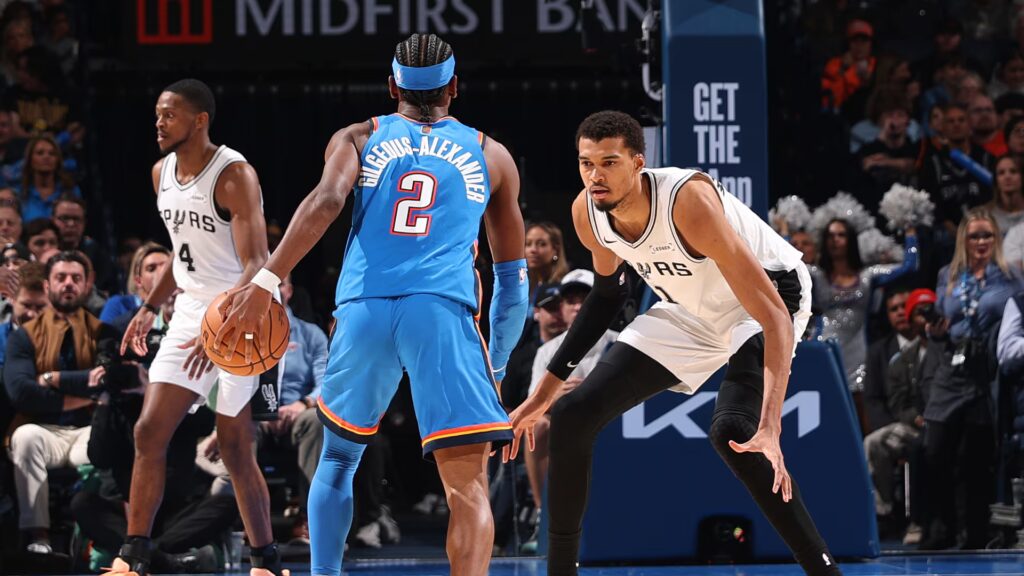
The Thunder-Spurs matchup carries unusual weight because Oklahoma City enters the Western Conference Finals after a 64-win regular season, yet four of its 18 losses came against San Antonio. That detail makes the Spurs one of the few teams that have already shown they can trouble the defending champions, even if the playoffs ask for a much tougher standard.
The series also brings together some of the league’s most important names and most compelling storylines. Shai Gilgeous-Alexander, Victor Wembanyama, Chet Holmgren, and other standout defenders and playmakers give this matchup a star level that matches its stakes.
What the regular season really means
The Spurs’ success against the Thunder adds intrigue, but it does not change how different the postseason is. Winning four games in a best-of-seven requires a level of consistency that no regular-season meeting can fully predict.
Oklahoma City has already shown that its structure can survive playoff pressure. The Thunder have moved through the first two rounds with a 10-man rotation that has created real problems for opponents on both ends of the floor.
Oklahoma City’s biggest advantage
Depth remains the clearest reason Oklahoma City is so difficult to beat. The Thunder have leaned on a rotation that includes strong bench production, and that balance has helped them maintain pace even with starter Jalen Williams missing the past six games because of a hamstring injury.
Shai Gilgeous-Alexander has led the scoring load with 29.1 points and 7.1 assists per game in the playoffs. Chet Holmgren has added 18.6 points and 9.1 rebounds, while Ajay Mitchell has emerged as a useful postseason scorer and passer with 18.8 points, 4.9 assists and 4.0 rebounds per game.
That production has come from a roster built to create disruption. Players such as Lu Dort, Alex Caruso, Isaiah Joe, Jaylin Williams, Cason Wallace and Isaiah Hartenstein have given the Thunder steals, deflections, spacing and interior efficiency without much drop-off.
The Wembanyama factor
Victor Wembanyama gives San Antonio a matchup changer on both ends. He has averaged 20.3 points, 10.7 rebounds, 4.1 blocks and 2.4 assists in the playoffs, and he has shot 53.8% from the field and 84.5% from the line.
His impact is easy to measure in the Spurs’ numbers. San Antonio has scored 118.3 points and allowed 96.4 per 100 possessions with Wembanyama on the court, compared with 112.2 scored and 105.1 allowed when he sits.
That gap highlights why the Thunder will have to decide how much size to use against him. Oklahoma City has Holmgren and Hartenstein, which gives it a real chance to match Wembanyama physically while still protecting the rim.
What the Thunder must solve
San Antonio’s best path includes making Gilgeous-Alexander less comfortable. The Lakers tried to force the ball out of his hands in the previous round, and the Spurs have more perimeter defenders and more depth to try a similar plan.
Even so, Gilgeous-Alexander has grown into a player who can affect games in different ways. He was the 2025 Finals MVP, and his playoff efficiency has remained strong with a true shooting percentage of 63.1%.
The Thunder have also been able to score even when he rests, which is a major change from the regular season. That makes it harder for opponents to pick one defensive answer and rely on it for an entire game.
What San Antonio is facing
The Spurs are still learning how to manage the pressure of this stage. Wembanyama, Stephon Castle, Devin Vassell, Keldon Johnson, Dylan Harper, Julian Champagnie, Carter Bryant and coach Mitch Johnson are all in their first playoff run.
De’Aaron Fox brings some experience, but even he had only one prior playoff series before April. That makes this series a test of emotional control as much as tactics, especially after Wembanyama’s flagrant foul ejection against Minnesota showed how one mistake can change his availability.
San Antonio has handled earlier challenges well, including a series in which Minnesota took a 1-0 lead before the Spurs tied it, won Game 5 at home and closed strongly in Game 6 on the road. The Thunder will demand more discipline than any opponent so far.
One number that stands out
Oklahoma City has outscored opponents by 12.0 points per 100 possessions more than those teams allowed in the regular season over its eight playoff games. That has been driven more by offense than defense, with the Thunder scoring 12.0 more points per 100 possessions than their opponents normally allowed in the regular season.
The Spurs, meanwhile, have posted the No. 1 defense in the playoffs and held Oklahoma City to 109.2 points per 100 possessions across five regular-season meetings. In Wembanyama’s 126 minutes against the Thunder, San Antonio allowed just 99.6 per 100, which gives this matchup a real defensive edge on paper.
Game 1 in Oklahoma City should show whether that regular-season resistance can carry over under playoff pressure, or whether the Thunder’s depth and scoring balance can create the same kind of separation they found in the earlier rounds.