


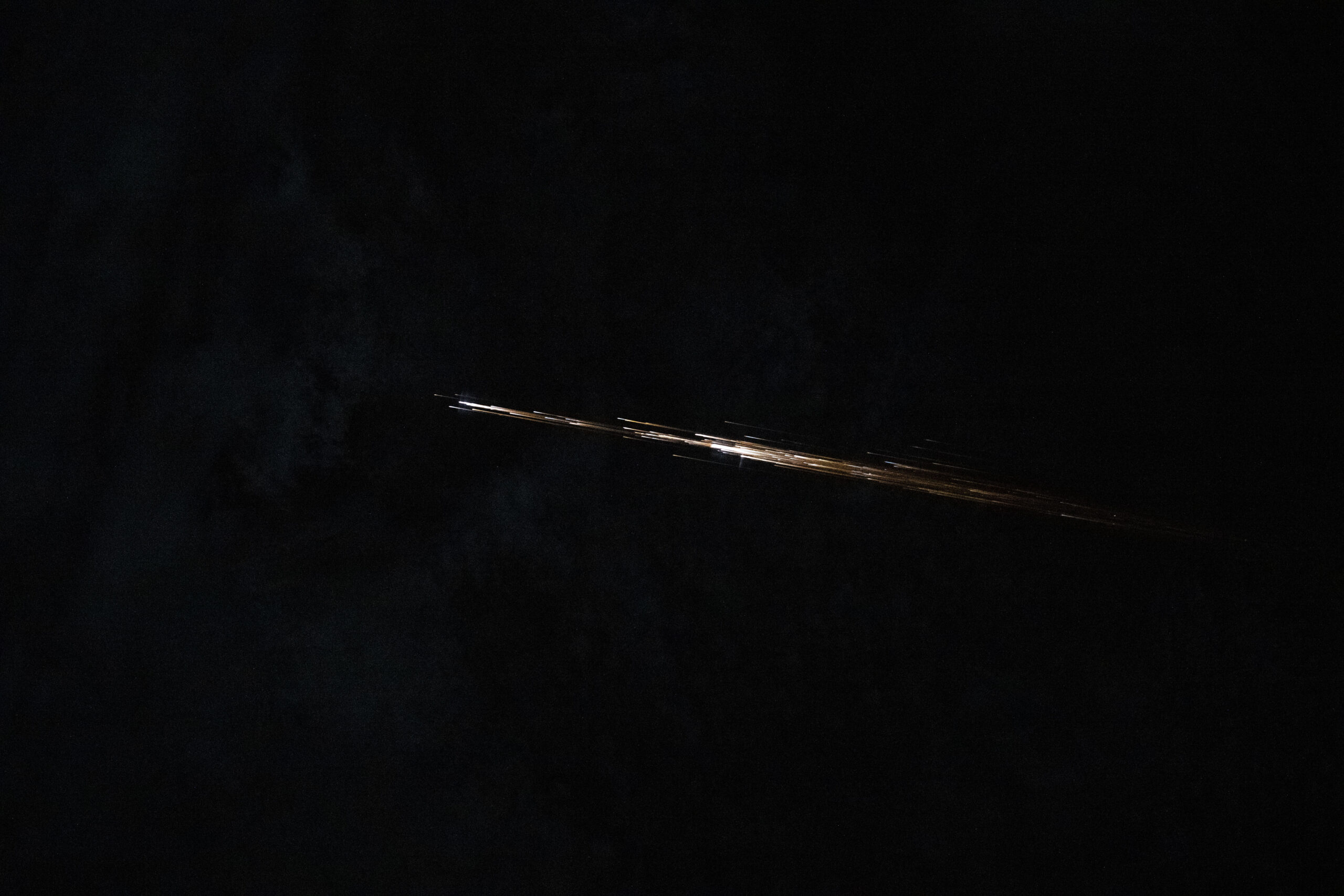
A bright streak captured from the International Space Station has drawn attention not only for its dramatic appearance, but also for the unanswered question behind it. NASA recently released the image, which shows a fireball crossing the upper atmosphere while its exact origin remains unidentified.
The scene was recorded from one of the rarest possible viewpoints: orbit. From the ISS, astronauts can observe events on Earth and in the atmosphere that may last only a moment before vanishing, and this one stood out immediately because of how clearly it showed an object breaking apart.
The sighting happened as the ISS passed over West Africa. Astronaut Chris Williams noticed a bright object directly below the station while he was trying to locate the approaching Progress MS-34 cargo craft.
At the same time, Williams was scanning the sky for a glimpse of the vehicle. Instead, he saw a luminous body move through the upper atmosphere, with its tail widening before it fragmented into a shower of smaller pieces.
The resulting image captures that disintegration in striking detail. NASA says the photo was taken with a Nikon Z9 camera and a 200 mm lens, which helped make the light trail and the breakup fragments stand out clearly.
Even with the breakup visible, the object itself has not been identified. Several explanations have been discussed, but none has been confirmed.
One possibility is that the object was a rocket stage that had previously launched the cargo vehicle and then reentered the atmosphere. Other ideas include a satellite, space debris, or even a meteor, according to some astronomers.
That uncertainty is part of what makes the image notable. A brilliant streak in the upper atmosphere does not always point to a single explanation, and reentering space hardware can look very similar to a natural fireball.
Events like this are not entirely unusual. Similar sightings have appeared in recent years, including the Starship event that also produced a fireball-like phenomenon in the sky.
Some satellites have also encountered problems that created comparable displays. For that reason, a bright flash overhead can be difficult to classify at first glance, even when the visual evidence is dramatic.
Seen from the ISS, the event now serves as another reminder of how much activity is happening in orbit and just above Earth’s atmosphere. It also shows how a brief moment, captured from a rare vantage point, can raise as many scientific questions as it answers.